Introduction
Choosing between an independent salon and a franchise can feel like a big decision. Both models can become profitable beauty businesses, but they require different approaches to branding, investment, marketing, training, and daily management.
The Independent Salon vs NS4 Salon Franchise decision is especially important for entrepreneurs who want to enter the growing salon and beauty industry while keeping their long-term business goals in mind.
An independent salon gives you complete control. You can choose your own name, pricing, interiors, services, suppliers, marketing strategy, and business direction. That’s attractive, particularly for experienced salon professionals who already have a strong local reputation.
On the other hand, an NS4 Salon Franchise offers the opportunity to operate under an established salon brand while benefiting from a structured business model, professional guidance, branding support, and a system designed to make salon entrepreneurship more organized.
Neither model is automatically better for everyone. The right choice depends on your budget, experience, location, risk tolerance, marketing skills, and growth ambitions.
In this detailed guide, we’ll compare the two models step by step so you can make a more informed business decision.
Understanding the Two Business Models
Before comparing costs and profitability, it’s important to understand how each model works.
An independent salon is usually created from scratch by an entrepreneur. The owner develops the brand identity, decides the service menu, hires employees, selects products, establishes pricing, and handles marketing.
A salon franchise works differently. The entrepreneur operates using an established brand’s identity and business framework. In return for the franchise arrangement and applicable fees, the franchisee may receive access to brand systems, operational guidance, training, marketing resources, and other support.
Here’s a quick comparison:
| Factor | Independent Salon | NS4 Salon Franchise |
| Brand creation | Owner builds from zero | Uses established NS4 branding |
| Control | Very high | High, within franchise standards |
| Marketing | Owner-managed | Structured brand + local marketing |
| Training | Owner arranges independently | Professional guidance and training support |
| Setup | Fully self-managed | Guided setup approach |
| Business systems | Built by owner | Established systems available |
| Customer trust | Built over time | Can benefit from existing brand identity |
| Expansion | Owner develops model | Franchise model can support expansion |
| Risk | Entirely owner-managed | Shared through established framework |
| Flexibility | Maximum | Subject to brand guidelines |
The biggest difference is simple: an independent salon means building the business model yourself, while a franchise allows you to work within an established business framework.
What Is an Independent Salon?
An independent salon is a beauty business owned and operated without a franchise agreement.
The entrepreneur has complete control over the business identity. You decide whether the salon will be luxury, premium, affordable, specialized, neighborhood-focused, or designed around a particular customer segment.
Advantages of an Independent Salon
The biggest advantage is freedom.
You can:
- Choose your own salon name.
- Create your own logo and visual identity.
- Set your own prices.
- Select your preferred product brands.
- Introduce new services whenever you want.
- Create your own offers.
- Change the interior design whenever required.
- Develop your own marketing strategy.
- Decide how you hire and train employees.
This freedom can be valuable if you’re already experienced in the beauty industry.
For example, an experienced hairstylist who has worked with clients for several years may already understand local demand. They may know which hair colors customers prefer, what pricing works in the neighborhood, and which services generate repeat visits.
The Challenge of Building Everything Yourself
However, freedom comes with responsibility.
An independent salon owner needs to build the brand from the ground up. That means developing:
- Brand awareness
- Customer trust
- Marketing systems
- Service standards
- Staff training
- Pricing strategies
- Customer retention systems
- Supplier relationships
- Social media presence
- Online reviews
And that’s where things can get difficult.
Opening a salon isn’t only about having good hairstyling or makeup skills. It’s also about running a business.
You need to understand rent, salaries, inventory, marketing costs, customer acquisition, repeat bookings, cash flow, and profitability.
When Independence Makes Sense
An independent salon can be a strong choice when the owner has:
- Strong salon experience
- A loyal customer base
- Marketing knowledge
- Business management skills
- A clear brand vision
- Enough time to develop systems
- Confidence in handling operational challenges
If you’re starting completely from scratch and don’t have experience in business management, the learning curve can be much steeper.
What Is an NS4 Salon Franchise?
An NS4 Salon Franchise is a business model in which an entrepreneur operates a salon under the NS4 Salon brand rather than creating a completely new salon identity.
The objective is to combine entrepreneurship with an established brand framework.
Instead of asking, “Where do I start?” at every stage, a franchisee can work with a predefined structure covering areas such as salon positioning, branding, services, setup, training, and marketing.
This can reduce some of the uncertainty involved in launching a completely new salon.
For entrepreneurs who want to enter the beauty industry but don’t want to build every business system from zero, this can be an attractive route.
Why Franchise Models Attract Entrepreneurs
A franchise model can be particularly appealing because it provides a combination of brand recognition and business ownership.
You’re still running your own business, managing your team, serving customers, controlling local operations, and working toward profitability.
However, you’re not starting with an entirely unknown brand.
This distinction matters.
When a new salon opens, one of the first questions customers may ask is:
“Is this salon good?”
A recognized brand can potentially reduce the amount of time required to establish initial credibility, although local reputation and service quality still matter enormously.
NS4 Franchise Models
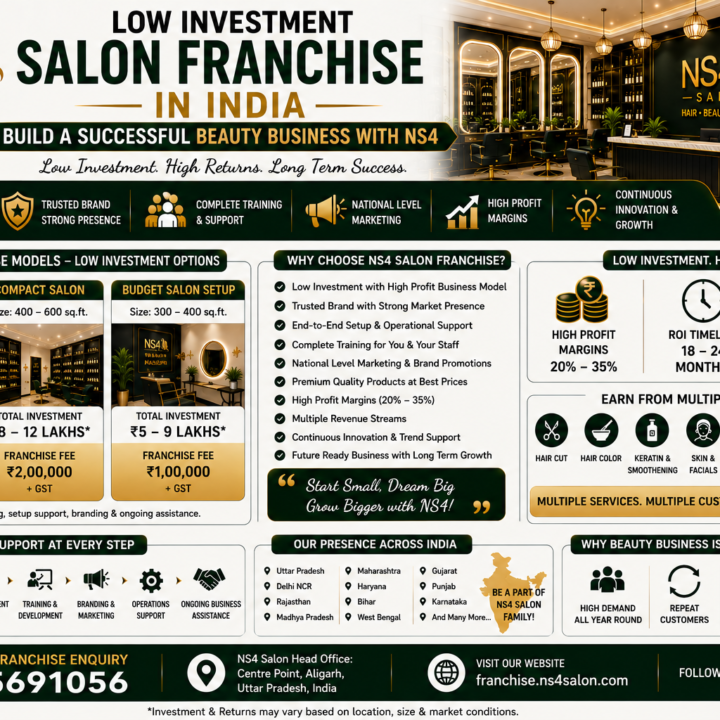
NS4 Salon has discussed multiple franchise formats designed for different investment capacities and property sizes.
Commonly referenced formats include:
| Model | Approx. Space | Franchise Fee |
| Luxury | 2,000–3,000 sq. ft. | ₹7 lakh + applicable GST |
| Premium | 1,000–1,500 sq. ft. | ₹5 lakh + applicable GST |
| Studio | 600–800 sq. ft. | ₹3 lakh + applicable GST |
Overall project investment can vary based on location, interiors, equipment, rent, staffing, inventory, and other operational requirements. A prospective franchisee should confirm the latest commercial terms directly with NS4 before making an investment decision.
Independent Salon vs NS4 Salon Franchise: Complete Business Comparison
The most useful way to evaluate the Independent Salon vs NS4 Salon Franchise question is to compare the two models across the areas that actually affect business performance.
Investment and Startup Costs
Investment is one of the first things an entrepreneur considers.
With an independent salon, the owner determines the budget from scratch. The total investment may include:
- Security deposit
- Monthly rent
- Interior work
- Salon chairs
- Mirrors
- Wash stations
- Hair equipment
- Facial equipment
- Makeup equipment
- Nail equipment
- Reception area
- Air conditioning
- Lighting
- Signage
- Product inventory
- Staff salaries
- Launch marketing
- Working capital
Because there is no fixed franchise framework, an independent salon can technically be started with different budgets.
However, lower initial investment doesn’t necessarily mean lower total risk.
You may save on franchise fees but spend significantly more time and money developing branding, systems, marketing, training, and customer acquisition.
Franchise Investment
An NS4 franchise also requires investment, including the applicable franchise fee and the cost of establishing and operating the salon.
The benefit is that you’re working within an established business format.
For an entrepreneur, the question shouldn’t simply be:
“Which model is cheaper?”
A better question is:
“Which model gives me the strongest chance of building a sustainable business with my available capital?”
That’s a much smarter way to look at the numbers.
Branding and Customer Trust
Branding is one of the biggest differences between the two models.
With an independent salon, your brand starts at zero.
You need to build:
Name → Awareness → Trust → First Visit → Good Experience → Repeat Visit → Referral
That process can take time.
An established salon franchise starts with a brand identity that customers may already recognize.
However, branding isn’t magic. A franchise doesn’t guarantee customers or profits.
The salon still needs:
- Excellent customer service
- Skilled professionals
- Clean surroundings
- Consistent results
- Positive reviews
- Good local marketing
- Competitive pricing
- Customer retention
Think of branding as a head start—not a finish line.
Location and Salon Setup
Location can make or break a salon business.
An independent salon owner can select virtually any location that fits the business strategy.
A franchisee also gets location flexibility, but the location should ideally match the brand’s positioning and target audience.
Important factors include:
- Visibility
- Parking
- Footfall
- Nearby residential areas
- Competition
- Accessibility
- Commercial activity
- Rental cost
- Local customer demographics
A beautiful salon in the wrong location can struggle.
A well-positioned salon with strong service quality can perform much better.
Setup Advantage of a Franchise
One advantage of a franchise model is that entrepreneurs may receive guidance regarding the salon concept and setup.
This can help reduce guesswork.
Instead of spending months deciding every design detail, the owner can work within an established format.
Training and Professional Expertise
Training is another major factor.
In an independent salon, the owner is responsible for deciding how employees are trained.
They may:
- Hire experienced professionals.
- Send employees to external academies.
- Conduct internal training.
- Learn through industry workshops.
- Build their own training system.
This can work extremely well for experienced salon professionals.
For a new entrepreneur, however, it may be challenging.
A structured franchise ecosystem can provide access to brand-level training or guidance, depending on the franchise agreement.
For a salon business, training isn’t just about technical skills.
It also includes:
- Customer consultation
- Hygiene
- Service protocols
- Product knowledge
- Upselling
- Customer communication
- Hair and beauty trends
- Complaint handling
- Retail sales
Better-trained teams can create more consistent customer experiences.
Marketing and Lead Generation
Marketing is where many new salon owners underestimate the workload.
Opening the salon is one thing.
Getting people through the door every week is another.
An independent salon typically needs to create its own marketing strategy.
That could include:
- Google Business Profile
- Local SEO
- WhatsApp marketing
- Referral campaigns
- Influencer collaborations
- Festive offers
- Paid advertisements
- Customer review campaigns
- Local partnerships
The advantage is complete creative control.
The disadvantage is that everything is your responsibility.
Franchise Marketing
A franchise can provide a more structured marketing direction.
The franchisee may benefit from established brand creatives, promotional concepts, brand guidelines, and marketing support, depending on the agreement.
This can save time and help maintain a consistent brand image.
However, local marketing remains extremely important.
Customers don’t visit a salon because of a national or regional brand alone. They visit because the salon is accessible, trustworthy, affordable, professional, and relevant to their needs.
Services, Products, and Pricing
Independent salon owners have maximum freedom when creating their service menu.
They can introduce services based on local demand.
For example:
- Haircuts
- Hair color
- Global hair color
- Keratin
- Nanoplastia
- Hair Botox
- Hair spa
- Facial
- Cleanup
- Manicure
- Pedicure
- Nail extensions
- Bridal makeup
- Party makeup
- Groom packages
An independent salon can change prices whenever it wants.
A franchise may operate within brand standards and recommended service structures.
This can actually be an advantage.
Standardization helps prevent random pricing and inconsistent customer experiences.
The key is finding the right balance between brand consistency and local market needs.
Daily Operations and Business Support
Running a salon involves much more than serving customers.
Every day, the owner may need to deal with:
- Staff attendance
- Payroll
- Inventory
- Customer complaints
- Appointment management
- Supplier payments
- Marketing
- Reviews
- Sales targets
- Hygiene
- Equipment maintenance
- Staff performance
An independent owner creates these systems independently.
That gives maximum control but also creates maximum responsibility.
A franchise model can provide a framework for several of these activities.
For a first-time entrepreneur, this can be a major advantage.
It’s like having a roadmap instead of trying to draw the map while driving.
Profitability and ROI
Profitability depends on many variables, so no responsible business comparison should promise a fixed return.
Your salon’s performance can depend on:
Revenue − Operating Expenses = Operating Profit
Revenue may come from:
- Hair services
- Hair treatments
- Hair color
- Skin services
- Makeup
- Nail services
- Bridal packages
- Product sales
- Memberships
- Packages
Expenses may include:
- Rent
- Salaries
- Utilities
- Product consumption
- Marketing
- Maintenance
- Taxes
- Software
- Franchise-related costs
- Miscellaneous expenses
Independent Salon ROI
An independent salon may have more pricing and cost-control flexibility.
However, the owner also carries the burden of creating demand.
If marketing is weak, customer acquisition can become expensive.
Franchise ROI
A franchise may potentially reduce certain startup uncertainties through brand systems and support.
But franchise costs must be carefully included in the financial model.
Before investing, calculate:
- Total startup investment
- Monthly fixed expenses
- Estimated monthly customers
- Average customer bill
- Gross margin
- Monthly revenue
- Marketing expenditure
- Break-even point
- Working-capital requirement
- Expected payback period
Don’t make the decision based only on the franchise fee.
Look at the entire business economics.
Risks and Challenges
Both models have risks.
Independent Salon Risks
Common challenges include:
- Slow brand recognition
- High competition
- Difficulty hiring skilled staff
- Marketing challenges
- Unpredictable customer acquisition
- Poor initial cash flow
- Lack of business systems
- Pricing mistakes
Franchise Risks
Franchise businesses can have different challenges:
- Franchise fees
- Brand compliance requirements
- Limited flexibility in certain areas
- Ongoing commercial obligations
- Dependence on brand reputation
- Restrictions defined by the franchise agreement
That’s why you should read the franchise agreement carefully before signing.
Ask about:
- Franchise duration
- Renewal terms
- Fees
- Territory
- Marketing obligations
- Training
- Support
- Exit conditions
- Branding requirements
- Procurement rules
- Performance expectations
Never invest purely because a business model sounds attractive.
Who Should Choose an Independent Salon?
An independent salon may be better suited to you if:
- You already have salon experience.
- You have a loyal customer base.
- You understand local competition.
- You are comfortable building a brand.
- You enjoy marketing.
- You want maximum freedom.
- You have strong business management skills.
- You have a unique salon concept.
For example, an experienced makeup artist with a strong Instagram following and a loyal client base may not need the support of an established franchise brand.
They already possess something extremely valuable: personal brand equity.
Who Should Choose an NS4 Salon Franchise?
An NS4 franchise can be particularly attractive to entrepreneurs who want a structured entry into the salon industry.
It may suit someone who:
- Wants to enter the salon business.
- Prefers an established brand.
- Doesn’t want to build a brand from zero.
- Wants professional business guidance.
- Values structured operations.
- Wants access to established salon concepts.
- Plans to build a scalable business.
- Wants to combine ownership with brand support.
It’s also worth considering for investors who are interested in building a salon business but aren’t necessarily professional hairstylists or makeup artists themselves.
In such cases, having systems and professional guidance can be especially valuable.
Independent Salon vs NS4 Salon Franchise: Quick Decision Table
| Business Factor | Independent Salon | NS4 Salon Franchise |
| Freedom | ⭐⭐⭐⭐⭐ | ⭐⭐⭐⭐ |
| Brand support | ⭐⭐ | ⭐⭐⭐⭐⭐ |
| Setup guidance | ⭐⭐ | ⭐⭐⭐⭐⭐ |
| Marketing framework | ⭐⭐ | ⭐⭐⭐⭐ |
| Brand recognition | Must be developed | Established brand |
| Operational flexibility | ⭐⭐⭐⭐⭐ | ⭐⭐⭐⭐ |
| Training support | Self-arranged | Structured support may be available |
| Entrepreneurial control | Very high | High |
| Beginner-friendly | Moderate | Potentially higher |
| Scalability | Owner-built | Franchise model |
| Business systems | Self-created | Established framework |
How to Choose the Right Model
If you’re still unsure, use this five-question test.
Question 1: Do I have salon experience?
If yes, an independent salon may be easier for you to manage.
If no, a structured franchise model may deserve stronger consideration.
Question 2: Can I build a brand from scratch?
If you enjoy branding, social media, marketing, and networking, independence may suit you.
If you’d rather start with an established brand identity, consider a franchise.
Question 3: How much freedom do I need?
If you want to change everything whenever you like, independent ownership wins.
If you’re comfortable following established standards, a franchise may work better.
Question 4: What’s my long-term goal?
If you want one highly customized salon, independence can be attractive.
If you want to build multiple locations using a repeatable model, franchising may provide a more structured path.
Question 5: Am I buying a job or building a business?
This is perhaps the most important question.
A salon should ideally be built as a business system—not simply as a place where the owner personally performs services every day.
If you want a scalable business, think about systems, staff, customer retention, marketing, and repeatable operations from day one.
7 Powerful Reasons an NS4 Franchise Can Be the Smarter Choice
For the right entrepreneur, an NS4 Salon Franchise can offer several practical advantages.
1. Established Brand Identity
You don’t have to invent a brand from zero.
2. Structured Business Model
A franchise provides a framework instead of leaving every decision to the entrepreneur.
3. Professional Guidance
Guidance can be valuable when entering an industry for the first time.
4. Marketing Advantage
An established brand can make marketing more systematic.
5. Customer Confidence
A recognizable salon identity may help reduce the initial trust barrier.
6. Scalable Opportunity
A standardized model can make expansion easier to plan.
7. Reduced Guesswork
You still have to work hard—but you don’t necessarily have to figure everything out alone.
Frequently Asked Questions
1. Is an independent salon better than an NS4 Salon Franchise?
It depends on your experience, budget, business goals, and preference for control. An independent salon provides maximum freedom, while an NS4 franchise can provide an established brand framework and structured support.
2. How much does an NS4 Salon Franchise cost?
NS4 has offered different franchise formats with franchise fees varying by model. Commonly referenced fees are approximately ₹3 lakh + applicable GST for a Studio format, ₹5 lakh + applicable GST for a Premium format, and ₹7 lakh + applicable GST for a Luxury format. Total project investment is higher because it can include interiors, equipment, rent, staffing, inventory, marketing, and working capital. Always confirm current pricing directly with NS4.
3. Can I open a salon without a franchise?
Yes. You can start an independent salon by creating your own brand and handling the setup, staffing, marketing, operations, and customer acquisition yourself.
4. Is a salon franchise profitable?
A salon franchise can be profitable, but profitability isn’t guaranteed. It depends on location, investment, pricing, customer volume, staff productivity, operating expenses, marketing, and management.
5. Is an NS4 franchise suitable for first-time entrepreneurs?
It can be suitable for entrepreneurs who prefer a structured business model and professional guidance. However, franchisees still need strong management, financial planning, customer service, and local marketing skills.
6. Which requires more marketing: an independent salon or franchise?
Both require marketing. An independent salon must build its brand from scratch, while a franchise may benefit from established branding and marketing systems. Local marketing remains essential for both.
7. Can I customize services in a franchise salon?
Customization depends on the franchise agreement and brand standards. Before signing, ask NS4 about permitted services, pricing flexibility, promotions, products, and local marketing.
8. What is the biggest advantage of an independent salon?
The biggest advantage is control. You can make decisions about branding, pricing, services, suppliers, interiors, promotions, and operations without franchise restrictions.
9. What is the biggest advantage of an NS4 franchise?
The biggest advantage can be the combination of entrepreneurship with an established salon brand and structured business framework.
10. How should I calculate my salon ROI?
Start with your total investment and monthly operating expenses. Estimate realistic customer volume and average bill value, calculate expected revenue, and then determine your operating profit and estimated payback period. Use conservative assumptions rather than relying on optimistic projections.
Final Verdict: Independent Salon or NS4 Salon Franchise?
The Independent Salon vs NS4 Salon Franchise debate doesn’t have one universal winner.
If you’re an experienced salon professional with a loyal customer base, strong marketing knowledge, and a unique vision, an independent salon can give you unmatched freedom.
But if you’re an entrepreneur looking for an established salon brand, structured systems, professional guidance, and a potentially more organized route into the beauty industry, an NS4 Salon Franchise may be the more attractive option.
The smartest decision is to look beyond the initial franchise fee or salon setup cost.
Consider the complete picture:
Investment + Brand + Training + Marketing + Operations + Customer Acquisition + Profitability + Scalability
That’s where the real business decision lies.
Before committing your capital, prepare a detailed business plan, study the local market, compare competitors, calculate your break-even point, and discuss the latest franchise terms directly with NS4.
In short, an independent salon gives you the freedom to build everything your way, while an NS4 Salon Franchise gives you the opportunity to build a salon business within an established framework.
For entrepreneurs who want to reduce the guesswork and focus on building a professional, scalable salon business, the franchise route can be a powerful option worth exploring.