Skip to Content

Blog

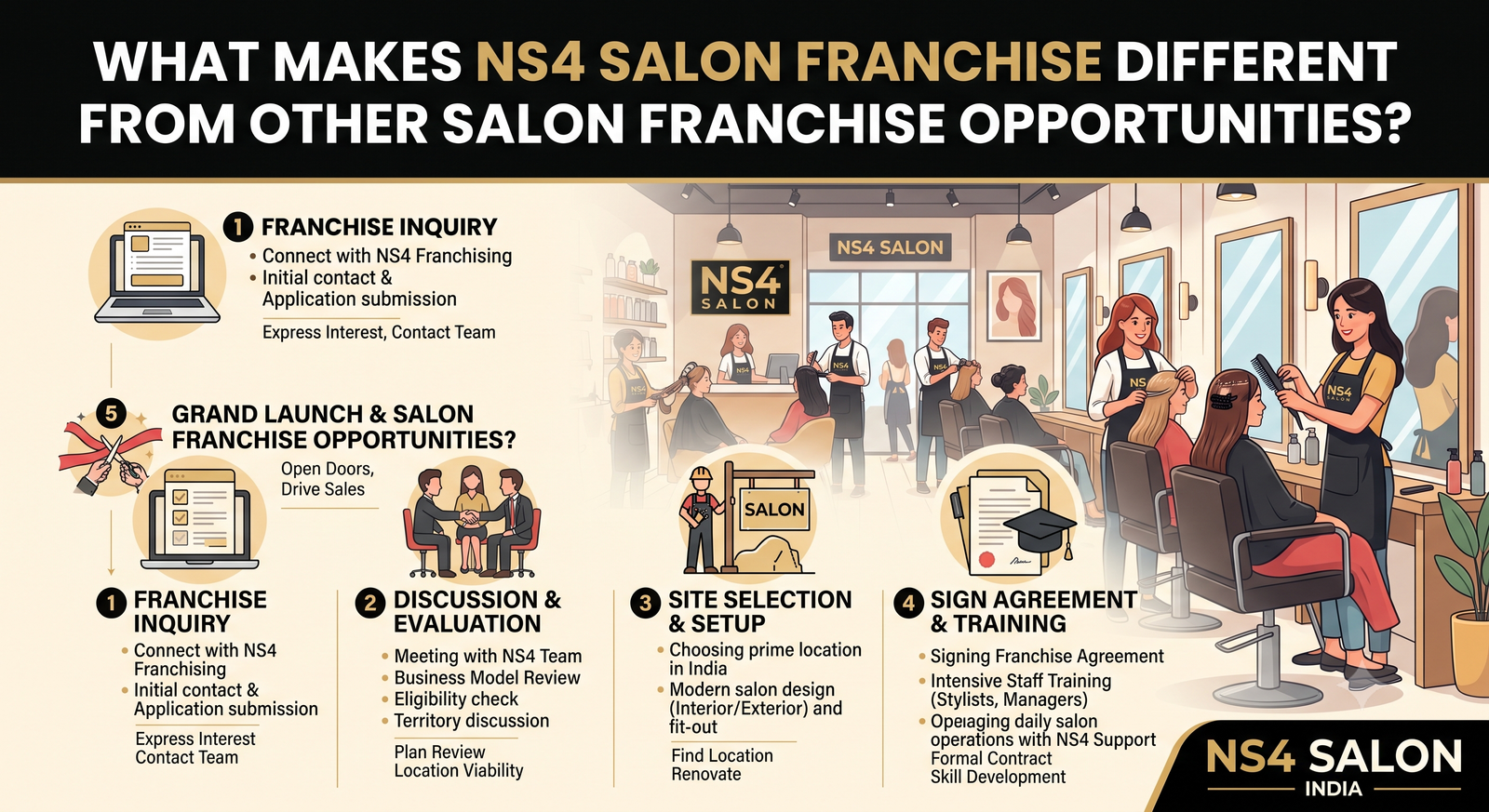
What Makes NS4 Salon Franchise Different from Other Salon Franchise Opportunities?

What Makes NS4 Salon Franchise Different from Other Salon Franchise Opportunities? 7 Powerful Reasons

The beauty and personal care industry has created exciting opportunities for entrepreneurs. People don’t visit salons only for haircuts anymore. Today, they look for complete experiences that may include hair care, skin care, hair colour, bridal makeup, grooming, nail services, advanced treatments, and professional beauty consultations.

As demand grows, many entrepreneurs are exploring a NS4 Salon Franchise as a way to enter the salon business with an established structure rather than starting completely from scratch.

However, choosing a salon franchise isn’t something to do on a whim. There are many salon franchise opportunities in the market, and each one offers a different combination of investment requirements, branding, training, operational support, services, and growth potential.

So, what makes the NS4 Salon Franchise different?

The answer isn’t limited to one factor. A strong franchise opportunity should help an entrepreneur build a professional business through a combination of brand identity, suitable business models, training, systems, marketing support, and opportunities for future growth.

In this article, we’ll explore 7 powerful reasons why the NS4 Salon Franchise can stand apart from other salon franchise opportunities and what prospective franchise partners should evaluate before making an investment decision.

For franchise-related information and opportunities, prospective entrepreneurs can explore the NS4 Salon Franchise website.

Why the Salon Franchise Industry Continues to Grow

The salon industry has changed dramatically over the years. Earlier, many customers chose salons based mainly on location or price. Today, several other factors influence their decisions.

Customers often consider:

  • Service quality
  • Professional behaviour
  • Hygiene and cleanliness
  • Skilled staff
  • Product quality
  • Modern techniques
  • Online reviews
  • Brand reputation
  • Convenient appointments
  • Consistency of service

This shift creates both an opportunity and a challenge.

The opportunity is clear: people continue to spend on personal grooming and beauty services. The challenge is that customers have higher expectations. A new independent salon owner must build trust, recruit and train staff, develop service standards, create marketing campaigns, manage inventory, and establish a recognizable identity.

That’s where a franchise model can offer an advantage.

Instead of building every part of the business alone, an entrepreneur may receive access to an existing business framework. Of course, the exact support depends on the franchise agreement and selected model, so investors should always review the official terms carefully.

The NS4 Salon Franchise aims to provide a structured route into the professional salon business. Rather than following a one-size-fits-all approach, the opportunity can be evaluated according to factors such as available investment, location, salon size, local demand, and long-term business goals.

In short, the salon business isn’t just about opening a beautiful space. Behind the scenes, successful operations require planning, people management, service quality, customer retention, and consistent execution.

Let’s look at the first major difference.

1. Multiple Franchise Models for Different Investment Goals

One of the biggest challenges for aspiring entrepreneurs is finding a business model that matches their available capital and local market.

Not every investor needs a large luxury salon. At the same time, not every location is suitable for a small studio. A high-footfall commercial area may support a larger premium setup, while another market may perform better with a compact and efficiently managed salon.

The NS4 Salon Franchise can provide different format options, helping entrepreneurs consider a model aligned with their business objectives.

Luxury Salon Model

A luxury-format salon is generally designed for entrepreneurs looking to build a larger and more premium beauty destination.

A larger space can potentially provide room for:

  • Multiple styling stations
  • Dedicated hair service areas
  • Skin and beauty treatment zones
  • Makeup facilities
  • Nail services
  • Grooming areas
  • Premium customer waiting space
  • Bridal and special occasion services

A luxury salon can also create opportunities to serve a broader range of customers. However, a larger format naturally requires stronger planning, investment, staffing, operations, and location analysis.

Before selecting this format, an entrepreneur should carefully evaluate local purchasing power, competition, accessibility, parking, commercial rent, and expected customer demand.

Premium Salon Model

A premium model can offer a balance between a large luxury setup and a compact studio.

This format may be suitable for business owners who want to establish a professional salon with multiple services while maintaining a manageable operational footprint.

A well-designed premium salon can focus on high-demand services such as:

  • Professional haircuts
  • Hair colouring
  • Hair spa
  • Keratin and smoothing services
  • Skin care
  • Facials
  • Makeup
  • Bridal packages
  • Manicure and pedicure

The key advantage is balance. An entrepreneur can work toward offering a strong service menu without necessarily operating an extremely large facility.

Studio Salon Model

For some entrepreneurs, a compact salon model may be a practical starting point.

A studio-format business can be especially relevant where:

  • Available investment is comparatively lower
  • The target market is focused
  • Commercial space is limited
  • The entrepreneur wants a more concentrated service model
  • Local demand supports a compact professional salon

Starting with the right size matters. Bigger isn’t automatically better. A salon should match the market it serves.

This flexibility is one reason the NS4 Salon Franchise can appeal to different types of entrepreneurs. Instead of assuming that every future salon owner has the same budget or business vision, multiple formats can allow a more practical evaluation of the opportunity.

Of course, franchise fees, setup costs, taxes, equipment, interiors, working capital, and other expenses should always be confirmed directly with the franchisor before signing any agreement.

2. Strong Brand Identity and Professional Positioning

Building a brand from zero takes time.

An independent salon owner has to decide everything: the name, logo, visual identity, service positioning, customer messaging, marketing approach, and overall experience.

That’s no small task.

A franchise model can help reduce some of this early-stage uncertainty by giving the business a recognizable professional identity.

Building Customer Trust

Customers often feel more comfortable trying a business that presents itself professionally and consistently.

A strong salon brand can communicate expectations before the customer even walks through the door. From signage and interiors to service communication and online visibility, consistency can influence how people perceive a salon.

For a new franchise location, brand recognition may help create an initial foundation for marketing. However, local performance still depends heavily on service quality, customer satisfaction, reviews, location, competition, and day-to-day management.

Put simply, a brand can open the door, but excellent service keeps customers coming back.

Creating a Consistent Salon Experience

Consistency is extremely important in the beauty business.

Imagine a customer receiving excellent service during one visit but a completely different experience the next time. That’s a recipe for disappointment.

A professionally managed franchise business can focus on maintaining standards across areas such as:

  • Customer greeting
  • Appointment handling
  • Service consultation
  • Staff presentation
  • Hygiene practices
  • Service procedures
  • Product usage
  • Billing
  • Customer feedback

The NS4 Salon Franchise concept is therefore about more than putting a name above the entrance. The goal is to build a business that customers can identify with and experience consistently.

For franchise partners, this can be valuable because developing systems from scratch can take considerable time and trial and error.

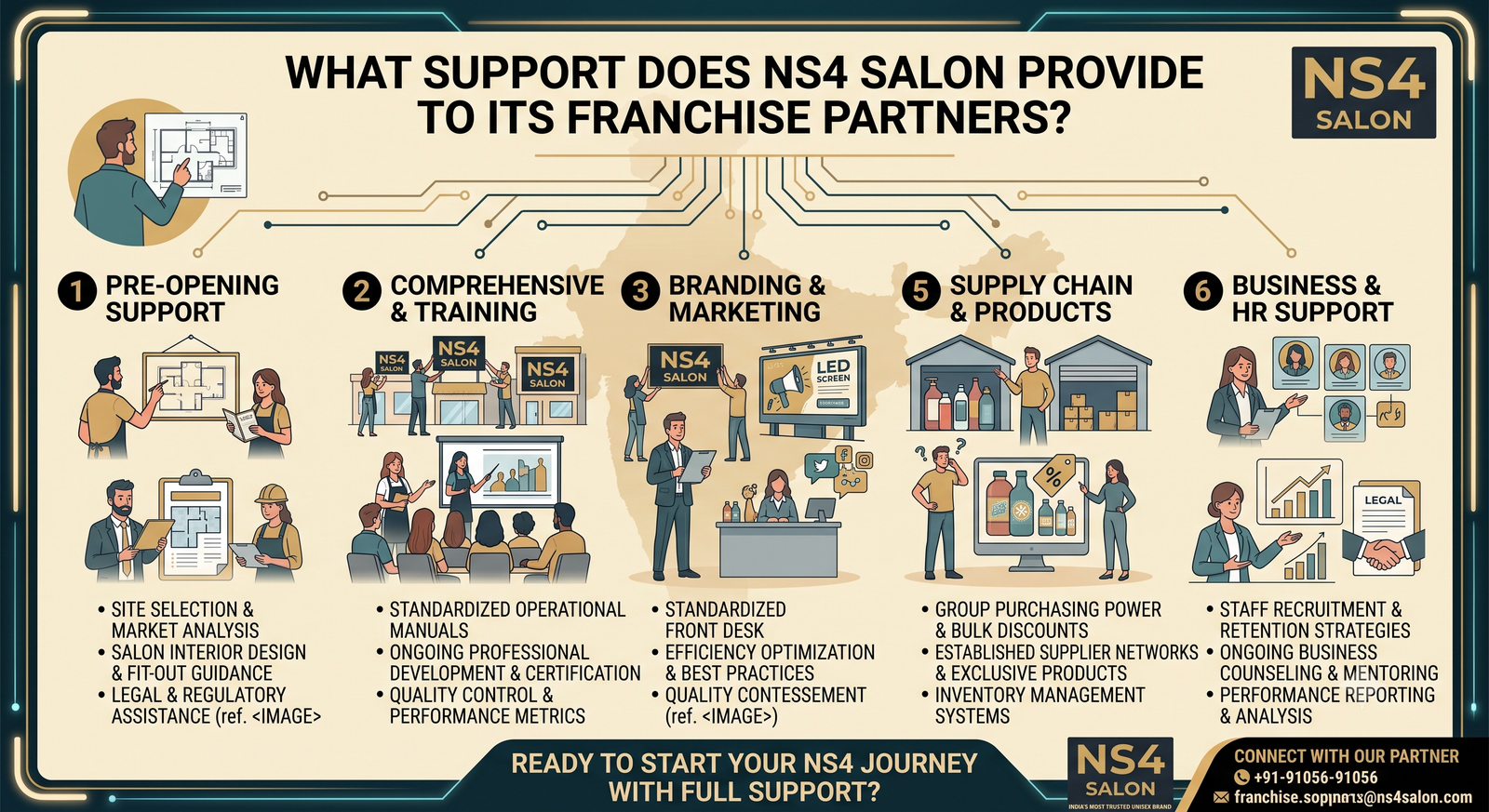
3. Training and Operational Support

A salon’s biggest asset is often its people.

Beautiful interiors alone won’t guarantee repeat customers. A salon also needs skilled professionals who understand both technical services and customer expectations.

This makes training a major part of any serious salon business.

Staff Training

A franchise system can help create a more structured approach to staff development.

Training may cover areas such as:

  • Hair cutting techniques
  • Hair styling
  • Hair colouring
  • Hair care consultation
  • Skin and beauty services
  • Makeup techniques
  • Customer communication
  • Hygiene standards
  • Product knowledge
  • Service recommendations

Regular skill development can help a salon remain competitive as customer preferences and beauty trends evolve.

For franchise owners, staff training may also help create consistency across the team. A customer shouldn’t feel that service quality depends entirely on luck or which employee happens to be available that day.

Salon Operations Guidance

Running a salon requires more than technical beauty knowledge.

An entrepreneur must also think about:

  • Staff scheduling
  • Inventory management
  • Product ordering
  • Customer records
  • Revenue tracking
  • Expense control
  • Service pricing
  • Upselling opportunities
  • Complaint handling
  • Customer retention

These are the nuts and bolts of the business.

Operational guidance can be particularly helpful for first-time entrepreneurs who may have a passion for beauty but limited experience in managing a commercial salon.

A franchise model can potentially reduce the learning curve by offering an established direction for daily operations. Still, the franchise owner remains responsible for executing the business effectively.

That distinction matters.

No franchise can magically guarantee success. The best systems still require committed ownership, strong local management, disciplined financial planning, and consistent customer service.

4. Marketing Support for Business Growth

Opening a salon is one thing. Getting customers through the door is another.

This is where marketing becomes crucial.

Many independent salons struggle because they focus heavily on interiors and services but don’t create a consistent customer acquisition strategy.

The NS4 Salon Franchise can offer franchise partners a structured brand foundation that supports marketing efforts.

Digital Marketing Opportunities

Today, customers often discover salons online.

They may search for:

  • Best salon near me
  • Hair salon in their city
  • Bridal makeup artist
  • Keratin treatment
  • Hair colour services
  • Nail extensions
  • Facial services
  • Beauty salon offers

A franchise location can work toward building visibility through digital channels and local search strategies.

Potential activities may include:

  • Social media content
  • Google Business Profile optimisation
  • Customer review management
  • Local SEO
  • Promotional campaigns
  • Before-and-after content
  • Festival offers
  • Bridal campaigns
  • Video marketing

The exact strategy should always be adapted to the local market. What works in one city may not work exactly the same way in another.

Local Promotion Strategies

Digital marketing is important, but local marketing still matters.

A salon serves people in a particular geographic area. Therefore, franchise owners can focus on building relationships within their local community.

Local promotional opportunities may include:

  • Opening campaigns
  • Seasonal offers
  • Festival packages
  • Referral programmes
  • Membership plans
  • Wedding collaborations
  • Influencer partnerships
  • Corporate tie-ups
  • Residential community promotions

A smart approach combines online visibility with offline awareness.

For example, someone may first discover a salon through social media, read reviews online, visit the location, and later become a repeat customer because of excellent service.

That’s why marketing shouldn’t be treated as a one-time opening activity. It should be an ongoing business process.

5. Wide Range of Beauty and Hair Services

Another important factor that can differentiate a salon franchise is the ability to serve multiple customer needs.

A narrow service menu may limit revenue opportunities. On the other hand, a well-managed multi-service salon can potentially generate income from different categories.

Hair Services

Hair services often form a core part of a modern salon business.

Depending on the location and business model, services may include:

  • Haircuts
  • Hair styling
  • Blow-drying
  • Hair spa
  • Hair colouring
  • Global hair colour
  • Highlights
  • Keratin treatments
  • Hair smoothening
  • Nanoplastia
  • Hair Botox and other advanced treatments

These services can create repeat business because customers regularly return for maintenance and new looks.

Beauty and Skin Services

Beauty services can add another important revenue stream.

Popular categories may include:

  • Facials
  • Cleanup services
  • D-Tan services
  • Manicure
  • Pedicure
  • Waxing
  • Threading
  • Skin care services
  • Pre-bridal packages

A broad service menu can also create cross-selling opportunities.

For instance, a customer visiting for a haircut may later book a facial. A bridal customer may choose additional pre-bridal services. This is why service planning can play a significant role in average customer value.

Bridal and Special Occasion Services

Bridal makeup and special occasion grooming can offer significant opportunities in the Indian beauty market.

These services may include:

  • Bridal makeup
  • Engagement makeup
  • Party makeup
  • Reception makeup
  • Pre-bridal grooming
  • Hairstyling
  • Groom packages

Such services can also generate referrals. A satisfied bridal customer may recommend the salon to friends, relatives, and wedding guests.

The NS4 Salon Franchise can therefore be considered from the perspective of diversified services rather than dependence on only one category.

However, diversification must be managed properly. Adding services without trained staff, proper equipment, or consistent quality can do more harm than good.

The goal should be to offer the right services for the right market.

6. Focus on Business Systems, Not Just Beauty Services

Here’s the bottom line: a salon may deliver beauty services, but it must operate like a business.

This is one of the most important ideas for aspiring franchise owners.

Passion is valuable. Creativity is valuable. Technical skills are valuable.

But profitability also requires systems.

Standard Operating Practices

A growing salon business needs repeatable processes.

Without systems, the business may become overly dependent on individual employees or the owner.

Standard operating practices can cover:

  1. Customer appointments
  2. Service consultations
  3. Hygiene procedures
  4. Product inventory
  5. Billing processes
  6. Staff responsibilities
  7. Complaint resolution
  8. Feedback collection
  9. Follow-up communication
  10. Daily and monthly performance tracking

The benefit is simple: systems can make a business more organised.

A franchise partner doesn’t have to reinvent every process from the ground up. Instead, they can work within an established operational direction while managing their local team and customers.

Customer Experience and Retention

Getting a new customer usually requires more effort than retaining an existing one.

Therefore, customer retention should be a priority.

A positive salon experience may involve:

  • Easy booking
  • Friendly staff
  • Professional consultation
  • Transparent pricing
  • Comfortable surroundings
  • Clean facilities
  • Reliable service quality
  • Follow-up communication

Small details can make a big difference.

Remember, customers may forget a promotional offer, but they often remember how a business made them feel.

A strong NS4 Salon Franchise location should therefore focus on building relationships, not just completing transactions.

Regular customers can become the foundation of sustainable salon revenue.

7. Long-Term Growth and Entrepreneurial Potential

The final major difference is the long-term perspective.

An entrepreneur shouldn’t evaluate a salon franchise only by asking, “How much will it cost to open?”

A better question is, “What kind of business can I build over the next several years?”

The NS4 Salon Franchise opportunity can be viewed as a platform for entrepreneurs who want to participate in the growing beauty and grooming sector with a structured business approach.

Long-term growth may come from:

  • Increasing repeat customers
  • Expanding service categories
  • Improving staff skills
  • Building a strong local reputation
  • Increasing average customer spending
  • Adding new locations where appropriate
  • Developing management capabilities
  • Strengthening community relationships

Growth won’t happen overnight. Like any business, a salon requires patience.

There may be slow periods, staffing challenges, competition, changing trends, and unexpected expenses. That’s part and parcel of entrepreneurship.

However, an owner who combines professional systems with strong local execution can work toward building a sustainable business.

How NS4 Salon Franchise Compares with Other Salon Franchise Opportunities

Every franchise opportunity should be compared carefully.

Here are some general factors prospective investors can evaluate:

Evaluation Factor NS4 Salon Franchise Approach What to Compare in Other Opportunities
Business Formats Multiple format possibilities based on business needs Whether only one fixed model is available
Brand Identity Professional salon branding Strength and consistency of brand positioning
Training Focus on professional skill development and operations Frequency and quality of training
Services Hair, beauty, makeup, grooming, and related categories Range of revenue-generating services
Marketing Brand and local marketing opportunities Level of ongoing marketing support
Operations Structured approach to salon management Availability of documented processes
Growth Opportunity to build long-term local business value Expansion potential and franchise terms
Investment Different requirements based on selected model Full cost, working capital, and hidden expenses

The most important point is this: don’t compare franchise opportunities only by franchise fee.

Compare the complete value proposition.

Ask about the full investment, ongoing expenses, royalty or other charges, training, marketing, technology, territory, contractual obligations, renewal conditions, and exit terms.

Do your homework. It’s better to ask tough questions before investing than face surprises later.

Who Should Consider an NS4 Salon Franchise?

An NS4 Salon Franchise may be worth considering for different types of entrepreneurs.

First-Time Entrepreneurs

Someone entering business for the first time may value an established structure and professional guidance.

Beauty Industry Professionals

Experienced hairstylists, beauticians, makeup artists, or salon managers may want to transition from working in the industry to owning a business.

Existing Business Owners

An entrepreneur already operating another business may want to diversify into the beauty and grooming sector with a professional team.

Investors Seeking a Service Business

Investors interested in consumer-facing businesses may evaluate salon franchises as part of a broader investment strategy.

Ambitious Multi-Unit Entrepreneurs

Some business owners may initially focus on one successful location and later explore additional growth opportunities, subject to business performance and franchise policies.

Important Questions to Ask Before Investing

Before choosing any salon franchise, ask clear and direct questions.

What Is the Total Investment?

Don’t focus only on the franchise fee.

Ask about:

  • Franchise fee
  • GST and applicable taxes
  • Interiors
  • Equipment
  • Furniture
  • Initial inventory
  • Technology
  • Staff recruitment
  • Training
  • Marketing
  • Deposits
  • Working capital

What Support Will I Receive?

Request clarity about:

  • Pre-opening support
  • Location guidance
  • Interior standards
  • Staff training
  • Operational support
  • Marketing assistance
  • Ongoing business guidance

What Are My Ongoing Costs?

Understand recurring expenses such as rent, salaries, utilities, product purchases, marketing, maintenance, and any contractual franchise-related charges.

Is My Location Suitable?

Location can make or break a salon.

Evaluate visibility, accessibility, parking, local demographics, nearby competition, and customer spending potential.

What Are My Responsibilities?

A franchise is a business partnership, not a passive guarantee.

Understand what the franchisor provides and what the franchisee must manage independently.

What Does the Agreement Say?

Review the franchise agreement carefully and seek qualified legal and financial advice before signing.

That’s simply good business sense.

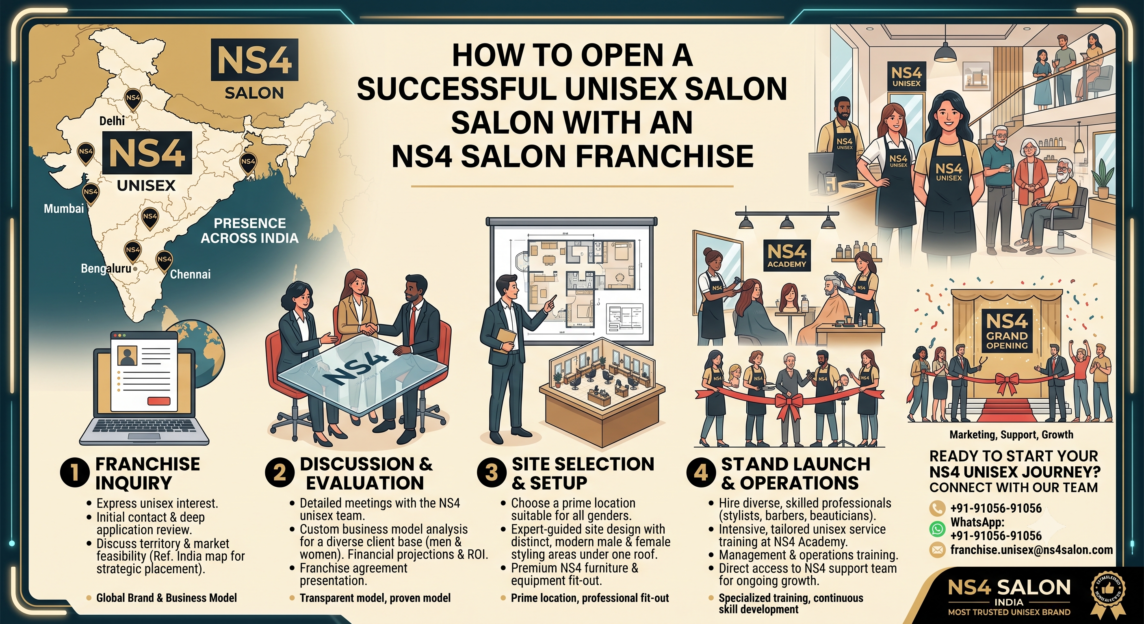
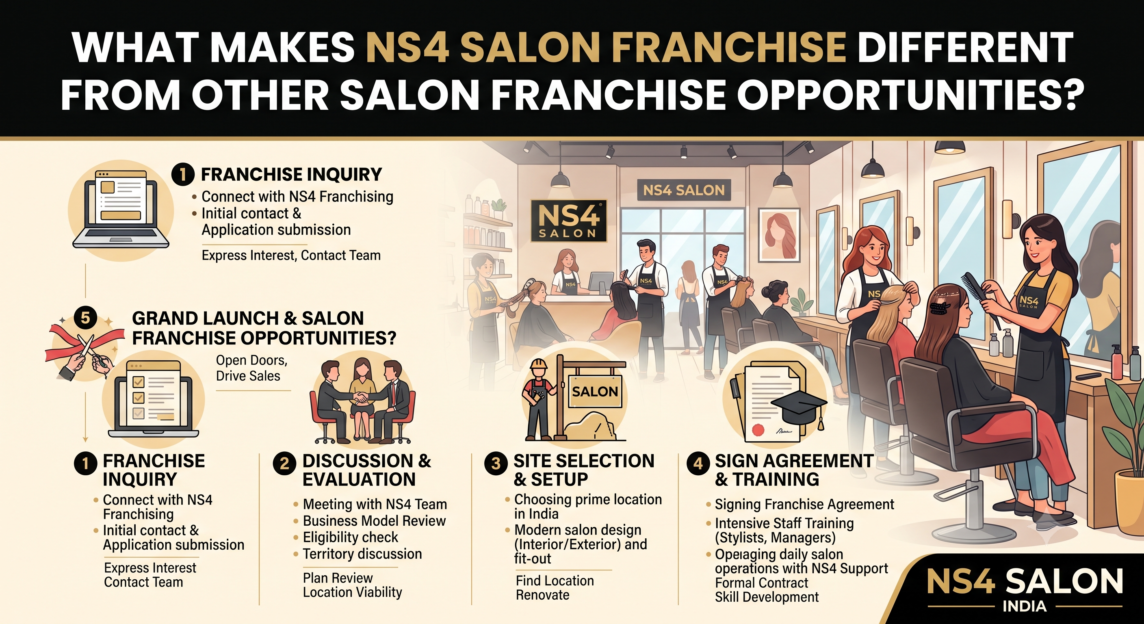
Steps to Start Your NS4 Salon Franchise Journey

If you’re considering the opportunity, a structured approach can help.

Step 1: Define Your Budget

Determine how much capital you can invest without creating unnecessary financial pressure.

Step 2: Study Your Local Market

Research the demand for professional salon services in your target location.

Step 3: Choose a Suitable Format

Consider whether a luxury, premium, or studio-style model best matches your investment and market.

Step 4: Contact the Franchise Team

Discuss the current franchise process, investment expectations, support structure, and eligibility directly with the official team.

Step 5: Evaluate the Location

Analyse the property carefully before making long-term commitments.

Step 6: Review Financial Projections

Create realistic estimates for revenue, expenses, working capital, and the time required to establish the business.

Don’t rely on overly optimistic assumptions.

Step 7: Complete Due Diligence

Review all documents, contractual terms, obligations, and applicable legal requirements.

Step 8: Prepare for Launch

Once approved, focus on setup, staffing, training, marketing, and creating a strong opening plan.

A successful launch can create initial momentum, but the real work begins after opening day.

Frequently Asked Questions About NS4 Salon Franchise

1. What is an NS4 Salon Franchise?

An NS4 Salon Franchise is an opportunity for entrepreneurs to operate a salon business under the NS4 Salon brand and business framework, subject to the applicable franchise model and agreement.

2. How is the NS4 Salon Franchise different from starting an independent salon?

An independent salon owner must build the brand, systems, processes, and business structure independently. A franchise model can provide an established direction, professional identity, and defined support structure, although the franchisee is still responsible for managing the local business effectively.

3. Are there different NS4 Salon Franchise models?

Different business formats may be available based on factors such as investment capacity, space requirements, and market potential. Entrepreneurs should contact the official franchise team for current details and eligibility.

4. What services can an NS4 Salon Franchise offer?

Depending on the selected model and business setup, services may include haircuts, styling, hair colour, hair treatments, beauty services, skin care, facials, makeup, bridal services, nail services, and grooming services.

5. Does a salon franchise guarantee profits?

No responsible business opportunity should guarantee profits. Revenue and profitability depend on many factors, including location, investment, competition, service quality, staff performance, customer demand, expenses, and business management.

6. Is salon business experience necessary to become a franchise owner?

Previous experience can be helpful, but entrepreneurs should discuss their background and requirements directly with the franchise team. Training and operational guidance can be important for business owners who are new to the salon industry.

7. What should I check before investing in a salon franchise?

You should review the total investment, ongoing costs, agreement terms, support structure, location requirements, market demand, staffing needs, working capital, and your own ability to manage the business.

8. How can I learn more about the NS4 Salon Franchise opportunity?

You can contact the official franchise team through the franchise website to request current information about available models, requirements, and the application process.

Conclusion: Is NS4 Salon Franchise the Right Opportunity for You?

Choosing a salon franchise is a major business decision, and there isn’t a one-size-fits-all answer.

What makes the NS4 Salon Franchise different from other salon franchise opportunities is the combination of flexible business formats, professional brand positioning, training potential, operational direction, marketing opportunities, diversified services, and a focus on long-term entrepreneurial growth.

The seven powerful factors discussed in this article are:

  1. Multiple franchise models
  2. Strong brand identity
  3. Training and operational support
  4. Marketing opportunities
  5. Wide service categories
  6. Business systems and customer retention
  7. Long-term growth potential

Still, the final decision should be based on careful research.

Evaluate the local market. Understand the full investment. Review the franchise agreement. Ask detailed questions. Plan for working capital. Most importantly, choose a business opportunity that matches your goals and your ability to manage it effectively.

A strong franchise system can provide direction, but success ultimately depends on execution.

With the right location, committed management, skilled staff, excellent customer service, and disciplined business planning, an entrepreneur can work toward building a professional and sustainable salon business.

If you’re ready to explore the next step, visit the official NS4 Salon Franchise platform to learn more about the opportunity and connect with the franchise team.

Post-Article Message: This article is written for informational and SEO purposes. Franchise investment terms, costs, business models, support, availability, and contractual conditions may change. Prospective franchisees should verify all current information directly with NS4 Salon and obtain appropriate legal and financial advice before making an investment decision.
0 0 Continue Reading →

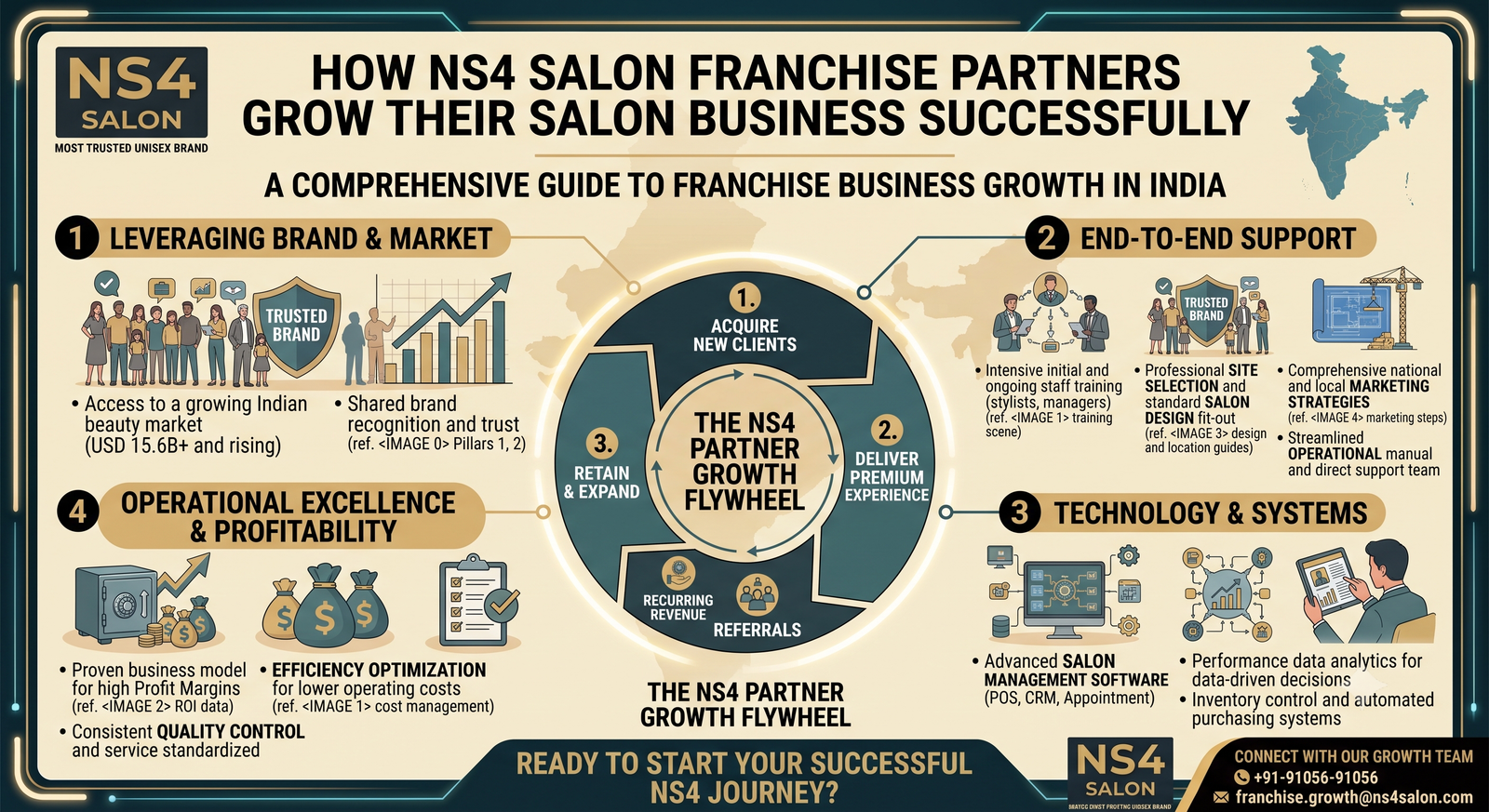
How NS4 Salon Franchise Partners Grow Their Salon Business Successfully

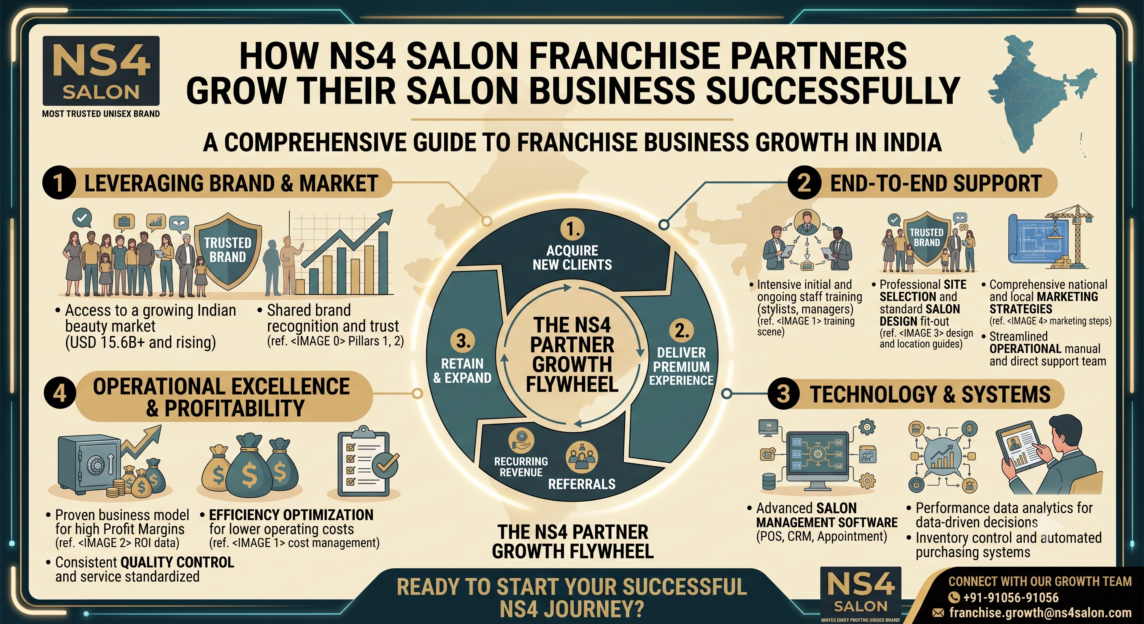
Why the Right Franchise Foundation Matters

A salon business can look exciting from the outside. Customers see stylish interiors, skilled professionals, attractive hair colours, bridal makeup, facials, nail services, and premium products. Behind the scenes, though, a successful salon requires systems.

A strong franchise foundation can help entrepreneurs understand how different parts of the business work together. This may include salon setup planning, service processes, team training, marketing direction, customer experience standards, and business operations.

For a new entrepreneur, this structure can be valuable. Starting independently often means making every decision alone. What services should be offered? How should prices be structured? How should staff be recruited? Which marketing channels should receive attention? How can customer complaints be handled professionally?

With the NS4 Salon Franchise, partners can work toward building their business around an organized brand and operational approach. This can make the journey more focused and reduce unnecessary trial and error.

Building on an Established Business System

A salon should not depend only on one talented stylist or makeup artist. A strong business needs repeatable systems.

For example, a system may define:

  • How customers are welcomed
  • How appointments are managed
  • How consultations are conducted
  • How services are recommended
  • How hygiene and cleanliness are maintained
  • How customer feedback is collected
  • How follow-up communication is handled
  • How staff performance is reviewed

When these processes are clear, daily operations can become easier to manage.

Consistency is particularly important in the beauty industry. A customer who enjoys a great experience once should have a good chance of receiving a similar experience during the next visit. This is how confidence develops.

Reducing Common Startup Challenges

Every business has risks, and no franchise can guarantee automatic success. Still, an organized franchise model can help partners avoid some common beginner mistakes.

These mistakes may include spending too much on unnecessary items, offering too many services without proper demand, ignoring local marketing, failing to train staff, or not monitoring expenses.

The goal is not simply to open the salon. The real goal is to build a salon that can attract customers, retain them, and operate efficiently for years.


Strategy 1: Choosing the Right Location

One of the first major decisions for a salon entrepreneur is location. Even a beautiful salon with skilled professionals can struggle if it opens in an area that doesn’t match its target market.

A successful location should be evaluated carefully.

Understanding Local Customer Demand

Before opening, franchise partners should study the local market. Important questions include:

  • Who lives or works nearby?
  • What age groups are common in the area?
  • What beauty and grooming services are in demand?
  • Are customers looking for affordable, premium, or luxury services?
  • Is there demand for bridal makeup?
  • Are hair treatments popular?
  • Is there growing interest in nail services?
  • How much are nearby customers willing to spend?

The answers can help a salon create the right service mix.

For example, one location may have strong demand for premium hair colour and advanced treatments. Another may generate more business from family grooming, facials, bridal services, and regular beauty packages.

Evaluating Competition and Accessibility

Competition isn’t always a bad sign. In fact, several salons in one commercial area may indicate strong customer demand. The important question is whether a new salon can offer a clear reason for customers to choose it.

Partners should consider visibility, parking, accessibility, surrounding businesses, residential areas, footfall, and local competition.

A salon located near shopping areas, residential communities, offices, or educational hubs may have different customer opportunities. The business plan should match the location rather than taking a one-size-fits-all approach.


Strategy 2: Delivering Consistent Service Quality

A beautiful logo can attract attention, and a great advertisement can bring customers through the door. However, service quality determines whether they return.

This is one of the most important growth factors for every NS4 Salon Franchise partner.

Standardizing the Customer Experience

The customer experience starts before the actual service.

It begins when someone sees the salon online, calls for information, sends a message, or walks through the entrance. Every interaction matters.

A strong service journey may include:

  1. A warm and professional greeting
  2. Understanding the customer’s needs
  3. Providing a proper consultation
  4. Clearly explaining suitable services
  5. Maintaining hygiene and comfort
  6. Delivering the service professionally
  7. Asking for feedback
  8. Suggesting appropriate aftercare
  9. Inviting the customer to return

Small details can make a big difference.

For example, customers appreciate punctuality, clean workstations, polite communication, transparent pricing, and professionals who listen carefully. These things may sound simple, but they create trust.

Creating Trust Through Consistency

Trust is built when customers know what to expect.

If a salon provides excellent service one month and poor service the next month, customers may not return. Consistency requires training, supervision, service standards, and communication.

The best approach is to avoid relying on luck. Partners should create repeatable processes that help every team member understand what quality means.

Quality Should Be Measured, Not Assumed

Managers should regularly review customer feedback, repeat bookings, complaints, cancellations, service outcomes, and online reviews.

If a problem appears repeatedly, it should be addressed quickly.

For instance, if customers frequently mention waiting too long, appointment management may need improvement. If customers complain about unclear pricing, staff communication may require additional training.

This mindset turns feedback into business improvement.


Strategy 3: Training and Developing the Salon Team

A salon’s people are one of its greatest assets.

Even the best interiors and equipment cannot replace a skilled, motivated, and customer-focused team. That’s why continuous staff development plays a major role in long-term growth.

Building Technical Skills

Beauty trends change quickly. Customers may ask about new hair colour techniques, hair treatments, skincare services, makeup styles, nail designs, and other emerging services.

A team must continue learning.

Regular training can help professionals improve:

  • Hair cutting techniques
  • Hair colouring knowledge
  • Hair treatment application
  • Styling skills
  • Bridal and party makeup
  • Skin and facial services
  • Nail art and extensions
  • Product knowledge
  • Hygiene practices
  • Consultation skills

Training shouldn’t be treated as a one-time activity completed when an employee joins.

The strongest salons build a culture of learning.

Improving Customer Communication

Technical skill is essential, but communication is equally important.

A stylist may know exactly how to perform a service, yet the customer can still be unhappy if expectations weren’t discussed properly.

Team members should learn how to ask useful questions, explain realistic results, discuss maintenance, and recommend suitable services without sounding pushy.

For example, instead of simply saying, “You need this treatment,” a professional can explain why the treatment may suit the customer’s hair or skin condition and what results can reasonably be expected.

This creates confidence.

Creating a Culture of Continuous Learning

Managers can encourage growth through regular team meetings, service demonstrations, performance discussions, and knowledge sharing.

A simple culture of improvement can include:

  • Weekly skill practice
  • Monthly service reviews
  • Customer feedback discussions
  • Product knowledge sessions
  • Recognition for good performance
  • Clear improvement goals

When employees feel they are developing professionally, they are often more engaged with the business.


Strategy 4: Using Smart Marketing to Generate Leads

A great salon still needs customers to know it exists.

Marketing should not be treated as an occasional activity performed only when business is slow. It should be an ongoing system.

For an NS4 Salon Franchise partner, smart marketing can support local awareness, lead generation, customer retention, and brand visibility.

Local Digital Marketing

Today’s customers often search online before choosing a salon.

They may search for terms such as:

  • Best salon near me
  • Unisex salon in my city
  • Bridal makeup artist
  • Hair colour salon
  • Keratin treatment
  • Hair spa
  • Nail extension
  • Facial services

This makes local digital visibility important.

A professional online presence should provide accurate business information, service details, photographs, contact options, customer reviews, and location information.

Social Media and Visual Content

Beauty is a highly visual industry. Before-and-after transformations, bridal looks, hair styling, nail art, skincare results, and salon interiors can help potential customers understand what the salon offers.

Content should be useful, attractive, and authentic.

Good content ideas include:

  • Hair transformation videos
  • Bridal makeup looks
  • Client testimonials
  • Nail art designs
  • Beauty tips
  • Behind-the-scenes videos
  • Festival offers
  • New service announcements
  • Team introductions
  • Educational reels

However, simply posting random content isn’t enough. The content should reflect the salon’s target audience and local market.

Google Business Profile and Local Visibility

Local search visibility can help customers discover nearby salons.

Partners should focus on keeping business information accurate and encouraging genuine customer feedback. High-quality photos, updated hours, correct contact details, and consistent information across online platforms can strengthen trust.

For broader guidance on building business credibility and responsible advertising, entrepreneurs can also review resources from the Google Maps

The key is simple: make it easy for potential customers to find accurate information and take the next step.


Strategy 5: Building Customer Loyalty

Getting a new customer is important. Getting that customer to return is even more valuable.

A loyal customer can book regular services, recommend the salon to friends and family, leave positive reviews, and become a long-term supporter of the business.

Creating Memorable Experiences

Customers remember how a business makes them feel.

A memorable salon experience doesn’t always require expensive gifts or dramatic gestures. Often, it comes from simple things done well.

These include:

  • Remembering customer preferences
  • Being respectful of time
  • Offering honest recommendations
  • Maintaining cleanliness
  • Using professional communication
  • Following up after important services
  • Resolving complaints fairly

A customer who feels valued is more likely to return.

Loyalty, Referrals, and Repeat Visits

Partners can create structured loyalty efforts through membership programs, referral offers, service packages, or personalized follow-ups.

For example, after a hair treatment, the salon can recommend a suitable maintenance schedule and invite the customer to book the next appointment.

The goal should not be aggressive selling. It should be helpful communication.

Happy customers can become one of the strongest marketing channels. Word-of-mouth recommendations often carry more trust than advertisements.


Strategy 6: Managing Salon Operations Efficiently

Revenue is important, but a high-revenue salon can still struggle if expenses and operations are poorly managed.

Successful growth requires operational discipline.

Appointment and Staff Management

Poor appointment management can lead to long waiting times, stressed employees, and unhappy customers.

A salon should have a clear process for:

  • Booking appointments
  • Confirming appointments
  • Managing walk-ins
  • Allocating staff
  • Handling delays
  • Tracking cancellations
  • Recording customer preferences

Staff schedules should also match business demand. If weekends are busy, the salon should prepare accordingly. If certain hours are consistently slow, managers can explore promotions, training sessions, or operational tasks during those periods.

Inventory and Expense Control

Salon products, disposables, tools, electricity, rent, salaries, and marketing all affect profitability.

Partners should monitor:

  • Product consumption
  • Stock levels
  • Wastage
  • Expired products
  • Supplier costs
  • Service profitability
  • Monthly fixed expenses

Without regular tracking, small leaks can become major financial problems.

Measuring Important Business Numbers

Business decisions should be supported by data whenever possible.

Useful metrics include:

Metric Why It Matters
Monthly Revenue Shows overall sales performance
Number of Customers Indicates customer activity
Repeat Customer Rate Measures loyalty
Average Bill Value Shows spending per visit
Staff Productivity Helps improve scheduling
Service-wise Revenue Identifies popular services
Product Sales Measures retail opportunities
Marketing Leads Evaluates campaign effectiveness

Numbers tell the real story.

If customer visits are increasing but profits aren’t improving, expenses may be rising too quickly. If marketing generates many enquiries but few bookings, the follow-up process may need attention.


Strategy 7: Increasing Revenue Per Customer

Growth doesn’t always mean finding thousands of new customers.

Sometimes the smartest opportunity is to increase the value created for existing customers.

Service Packages and Upselling

Upselling should mean helping customers choose suitable additional services, not pressuring them to spend unnecessarily.

For example, a customer booking a haircut may also benefit from a hair spa or conditioning service. A bridal customer may require pre-bridal skincare, hair styling, nail services, or additional event makeup.

Packages can make the buying process easier while increasing value.

The important rule is relevance.

Recommendations should match the customer’s needs.

Retail Product Opportunities

Home-care products can support both customer results and salon revenue.

After receiving a professional hair or skin service, customers may need suitable products to maintain the result at home.

Professionals should explain:

  • How to use the product
  • Why it may be suitable
  • How often to use it
  • What realistic benefits to expect

Creating Value Instead of Simply Cutting Prices

Constant discounting can damage a salon’s long-term positioning.

Instead of always reducing prices, businesses can create value through service bundles, memberships, seasonal packages, expert consultations, or exclusive experiences.

Price matters, of course. But customers also consider quality, trust, convenience, professionalism, and results.


Strategy 8: Building a Strong Local Brand Reputation

Reputation takes time to build and only moments to damage.

Every NS4 Salon Franchise partner should understand that local reputation can become a major competitive advantage.

Reviews and Customer Feedback

Online reviews influence how potential customers view a business.

The best way to receive positive reviews is not to chase them blindly. It is to consistently deliver experiences worth discussing.

Partners can politely ask satisfied customers for honest feedback. They should also respond professionally to criticism.

A negative review should not automatically lead to an argument. First, understand the concern. If the salon made a mistake, acknowledge it and work toward a fair solution.

Professional responses show future customers that the business cares.

Community Engagement

A local salon can strengthen its presence by connecting with the surrounding community.

This may include participating in local events, supporting relevant initiatives, collaborating with complementary businesses, or running seasonal campaigns.

The goal is to become more than a place where customers occasionally receive services. A strong salon brand can become a trusted part of the local beauty and lifestyle community.


Strategy 9: Planning for Long-Term Growth

Successful business owners don’t only think about today’s bookings. They also plan for the next month, next year, and beyond.

Growth should be intentional.

Setting Monthly and Annual Goals

Partners should create measurable goals.

Examples include:

  • Increase monthly customer visits
  • Improve repeat booking rates
  • Grow average bill value
  • Add a new high-demand service
  • Improve online reviews
  • Train staff in advanced techniques
  • Reduce unnecessary product wastage
  • Increase local brand awareness

Large goals should be broken into smaller actions.

For example, “Increase revenue” is a broad goal. A better plan may be to increase repeat visits, improve service packages, train staff, strengthen follow-ups, and measure performance every month.

Expanding Services and Opportunities

Expansion should follow market demand.

Before adding a new service, partners should ask:

  • Is there customer demand?
  • Does the team have the required skills?
  • What equipment is needed?
  • What are the costs?
  • Can the service be marketed effectively?
  • Will the service support profitability?

This prevents businesses from adding services simply because competitors have them.

Scaling Without Losing Quality

Growth can create new challenges.

A larger team requires stronger communication. More customers require better appointment systems. More locations require stronger operational consistency.

That’s why systems become even more important during expansion.

The business should grow without losing the quality and customer experience that helped it succeed in the first place.


Common Mistakes Salon Franchise Partners Should Avoid

Even a strong franchise model requires careful execution.

Common mistakes include:

1. Ignoring Local Market Research

What works in one city or neighborhood may not work exactly the same way elsewhere.

2. Depending Only on Discounts

Discounts can bring attention, but long-term success requires service quality and customer loyalty.

3. Neglecting Staff Training

Beauty trends and customer expectations change. Training must continue.

4. Failing to Track Business Performance

Without numbers, it is difficult to understand whether the business is truly improving.

5. Ignoring Customer Complaints

Complaints can reveal operational problems that need attention.

6. Inconsistent Marketing

Marketing should continue even during busy periods.

7. Poor Follow-Up

Many potential customers need a reminder or additional information before booking.

8. Growing Too Quickly

Expansion without strong systems can create more problems than profits.


How to Measure Salon Business Growth

Growth should be measured from several angles.

A salon may appear busy, but true business growth should include improvements in revenue, profitability, customer loyalty, team performance, and reputation.

A practical monthly review can answer:

  1. Did revenue increase?
  2. Did profit improve?
  3. Are more customers returning?
  4. Which services are growing?
  5. Which services are underperforming?
  6. Did the average bill value improve?
  7. Are customers leaving positive feedback?
  8. Is staff productivity improving?
  9. Are marketing efforts generating quality leads?
  10. What should be improved next month?

The NS4 Salon Franchise approach can provide partners with a structured foundation, but regular measurement helps turn daily activity into informed business decisions.


Frequently Asked Questions

1. How can an NS4 Salon Franchise partner grow a salon business?

An NS4 Salon Franchise partner can focus on service quality, staff training, local marketing, customer retention, efficient operations, financial monitoring, and consistent brand standards. Growth usually comes from improving several areas together rather than depending on only one strategy.

2. Is salon marketing important for franchise growth?

Yes. Marketing helps potential customers discover the salon and understand its services. A good strategy can include local search visibility, social media, customer referrals, promotional campaigns, visual content, and follow-up communication.

3. How important is staff training in a salon business?

Staff training is extremely important because the customer experience depends heavily on the people delivering services. Technical skills, consultations, product knowledge, communication, and customer service should all be improved continuously.

4. How can a salon increase repeat customers?

A salon can increase repeat customers by delivering consistent quality, remembering customer preferences, recommending suitable maintenance schedules, communicating professionally, resolving issues quickly, and creating loyalty or referral opportunities.

5. Should a salon always offer discounts to attract customers?

No. Discounts can be useful for specific campaigns, but relying only on low prices may reduce profitability and weaken brand positioning. Creating value through quality, packages, memberships, expert services, and excellent customer experiences can be more sustainable.

6. What numbers should a salon owner track every month?

Important numbers include total revenue, expenses, profit, number of customers, repeat customer rate, average bill value, service-wise revenue, staff productivity, inventory usage, and marketing results.

7. Can a franchise guarantee salon business success?

No business model can guarantee success. A franchise can provide systems, guidance, branding, and support, but results also depend on the franchise partner’s location, investment, management, team, local market, customer service, and execution.

8. What is the biggest factor in long-term salon success?

There isn’t just one factor. Long-term success usually comes from combining strong service quality, customer trust, trained staff, efficient operations, smart marketing, and continuous improvement.


Conclusion: Build Growth Step by Step

Growing a salon business successfully is a journey, not a one-day achievement. The strongest businesses are built through consistent action.

For NS4 Salon Franchise partners, the opportunity is to combine franchise support with strong local execution. Choosing the right location, training the team, delivering excellent customer experiences, using smart marketing, managing operations, and tracking performance can all contribute to sustainable growth.

The biggest lesson is simple: don’t focus only on getting more customers. Focus on building a better business.

When customers receive consistent value, employees continue improving, operations are monitored carefully, and marketing stays active, a salon can build stronger foundations for the future.

Success may not happen overnight, but with the right systems, discipline, and commitment, every step forward can create momentum. In the salon industry, trust is earned one customer, one service, and one positive experience at a time.

Post-Article Message: Ready to strengthen your salon entrepreneurship journey? Focus on consistent quality, smart marketing, trained professionals, and measurable business goals to build a stronger and more successful salon business.

0 0 Continue Reading →

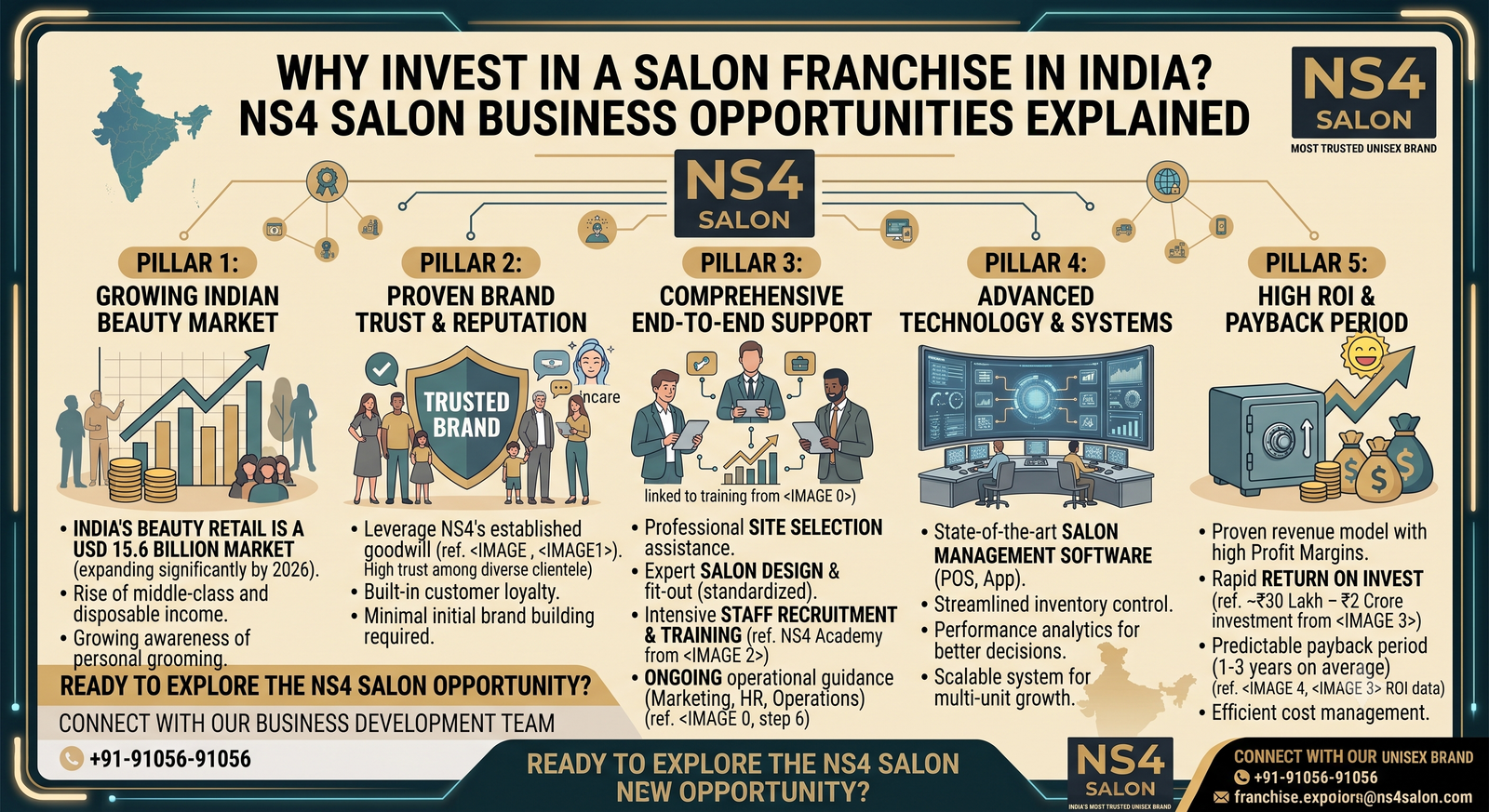
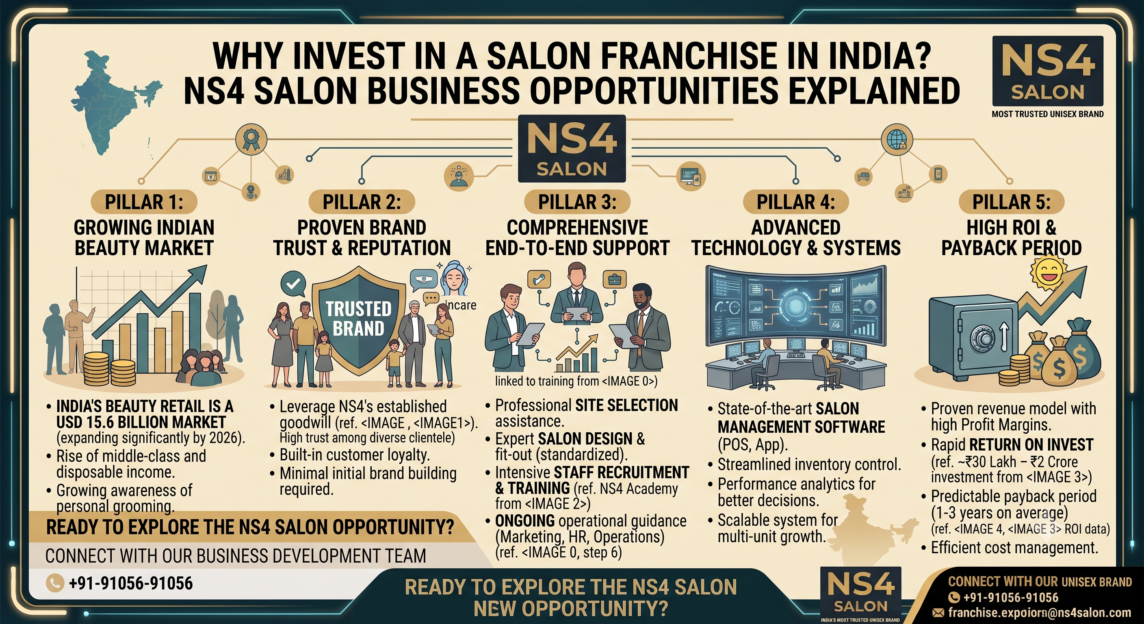
Why Invest in a Salon Franchise in India? NS4 Salon Business Opportunities Explained

Introduction

India’s beauty and wellness industry is changing quickly. Customers no longer visit salons only for a haircut before a wedding or festival. Today, salon services have become part of regular grooming and self-care. Haircuts, hair colour, facials, skin treatments, nail services, bridal makeup, grooming packages, and advanced hair treatments are in steady demand.

This growing demand has created exciting opportunities for entrepreneurs. For many people, starting a business from scratch can feel risky. You have to build a brand, develop systems, hire and train staff, attract customers, and solve problems without an established framework. That’s where a salon franchise in India can offer an important advantage.

Instead of starting with a completely unknown business name, a franchise investor can work with an established business concept, defined service standards, operational guidance, and brand support. NS4 Salon aims to provide entrepreneurs with different salon business models designed around varying investment capacities and space requirements.

So, why should an entrepreneur consider this industry? Let’s explore the opportunity in detail.

Understanding the Salon Franchise Opportunity in India

A salon franchise in India allows an entrepreneur to operate a salon under an established brand and business system. The franchise partner invests in setting up and operating the location while following the brand’s business standards, service processes, and operational guidelines.

The basic idea is simple: the franchisor develops the business model, while the franchise partner brings local investment, management, and commitment.

A typical salon franchise model may include support related to:

  • Brand identity
  • Salon design and setup guidance
  • Staff recruitment support
  • Professional training
  • Service standards
  • Marketing strategies
  • Operational systems
  • Product and service knowledge
  • Business development guidance

Of course, the exact support depends on the franchise agreement and business model. That’s why potential investors should always review the terms carefully before making a decision.

The biggest attraction is that you don’t have to reinvent the wheel. Building a new salon brand can take years. You need to earn customer trust one visit at a time. A recognised and professionally presented franchise model may help an entrepreneur begin with a clearer direction.

However, a franchise isn’t a magic shortcut. Success still depends on location, investment planning, customer service, staff performance, local marketing, and day-to-day management. In short, the brand can provide the roadmap, but the franchise owner still has to drive the business.

Why India’s Beauty and Wellness Industry Is Growing

The Indian beauty industry has strong growth potential because consumer habits are evolving. People are spending more on personal grooming, appearance, skincare, haircare, and professional beauty services.

Several factors are driving this change.

Rising Focus on Personal Grooming

Both men and women are increasingly investing in grooming. A professional salon is now seen as a regular service destination rather than only an occasional luxury.

Customers may visit for:

  • Regular haircuts
  • Hair styling
  • Beard and grooming services
  • Hair colour
  • Hair spa
  • Keratin treatments
  • Hair Botox
  • Nanoplastia
  • Facials
  • D-Tan services
  • Manicure and pedicure
  • Nail extensions
  • Nail art
  • Party makeup
  • Bridal makeup

This variety is important because a salon doesn’t have to depend on one service alone.

Growing Aspirations Beyond Metro Cities

Beauty and wellness demand isn’t limited to India’s biggest metropolitan cities. Customers in Tier 2 and Tier 3 cities are also seeking professional salon experiences, modern treatments, trained artists, and premium services.

This creates opportunities for a well-planned salon franchise in India to serve markets where customer demand is increasing but organised salon options may still be developing.

Social Media and Beauty Awareness

Instagram, YouTube, beauty creators, celebrities, and online tutorials have increased awareness about hairstyles, skincare, makeup, and new beauty trends.

Customers often arrive at salons with specific expectations. They may ask for:

  • Global hair colour
  • Balayage-inspired looks
  • Advanced makeup
  • HD makeup
  • Airbrush makeup
  • Smoothening
  • Keratin
  • Nanoplastia
  • Premium facials
  • Nail extensions

As awareness grows, so does the opportunity for professionally trained salons.

For broader information on India’s beauty and wellness ecosystem, investors can also explore the Ministry of MSME, Government of India for business-related resources and initiatives.

7 Powerful Reasons to Invest in a Salon Franchise in India

1. Established Brand Recognition

Building trust is one of the hardest parts of launching a new business. A customer may hesitate to try an unknown salon, especially for high-value services such as bridal makeup or chemical hair treatments.

An established franchise brand can help reduce this initial barrier.

With NS4 Salon, franchise partners can operate within a defined brand identity. Consistent branding can support customer recognition across signage, interiors, service communication, marketing materials, and online promotion.

This doesn’t guarantee customers. However, a stronger brand presentation can provide a better starting point than launching without any established identity.

2. Growing Customer Demand

The beauty business benefits from repeat customer potential. A customer who receives a haircut today may return for another haircut in a few weeks. The same customer may later book a facial, hair colour, manicure, or festive makeup service.

This creates opportunities for recurring business.

For example, one salon customer may generate revenue through:

Customer Need Possible Salon Service
Monthly grooming Haircut or styling
Hair concerns Hair spa or treatment
New look Hair colour
Special event Party makeup
Wedding Bridal or pre-bridal services
Skincare Facial or cleanup
Beauty trends Nail art or nail extensions

A well-managed salon franchise in India can therefore develop multiple customer touchpoints.

The key is delivering a good experience. Customers don’t return simply because of a beautiful interior. They return because the service is professional, the staff understands their needs, pricing is clear, hygiene is maintained, and the experience feels worthwhile.

3. A Proven Business Model

Starting independently means making every major decision yourself. What should the menu look like? Which services should be introduced first? How should staff be trained? What pricing structure should be used?

A franchise model can offer a more organised approach.

The business may provide guidance around:

  • Service categories
  • Salon workflow
  • Customer handling
  • Staff roles
  • Training systems
  • Brand standards
  • Promotional planning
  • Operational processes

This structure can be especially useful for first-time entrepreneurs.

That said, investors should ask detailed questions. A “proven model” should be understood clearly. Before investing, ask how the model has performed across different markets and what responsibilities belong to the franchise owner.

Smart investors don’t simply buy a name. They study the complete business system.

4. Training and Operational Support

The salon business is highly service-driven. Your equipment may be excellent, but customers will judge the experience based heavily on the people providing the service.

Professional training matters.

Franchise support can help establish consistency in areas such as:

  • Consultation procedures
  • Hair service techniques
  • Makeup application
  • Skin service knowledge
  • Hygiene practices
  • Product usage
  • Customer communication
  • Upselling
  • Complaint handling

For an owner, operational guidance can also be valuable. Managing appointments, staff schedules, inventory, customer records, and promotions requires a system.

When these areas are handled poorly, even a busy salon can struggle. When they are managed well, the business can become more organised and easier to monitor.

5. Marketing Support

A great salon hidden from potential customers won’t achieve its full potential. Marketing is essential.

Today, local salon marketing may involve:

  • Google Business Profile optimisation
  • Instagram content
  • Facebook promotion
  • Reels and short videos
  • Before-and-after transformations
  • Customer reviews
  • Festival offers
  • Referral campaigns
  • WhatsApp communication
  • Local partnerships

A franchise brand can provide marketing direction and branded creative support, depending on the model.

For a salon franchise in India, local marketing should never be ignored. Customers usually search for services close to them. Terms such as “best salon near me,” “hair salon,” “bridal makeup artist,” or “hair colour salon” can influence local discovery.

The winning approach is often a combination of strong brand marketing and active local promotion.

6. Multiple Revenue Opportunities

One major advantage of the salon industry is service diversity.

A salon can potentially earn through different categories rather than relying on one product or service.

Possible revenue categories include:

  1. Haircuts and styling
  2. Hair colour
  3. Hair treatments
  4. Keratin and smoothening
  5. Nanoplastia
  6. Hair spa
  7. Facials
  8. Skin services
  9. Makeup
  10. Bridal packages
  11. Pre-bridal packages
  12. Manicure and pedicure
  13. Nail extensions
  14. Nail art
  15. Groom packages

This diversity can create more opportunities to serve the same customer over time.

For example, a bridal customer may initially book a makeup trial. Later, she may book a complete bridal package, hair spa, facial, pre-bridal sessions, and nail services.

That’s why customer relationship management is so important.

The goal shouldn’t be to push unnecessary services. Instead, trained professionals should recommend services that genuinely match customer needs.

7. Long-Term Business Potential

Beauty and grooming are recurring needs. Trends may change, but people will continue to need grooming services.

A strong salon can build long-term value through:

  • Repeat customers
  • Customer referrals
  • A trained team
  • Strong online reviews
  • Local reputation
  • Efficient operations
  • Consistent service quality

A salon franchise in India may therefore suit entrepreneurs looking to build a business with repeat-service potential rather than relying only on one-time sales.

Still, long-term success takes patience. In the early stages, an owner may need to focus heavily on awareness, team development, customer acquisition, and operational discipline.

There are no shortcuts here. But with the right strategy, the industry offers meaningful long-term potential.

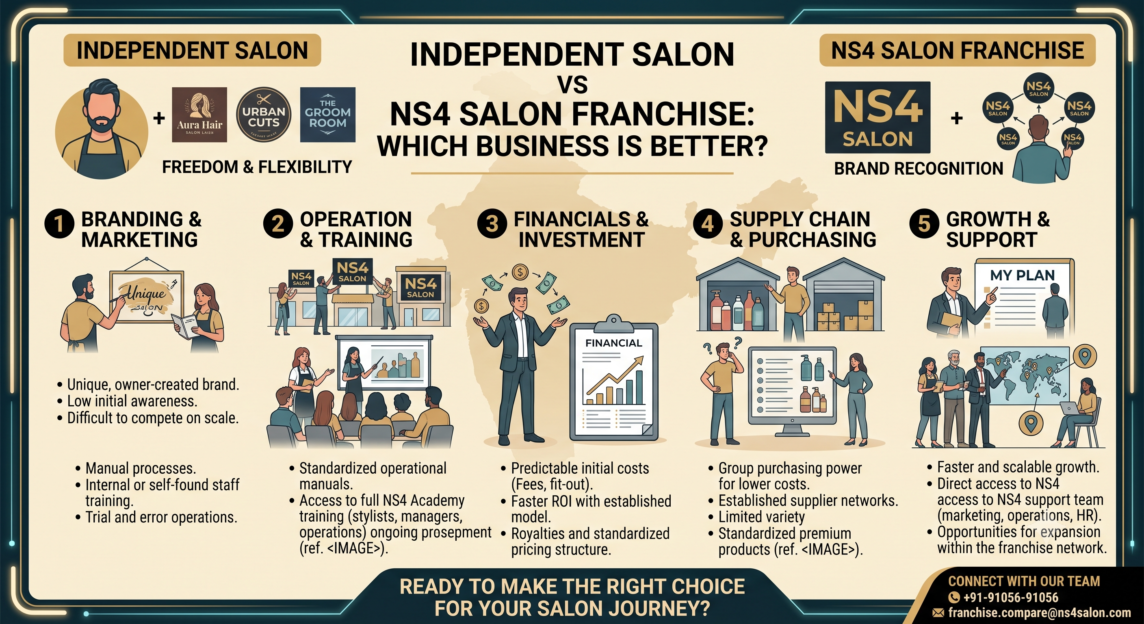
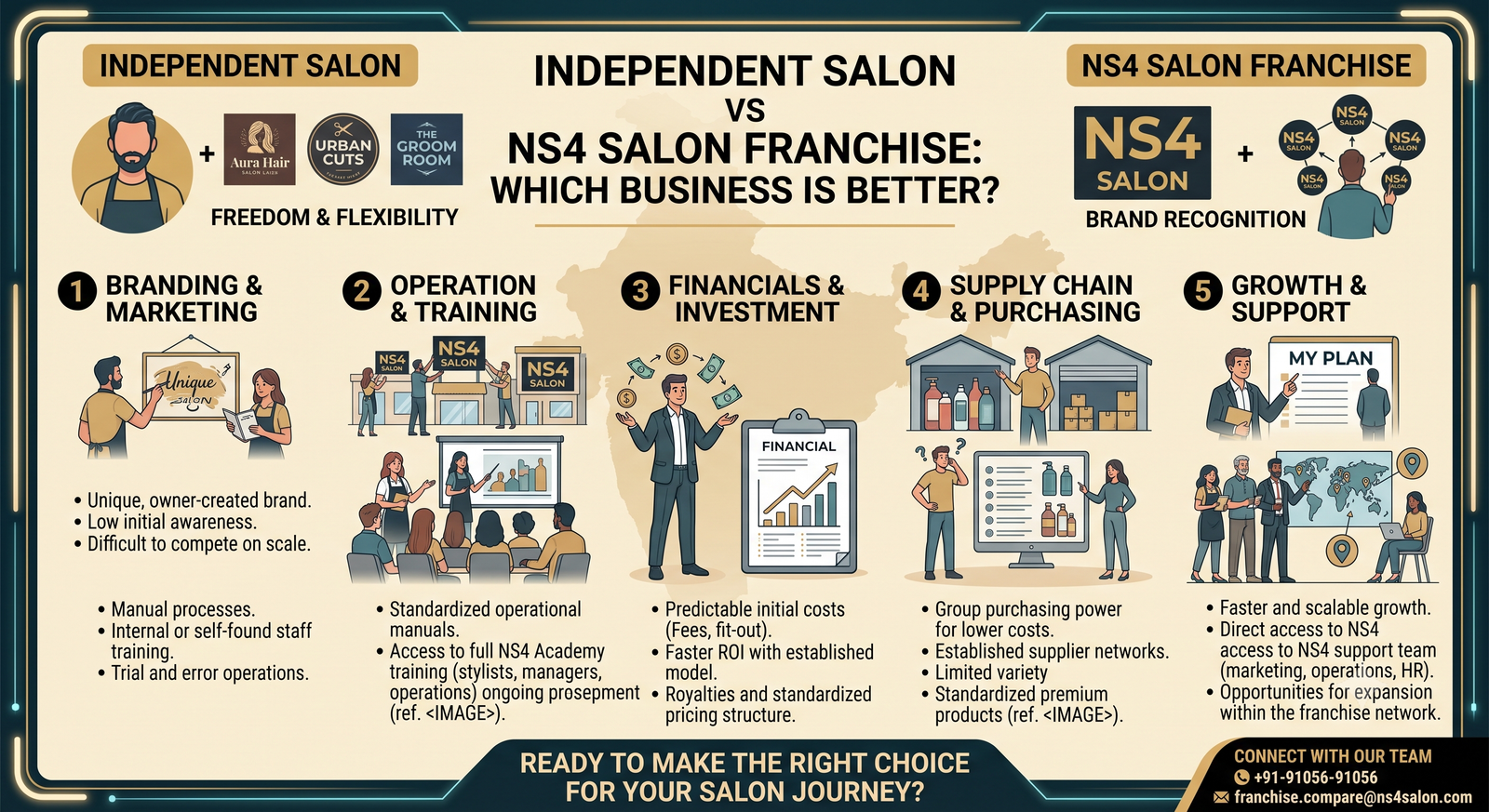
What Makes a Salon Franchise Different from an Independent Salon?

An independent salon gives you complete control. You choose the name, design, services, systems, and marketing approach.

A franchise provides a more structured framework.

Factor Independent Salon Franchise Salon
Brand name Built from scratch Established brand framework
Business systems Created by owner Defined operating guidance
Training Owner arranges independently May receive franchise support
Marketing Created independently Brand and local support may be available
Flexibility Generally higher Must follow brand standards
Initial direction Self-developed More structured
Risk Depends entirely on execution Still present, but supported by a system

Neither model is automatically better for everyone.

If you’re highly experienced and want complete creative freedom, an independent salon may appeal to you. If you prefer working within a structured brand system, a franchise may be a better fit.

The important thing is to choose based on your business goals, budget, experience, and ability to manage operations.

NS4 Salon Business Opportunities Explained

NS4 Salon offers different business models designed around varying space and investment requirements. This gives potential entrepreneurs the ability to consider a format that matches their local market and business plan.

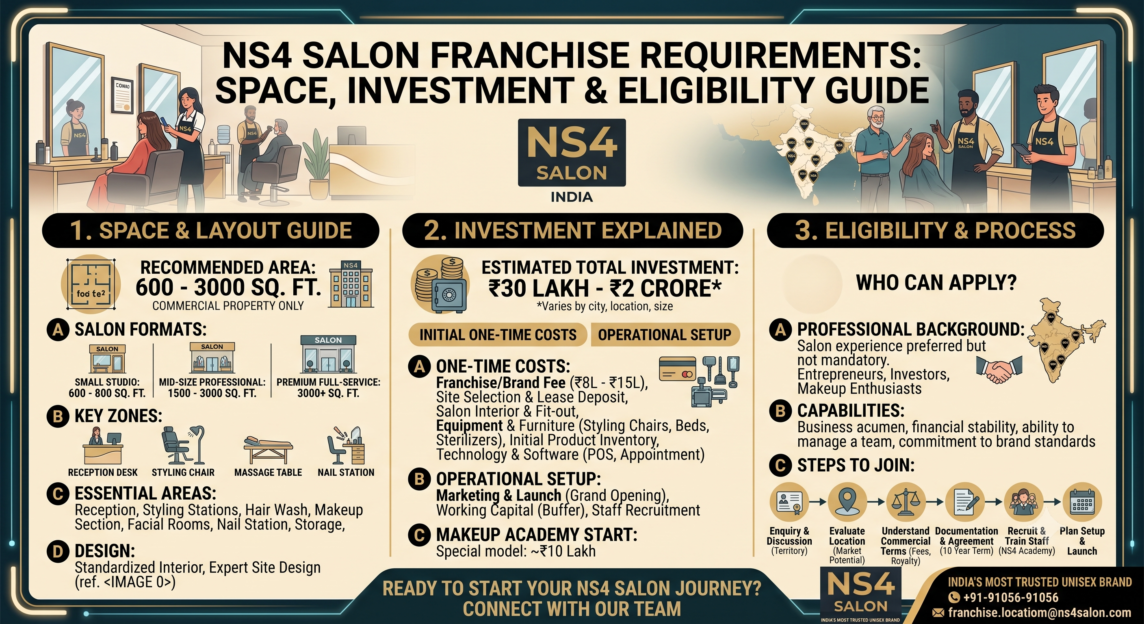
NS4 Luxury Salon Model

The Luxury Salon model is designed for a larger-format salon experience.

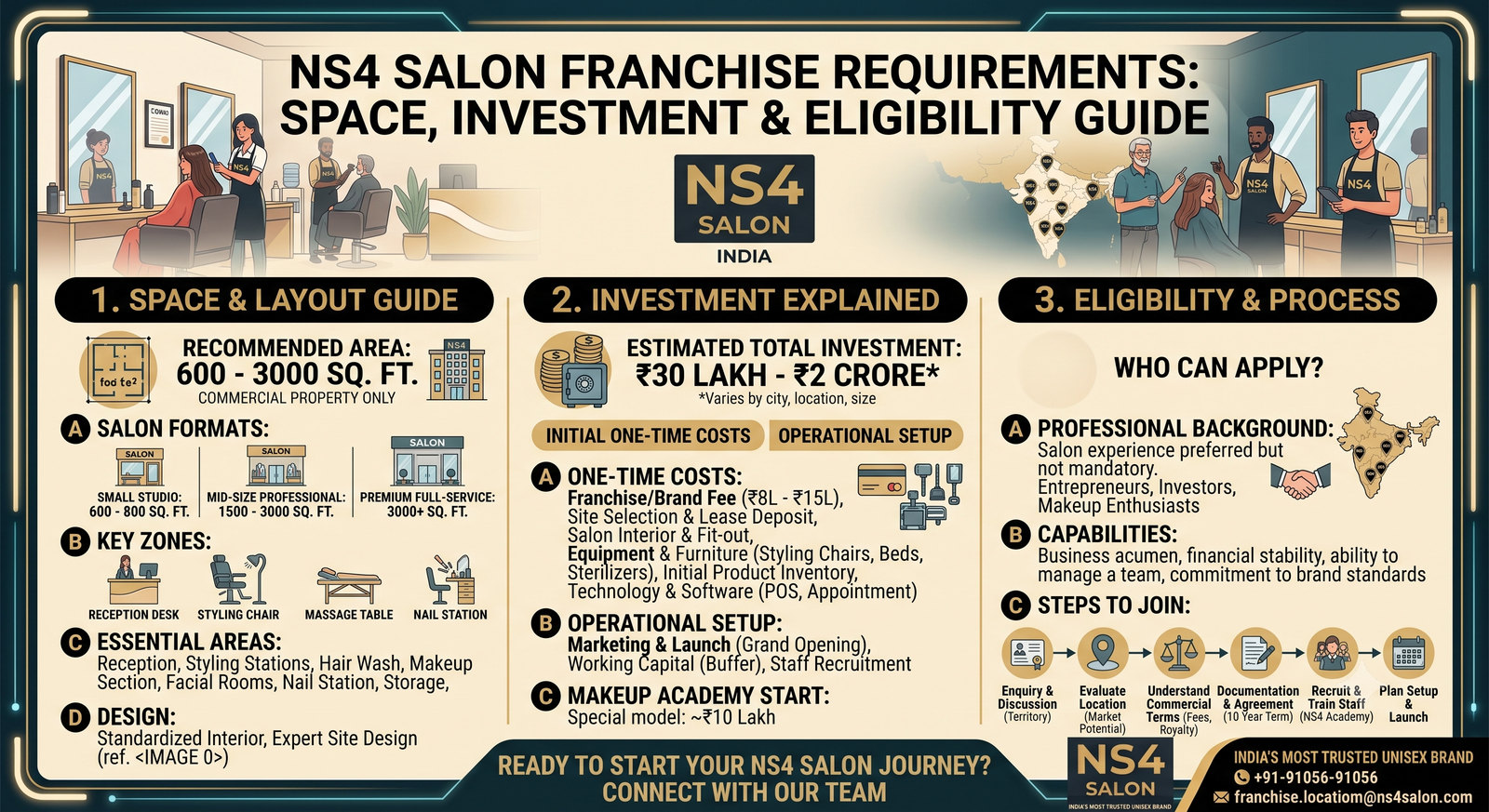
Suggested space: Approximately 2,000 to 3,000 square feet.

This model may be suitable for high-visibility locations with sufficient customer demand for a broad service portfolio.

A larger salon can potentially support dedicated areas for:

  • Hair services
  • Makeup
  • Bridal services
  • Skin services
  • Nail services
  • Premium customer experiences

The stated franchise fee structure for this model includes ₹7 lakh plus GST, described as 5% + 2%.

Because total project costs can vary based on location, interiors, equipment, rent deposits, staffing, and working capital, investors should obtain a detailed current proposal before proceeding.

NS4 Premium Salon Model

The Premium Salon model is designed for a mid-sized format.

Suggested space: Approximately 1,000 to 1,500 square feet.

This model can suit entrepreneurs who want to offer a comprehensive professional salon experience without operating the largest format.

The stated franchise fee is ₹5 lakh plus 18% GST.

A Premium model may be planned around a strong mix of hair, beauty, skin, makeup, and related services based on the location and business requirements.

NS4 Studio Salon Model

The Studio Salon model is designed for a more compact format.

Suggested space: Approximately 600 to 800 square feet.

The stated franchise fee is ₹3 lakh plus applicable GST.

This option may be relevant for entrepreneurs entering the organised salon business with a smaller space requirement.

A compact salon doesn’t mean poor service. The focus should be on efficient layout planning, strong service selection, trained staff, and excellent customer experience.

Investment and Cost Considerations

The total investment for a salon franchise in India depends on several variables.

NS4 Salon business opportunities have been discussed across formats with approximate total investment ranges from ₹20 lakh to ₹50 lakh, depending on the selected model and project requirements.

However, investors shouldn’t look only at the franchise fee.

A complete financial plan should consider:

  • Franchise fees
  • GST and applicable taxes
  • Security deposit
  • Interior work
  • Furniture
  • Salon chairs and equipment
  • Mirrors and workstations
  • Air conditioning
  • Electrical work
  • Plumbing
  • Signage
  • Opening inventory
  • Staff salaries
  • Recruitment
  • Local marketing
  • Technology and billing systems
  • Working capital

This is one of the most important stages of planning.

Don’t put every rupee into interiors and then struggle to pay salaries or marketing expenses. Working capital is crucial, especially during the first months of operation.

Create a realistic financial model that includes conservative, expected, and optimistic scenarios.

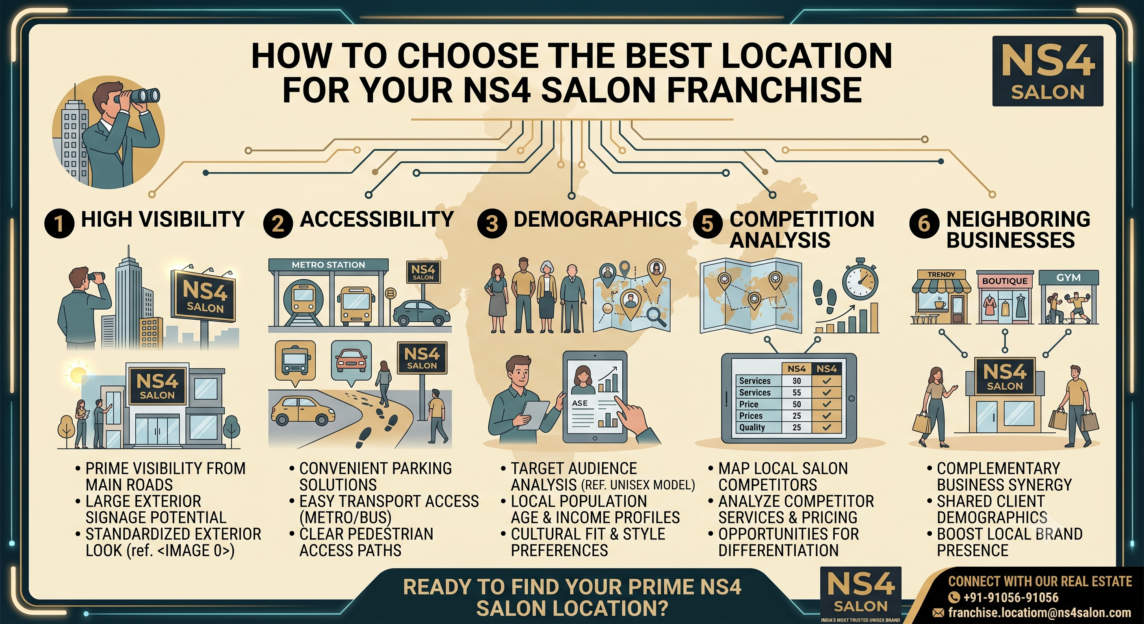
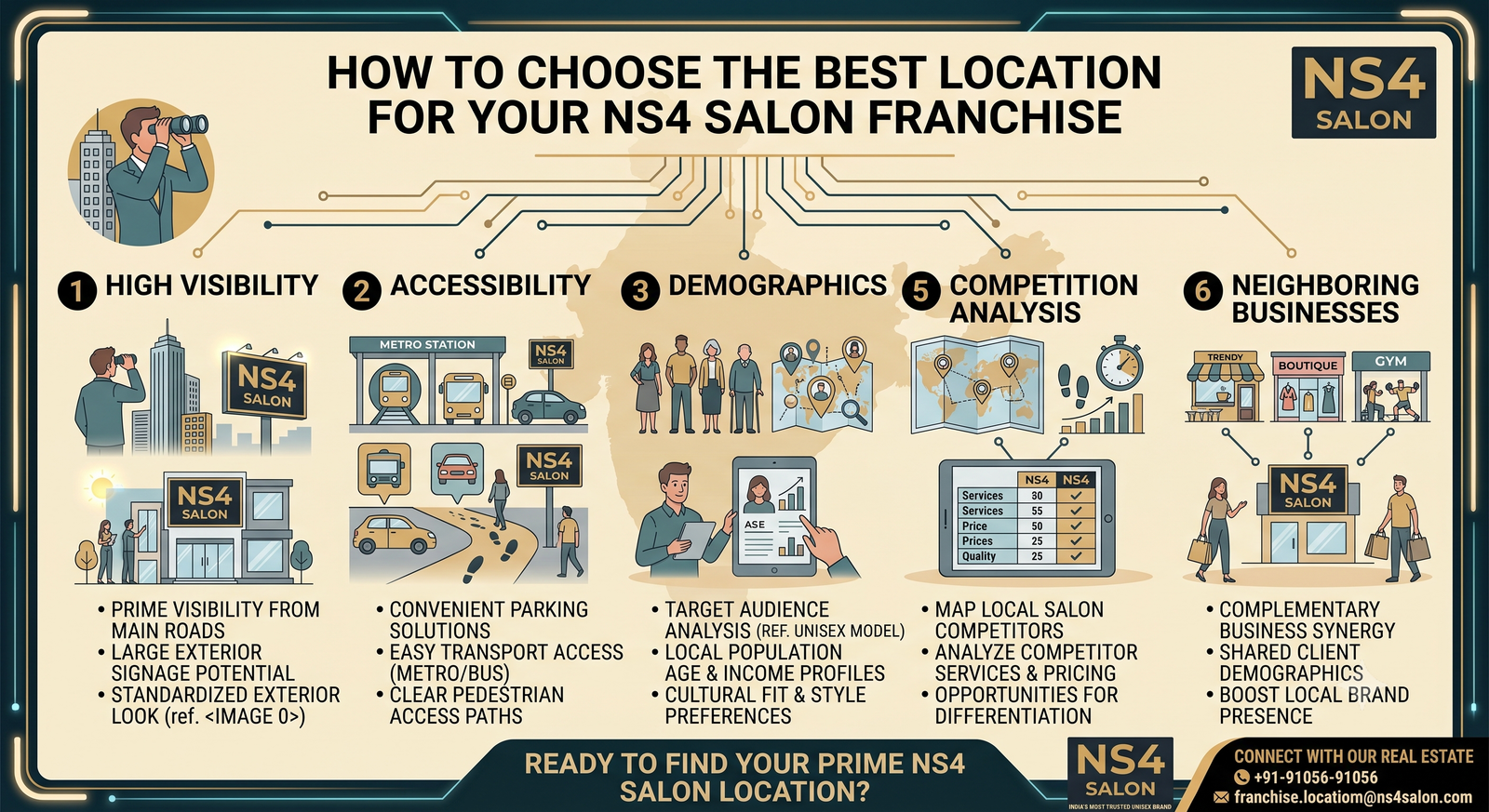
Choosing the Right Location for Your Salon

Location can make or break a salon.

Before finalising a property, study:

Customer Profile

Who lives or works nearby?

Consider income levels, age groups, lifestyle, and demand for professional grooming services.

Visibility

Can customers easily find the salon?

A visible location with good frontage may support walk-ins and brand awareness.

Accessibility

Check:

  • Parking availability
  • Main-road access
  • Public transport
  • Ease of entry
  • Nearby landmarks

Competition

Competition isn’t always bad. A busy commercial beauty market can indicate strong customer demand.

However, study competitors carefully. Understand their pricing, services, reviews, strengths, and weaknesses.

Your goal is to find a clear opportunity rather than simply opening beside another salon without a strategy.

Essential Services for Higher Revenue Potential

A successful salon needs a balanced service menu.

Hair Services

Hair is often a major traffic driver.

Services may include:

  • Haircut
  • Blow-dry
  • Styling
  • Hair colour
  • Global colour
  • Highlights
  • Hair spa
  • Keratin
  • Smoothening
  • Hair Botox
  • Nanoplastia

Beauty and Skin Services

Regular skincare services can encourage repeat visits.

Examples include:

  • Cleanup
  • Facial
  • D-Tan
  • Manicure
  • Pedicure
  • Waxing
  • Threading

Makeup Services

Makeup can generate strong business during wedding and festive seasons.

Possible services include:

  • Party makeup
  • Engagement makeup
  • Bridal makeup
  • HD makeup
  • Airbrush makeup
  • Pre-bridal packages

Nail Services

Nail art and nail extensions have become increasingly popular among customers seeking specialised beauty services.

A diversified menu can help a salon create several revenue streams while serving different customer needs.

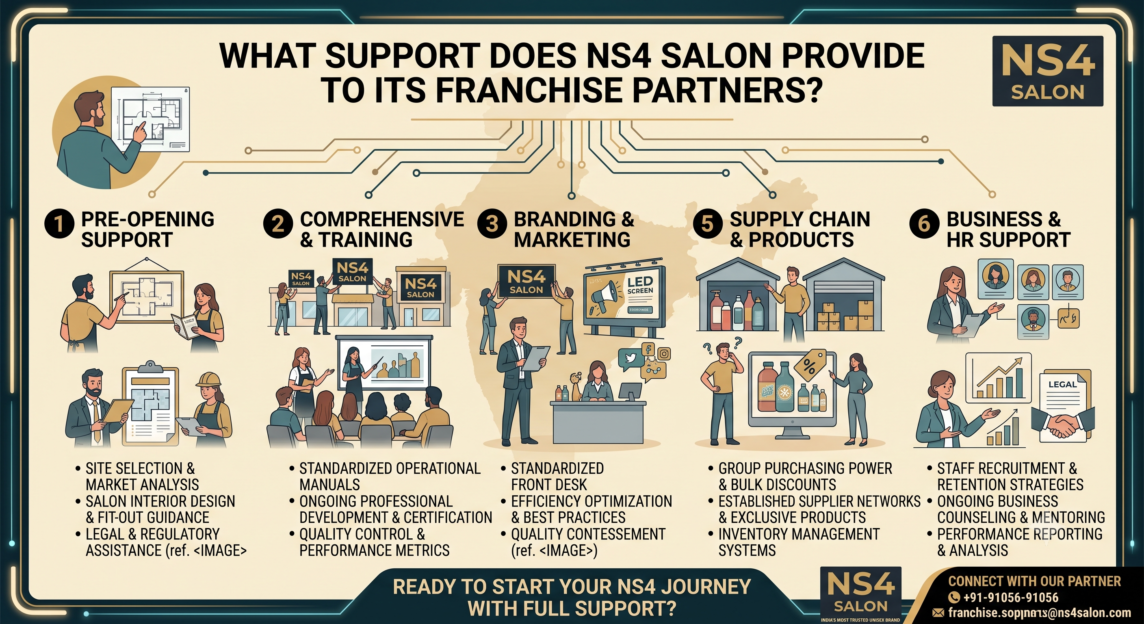
How NS4 Salon Supports Franchise Partners

A franchise business works best when the franchisor and franchise partner operate as a team.

NS4 Salon’s business opportunity is built around providing franchise partners with guidance across important areas of salon development and operations.

Depending on the selected franchise arrangement, support may focus on areas such as:

  • Brand usage and identity
  • Salon setup guidance
  • Interior planning support
  • Operational systems
  • Service guidance
  • Staff training
  • Marketing direction
  • Business development
  • Customer service standards

Potential investors should discuss the exact support available for their selected model before signing an agreement.

Ask direct questions such as:

  1. What training is included?
  2. How long is the training period?
  3. Is opening support provided?
  4. What marketing support is available?
  5. Are there recurring fees?
  6. What are the brand standards?
  7. What is the agreement period?
  8. How are products and supplies managed?
  9. What support is available after launch?
  10. What are the responsibilities of the franchise owner?

Clear answers protect both sides.

Marketing Your Salon Franchise Successfully

Opening day is only the beginning.

A successful salon needs continuous visibility.

Build a Strong Local Digital Presence

Create and maintain:

  • Google Business Profile
  • Instagram account
  • Facebook presence
  • WhatsApp Business communication
  • Online review strategy

Upload authentic salon images, showcase real work, and encourage genuine customer feedback.

Use Before-and-After Content

Hair transformations, makeup looks, nail art, and styling results can provide highly engaging social media content.

Always take customer permission where necessary.

Run Festival Campaigns

India offers many promotional opportunities around:

  • Wedding season
  • Rakshabandhan
  • Karwa Chauth
  • Diwali
  • Christmas
  • New Year
  • Valentine’s Day
  • Teej
  • Mother’s Day

Packages can encourage customers to try multiple services.

Focus on Reviews and Referrals

Happy customers can become your best marketers.

Train your team to deliver a memorable experience. Then, politely encourage satisfied customers to share reviews.

Word of mouth remains incredibly powerful in the salon business.

Skills Needed to Become a Successful Franchise Owner

You don’t necessarily need to be a professional hairstylist or makeup artist to own a salon franchise.

However, you should develop strong business skills.

Leadership

Your team needs direction and accountability.

Customer Focus

The customer’s experience should remain central to every decision.

Financial Discipline

Monitor sales, expenses, salaries, inventory, and profitability regularly.

Marketing Mindset

Don’t wait for customers to discover you. Promote the business consistently.

Problem-Solving Ability

Staff issues, customer complaints, and operational challenges will happen. The question is how quickly and professionally you solve them.

Willingness to Learn

Beauty trends and customer expectations change. A good business owner keeps learning.

Common Mistakes to Avoid When Investing in a Salon Franchise

Choosing a Location Only Because Rent Is Cheap

Cheap rent doesn’t automatically mean a good opportunity. The property still needs suitable visibility and customer potential.

Spending Too Much on Interiors

A beautiful salon is valuable, but overspending can create cash-flow problems.

Ignoring Working Capital

You need funds for the months after opening, not just the launch.

Hiring Without Training

Untrained staff can damage customer trust.

Inconsistent Marketing

Posting once every two months won’t build sustained awareness.

Ignoring Customer Complaints

A complaint can reveal an operational weakness. Handle it quickly and professionally.

Expecting Instant Profits

Every business needs time to establish itself. Build realistic expectations.

How to Start a Salon Franchise with NS4 Salon

If you’re considering an NS4 salon franchise in India, follow a structured process.

Step 1: Assess Your Budget

Understand your total available investment and reserve sufficient working capital.

Step 2: Select a Business Model

Consider whether the Luxury, Premium, or Studio format best matches your budget, space, and market.

Step 3: Identify Potential Locations

Study visibility, customer demographics, accessibility, competition, and rental costs.

Step 4: Discuss Franchise Requirements

Contact the franchise team and request detailed information about:

  • Current fees
  • Investment requirements
  • Space criteria
  • Support
  • Agreement terms
  • Ongoing responsibilities

For franchise-related information, visit NS4 Salon Franchise.

Step 5: Review the Business Plan

Study projected expenses and revenue assumptions carefully.

Don’t make a decision based only on optimistic sales estimates.

Step 6: Finalise Documentation

Review all legal and commercial documents carefully. Consider professional financial or legal advice where required.

Step 7: Prepare the Salon

Move through planning, interiors, equipment, staffing, and training according to the agreed business process.

Step 8: Launch With Strong Marketing

Build awareness before opening day and continue local promotion after launch.

Frequently Asked Questions

1. Is a salon franchise in India a good business opportunity?

A salon franchise in India can be a promising opportunity because beauty and grooming services have repeat customer potential. However, profitability depends on factors such as location, investment management, staff quality, customer experience, and marketing.

2. How much investment is required for an NS4 Salon franchise?

Investment requirements vary according to the selected format. NS4 Salon opportunities have been discussed within an approximate total investment range of ₹20 lakh to ₹50 lakh. The actual project cost should be confirmed directly based on the chosen location and model.

3. What space is required for an NS4 Salon franchise?

The stated formats include approximately 2,000–3,000 square feet for the Luxury model, 1,000–1,500 square feet for the Premium model, and 600–800 square feet for the Studio model.

4. Do I need salon experience to invest in a salon franchise?

Not necessarily. However, business management, customer service, leadership, financial planning, and a willingness to follow operational systems are important. Training and support can also play a valuable role.

5. Which salon services can generate repeat customers?

Haircuts, hair colour maintenance, hair spa, skincare services, facials, manicure, pedicure, grooming, and other regular beauty services can encourage repeat visits when customers are satisfied.

6. How important is location for a salon franchise?

Location is extremely important. A suitable location should offer access to the target customer base, visibility, convenience, and a reasonable balance between rental costs and revenue potential.

7. How long does it take for a new salon to become established?

There is no fixed timeline. Results depend on the market, local awareness, service quality, staffing, marketing investment, customer retention, and business management. Investors should plan with realistic expectations rather than expecting immediate returns.

8. Why should I choose NS4 Salon for a franchise opportunity?

NS4 Salon offers multiple salon formats for different space and investment levels, along with a structured brand and business approach. Before investing, prospective franchise partners should evaluate the current proposal, support structure, financial requirements, and agreement terms to determine whether the opportunity fits their goals.

Conclusion: Is an NS4 Salon Franchise Right for You?

Investing in a salon franchise in India can be an exciting step for entrepreneurs who want to enter India’s growing beauty and wellness sector with a structured business model.

The opportunity is supported by changing consumer habits, increasing grooming awareness, demand for professional beauty services, and the potential for repeat business across multiple service categories.

NS4 Salon business opportunities offer different formats, including Luxury, Premium, and Studio models, allowing investors to consider an option based on available space and investment capacity.

However, a successful franchise still requires commitment. The right location, financial discipline, trained staff, consistent marketing, and outstanding customer service all matter.

The best approach is simple: do your homework. Study the market. Understand the complete investment. Review the franchise terms. Keep sufficient working capital. And build your business around genuine customer satisfaction.

When these foundations are strong, a salon can become more than a place for beauty services. It can become a trusted local brand with long-term business potential.

0 0 Continue Reading →

Can Beginners Start an NS4 Salon Franchise? A Complete Guide for New Entrepreneurs

Introduction

Starting a salon business can be an exciting opportunity, but launching an independent salon from scratch isn’t always easy. Entrepreneurs have to build a brand, create operating systems, hire professionals, market the business, manage suppliers, and attract customers—all at the same time.

That’s one reason a NS4 Salon Franchise can be an attractive option for new entrepreneurs.

A franchise gives beginners the opportunity to operate under an established salon brand while following a structured business model. Instead of figuring out every part of the business alone, a franchise owner can receive support related to salon setup, branding, training, operations, and marketing.

However, franchising isn’t a shortcut to success. You still need capital, commitment, customer-service skills, and the ability to manage a team. The good news is that you don’t necessarily need years of salon-industry experience to become a salon franchise owner.

With the right preparation, even a beginner can enter the beauty and wellness industry with a more organized approach.

This guide explains how beginners can start an NS4 Salon Franchise, what they should consider before investing, the different franchise formats, and seven powerful steps that can help build a sustainable salon business.


Understanding an NS4 Salon Franchise

An NS4 Salon Franchise is based on the franchise model, where an entrepreneur operates a salon using the established NS4 brand and business framework.

Rather than creating everything independently, the franchisee follows a defined system. This can make the initial business journey easier to organize, particularly for someone entering the salon industry for the first time.

A typical franchise operation can involve several important areas:

  • Salon branding and identity
  • Interior and store setup
  • Service standards
  • Staff training
  • Business processes
  • Marketing support
  • Customer experience
  • Product and service planning
  • Operational guidance

The franchisee, however, remains responsible for the day-to-day performance of the outlet.

That means you should think of franchising as structured entrepreneurship, not passive investment.

A beginner can own the business, but success depends on how well they manage people, expenses, customers, quality, and local marketing.

What Makes Salon Franchising Attractive?

The beauty industry depends heavily on trust and customer experience. People don’t simply buy a haircut or facial—they’re also buying convenience, hygiene, expertise, consistency, and confidence.

An established salon brand can help reduce some of the challenges associated with building credibility from zero.

For a new entrepreneur, this can be particularly valuable.


Can Beginners Start an NS4 Salon Franchise?

Yes, beginners can potentially start an NS4 Salon Franchise, provided they meet the investment, location, operational, and franchise requirements.

You don’t necessarily have to be an experienced hairstylist, makeup artist, or beautician.

In fact, many successful business owners work primarily as managers and entrepreneurs rather than performing salon services themselves.

However, beginners should develop an understanding of:

  1. Basic business management
  2. Customer service
  3. Staff management
  4. Financial planning
  5. Local marketing
  6. Inventory control
  7. Salon operations
  8. Sales and customer retention

You can learn many of these skills through training and hands-on experience.

The key is to avoid thinking, “I’ll open the salon and customers will automatically come.”

They won’t.

A successful salon requires consistent marketing, excellent service, professional employees, cleanliness, customer relationships, and financial discipline.

Do You Need Salon Experience?

Not necessarily.

A beginner can focus on business management while trained professionals handle technical services such as haircuts, hair colouring, chemical treatments, makeup, facials, manicures, and other salon services.

Still, learning the basics of the industry is highly recommended.

The more you understand your customers and services, the better decisions you’ll make as an owner.


7 Powerful Steps to Start an NS4 Salon Franchise

Starting a salon franchise becomes much easier when the process is broken into practical steps.

1. Understand the Investment Before Starting

Your first step shouldn’t be choosing paint colours or salon furniture.

It should be understanding the total investment.

The franchise investment can include:

  • Franchise fee
  • Interior and civil work
  • Furniture
  • Salon equipment
  • Electrical work
  • Signage
  • Air conditioning
  • Product inventory
  • Staff salaries
  • Marketing
  • Licences and registrations
  • Rent deposit
  • Working capital

NS4 Salon franchise formats have been discussed in different investment ranges, including Studio, Premium, and Luxury models, with overall business investment potentially varying according to location, size, interiors, equipment, and other requirements.

Before investing, prepare a realistic financial plan.

Why Working Capital Matters

One common beginner mistake is spending almost the entire budget on the salon setup.

That’s risky.

A new salon needs money after opening too.

You may have rent, salaries, electricity, products, advertising, maintenance, and other expenses before the outlet reaches its desired customer volume.

Therefore, keep a working-capital reserve.


2. Choose the Right NS4 Franchise Model

Different locations require different salon formats.

A large premium market may support a larger salon, while a smaller market could be better suited to a compact studio.

Common NS4 franchise formats include:

Model Approx. Size Suitable For
Studio 600–800 sq. ft. Compact markets and smaller investments
Premium 1,000–1,500 sq. ft. Growing markets and established neighbourhoods
Luxury 2,000–3,000 sq. ft. High-footfall or premium markets

The exact investment should always be confirmed directly with NS4 before making a business decision because costs can change according to location and setup requirements.

How Should a Beginner Choose?

Don’t automatically choose the biggest model.

Instead, consider:

  • Local demand
  • Available capital
  • Rent
  • Competition
  • Customer spending power
  • Property size
  • Expected footfall
  • Long-term business goals

A smaller, well-managed salon can be better than a large salon with high fixed expenses.


3. Select the Right Location

Location can make or break a salon business.

You don’t necessarily need the most expensive commercial street. What you need is a location that matches your target customers.

Before finalising a property, study:

  • Population density
  • Nearby residential areas
  • Offices and commercial spaces
  • Colleges and educational institutions
  • Parking availability
  • Road visibility
  • Public transportation
  • Nearby competitors
  • Existing beauty and salon demand
  • Average customer spending

Think Like Your Customer

Ask yourself:

Would my target customer find this salon convenient?

If customers struggle to park, can’t easily find the salon, or have to travel too far, convenience becomes a problem.

A visible location with easy access can support customer acquisition and repeat visits.


4. Complete Training and Salon Setup

A beginner doesn’t need to know everything on day one.

That’s where structured training and operational guidance can be valuable.

Before opening, make sure you understand:

  • Customer reception procedures
  • Appointment management
  • Service consultation
  • Hygiene standards
  • Product usage
  • Billing
  • Inventory management
  • Complaint handling
  • Staff scheduling
  • Daily opening and closing procedures

The salon should also have consistent service standards.

For example, a customer visiting for hair colouring should receive a professional consultation before the service begins. The team should understand the customer’s expectations, hair condition, desired result, and suitable treatment.

Consistency builds trust.


5. Build a Strong Professional Team

Your salon’s reputation won’t come from the logo alone.

It will come from your people.

Hairdressers, makeup artists, beauticians, nail technicians, reception staff, and managers all influence the customer experience.

Hiring Tips for Beginners

Look for people who demonstrate:

  • Technical ability
  • Good communication
  • Professional behaviour
  • Hygiene awareness
  • Willingness to learn
  • Customer-friendly attitude
  • Reliability

Don’t hire purely based on years of experience.

A technically skilled employee who treats customers poorly can damage the business.

Likewise, someone with good communication and a willingness to learn can become a valuable long-term team member.

Train Your Team Continuously

Training shouldn’t stop after opening day.

Beauty trends change quickly.

Customers increasingly ask about services such as:

  • Global hair colour
  • Keratin
  • Nanoplastia
  • Hair Botox
  • Hair spa
  • Bridal makeup
  • Party makeup
  • Facial treatments
  • Nail extensions
  • Nail art

Keeping your team updated can help your salon stay competitive.


6. Use Smart Marketing to Attract Customers

Opening a beautiful salon isn’t enough.

People need to know that you’re there.

A beginner franchise owner should create a marketing plan before opening.

Digital Marketing

Your strategy can include:

  • Instagram
  • Facebook
  • Google Business Profile
  • Local SEO
  • WhatsApp marketing
  • Short-form videos
  • Customer reviews
  • Before-and-after content
  • Festival offers
  • Referral campaigns

Google Business Profile is particularly important for local salons because customers frequently search for services such as “best salon near me,” “hair salon near me,” “bridal makeup near me,” and similar terms.

For general guidance on Google Business Profile, visit Google Business Profile.

Local Marketing Still Works

Don’t ignore offline marketing.

You can use:

  • Opening events
  • Local partnerships
  • Apartment-community promotions
  • Corporate tie-ups
  • College promotions
  • Referral cards
  • Flyers
  • Local influencers
  • Festival campaigns

The strongest strategy often combines digital and local marketing.


7. Monitor Performance and Grow Strategically

Once your salon is operational, your job changes from opening the business to improving the business.

Track important numbers regularly.

KPI Why It Matters
Daily customers Measures footfall
Average bill value Shows customer spending
Repeat customers Measures loyalty
New customer sources Shows marketing performance
Service-wise sales Identifies popular services
Product sales Adds revenue opportunities
Staff productivity Measures team performance
Monthly expenses Controls profitability

Don’t rely only on how busy the salon looks.

A salon can be busy and still make poor profits if expenses are too high.

Focus on Repeat Customers

Repeat customers are extremely valuable.

Instead of constantly chasing new customers, create reasons for existing customers to return.

For example:

  • Membership plans
  • Birthday offers
  • Loyalty rewards
  • Service packages
  • Referral benefits
  • Seasonal promotions
  • Follow-up messages

Customer retention can become one of the strongest foundations of a salon business.


Common Mistakes Beginners Should Avoid

Starting a franchise can reduce some challenges, but it doesn’t eliminate business risks.

Mistake 1: Underestimating Working Capital

Don’t spend the entire budget before opening.

Mistake 2: Choosing a Location Based Only on Cheap Rent

Low rent isn’t always a good deal if the location has poor visibility or limited demand.

Mistake 3: Ignoring Staff Management

Your employees directly influence customer satisfaction.

Mistake 4: Depending Only on Discounts

Discounts can attract customers, but excessive discounting can hurt profitability and brand positioning.

Mistake 5: Neglecting Online Reviews

Customers often check reviews before visiting a salon.

Encourage satisfied customers to leave genuine feedback.

Mistake 6: Poor Inventory Control

Overstocking products can block cash flow, while understocking can disrupt services.

Mistake 7: Expecting Immediate Profit

A new business needs time to establish a customer base.

Set realistic targets instead of expecting overnight success.


What Determines NS4 Salon Franchise Profitability?

There isn’t one guaranteed profit figure for every franchise.

Profitability depends on several factors.

Major Factors Include

Location: A strong market can produce greater customer demand.

Rent: Excessive fixed costs can reduce margins.

Average bill value: Higher-value services can increase revenue.

Customer retention: Returning customers can create more predictable sales.

Staff productivity: Efficient teams can improve revenue per employee.

Marketing: Consistent lead generation helps maintain customer flow.

Cost control: Managing salaries, inventory, utilities, and other expenses is essential.

A Simple Business Formula

You can think about salon profitability as:

Revenue − Operating Expenses = Operating Profit

Revenue can come from:

  • Hair services
  • Skin services
  • Makeup
  • Nail services
  • Treatments
  • Packages
  • Retail products

The goal isn’t simply to maximise customer count.

The goal is to build a healthy combination of customer volume, average spending, repeat visits, and controlled expenses.


Skills Beginners Need to Become Successful Franchise Owners

You don’t need to be an expert beautician.

But you do need business skills.

1. Leadership

Your team needs direction and motivation.

2. Communication

You should be able to communicate clearly with customers, staff, suppliers, and the franchise team.

3. Financial Discipline

Know where every major expense is going.

4. Customer Focus

Listen to customer feedback and respond professionally.

5. Marketing Awareness

Understand how local customers discover and choose salons.

6. Problem Solving

Unexpected issues will happen. Good owners solve them quickly rather than ignoring them.

7. Consistency

A salon needs consistent service quality every day—not just during the grand opening.


Is an NS4 Salon Franchise Suitable for First-Time Entrepreneurs?

For someone who wants to enter the salon industry but doesn’t want to build a brand and operating system entirely from scratch, franchising can be worth considering.

An NS4 Salon Franchise may be particularly suitable for beginners who:

  • Have sufficient investment capacity
  • Are willing to follow established systems
  • Want structured business support
  • Enjoy working with people
  • Are prepared to manage a team
  • Understand the importance of marketing
  • Are willing to learn the beauty industry

However, it may not be ideal for someone looking for completely passive income.

A salon is a people-driven business.

The owner or manager needs to stay involved.


How to Prepare Before Contacting NS4

Before discussing a franchise opportunity, prepare a basic business plan.

Write down:

  1. Your approximate investment budget
  2. Preferred city
  3. Preferred neighbourhood
  4. Available property size
  5. Target customers
  6. Expected monthly expenses
  7. Your management plan
  8. Marketing budget
  9. Working-capital reserve
  10. Long-term business goal

You should also ask the franchisor detailed questions about the current franchise fee, setup requirements, training, support, branding, operational standards, renewal terms, and other commercial conditions.

Don’t make a financial commitment until you’ve reviewed the current franchise agreement and all applicable costs.


Why an Established Brand Can Help Beginners

Building a new salon brand takes time.

You need to establish:

  • Brand identity
  • Customer trust
  • Visual standards
  • Marketing materials
  • Service processes
  • Reputation
  • Training systems

A franchise model can provide a framework around these areas.

That doesn’t guarantee success, but it can give a beginner a clearer starting point.

Think of it this way:

Independent salon: You build the road yourself.

Franchise: A road map and established system are already available, but you still have to drive the business successfully.


Frequently Asked Questions

1. Can a beginner start an NS4 Salon Franchise?

Yes. A beginner can consider an NS4 Salon Franchise without being a professional hairstylist or beautician. However, they should have adequate investment, management ability, and willingness to learn salon operations.

2. Do I need previous salon experience?

Previous salon experience isn’t necessarily required. Business management, customer service, team management, and financial planning skills are highly important for a franchise owner.

3. How much investment is required for an NS4 Salon Franchise?

The investment depends on the selected franchise format, property, location, interiors, equipment, working capital, and other business requirements. NS4 has different formats, so prospective franchisees should confirm the latest commercial terms directly before investing.

4. What franchise models are available?

NS4 franchise formats discussed include Studio, Premium, and Luxury models. Studio formats are generally smaller, while Premium and Luxury models require larger spaces and potentially greater investment.

5. Can I run the salon without personally providing salon services?

Yes. A franchise owner can focus on business management while trained professionals handle salon services. However, the owner should remain involved in team management, customer experience, finances, and business development.

6. Is a salon franchise profitable?

A salon franchise can be profitable, but profitability isn’t guaranteed. Results depend on location, rent, customer demand, pricing, service quality, staff productivity, marketing, customer retention, and expense management.

7. How can I attract customers to a new salon?

Use a combination of Google Business Profile, social media, local SEO, opening promotions, referrals, local partnerships, customer reviews, WhatsApp marketing, and targeted promotional campaigns.

8. What should beginners do before investing?

Research the market, understand the total investment, evaluate the location, calculate working capital, review the franchise agreement, understand ongoing costs, and discuss all support and operational terms with the franchisor.

9. Can I choose a smaller franchise model as a beginner?

A smaller format can be worth considering when the available capital, property size, and local market support a compact salon. The right model should be selected based on business economics rather than size alone.

10. Is salon franchising better than starting an independent salon?

Neither model is automatically better. An independent salon offers greater freedom, while a franchise can provide an established brand and structured systems. Beginners should compare investment, support, control, and business goals before deciding.


Conclusion

So, can beginners start an NS4 Salon Franchise?

Absolutely, provided they’re prepared to approach it as a serious business venture.

You don’t need to be a master hairstylist or experienced beautician to become a salon entrepreneur. What you do need is the right investment, a suitable location, a capable team, customer-focused service, effective marketing, and strong financial management.

The seven powerful steps are simple to remember:

  1. Understand your investment
  2. Choose the right franchise model
  3. Select a suitable location
  4. Complete training and setup
  5. Build a professional team
  6. Market your salon consistently
  7. Track performance and improve

Most importantly, don’t rush the decision.

Research the opportunity, understand the commercial terms, study your local market, and prepare a realistic financial plan. With proper preparation and disciplined management, a franchise can give a first-time entrepreneur a structured way to enter India’s growing beauty and salon industry.

The opportunity is promising—but your execution will ultimately determine your results.

Ready to explore an NS4 Salon Franchise? Research the latest franchise models, investment requirements, location criteria, and support available before taking the next step.

0 0 Continue Reading →

How Can an NS4 Salon Franchise Help You Build a Profitable Beauty Business?

Introduction: Why Consider an NS4 Salon Franchise?

Starting a beauty salon from scratch can be exciting, but it also comes with plenty of moving parts. You need to select a location, design the salon, hire skilled professionals, source products, build a customer base, promote your services, and manage daily operations.

For a first-time entrepreneur, that’s a lot to juggle.

An NS4 Salon franchise can provide a more structured route into the beauty industry. Instead of building every part of the business independently, a franchise model can give entrepreneurs access to an established salon concept, operational guidance, training systems, branding support, and a ready framework for launching their business.

The beauty and personal-care industry also has an important advantage: customers regularly need services such as haircuts, hair colour, hair treatments, facials, skincare, nail services, bridal makeup, and grooming. This creates opportunities for repeat visits rather than relying only on one-time purchases.

However, a franchise isn’t a magic wand. Profitability still depends on location, management, service quality, pricing, customer experience, staff performance, and consistent marketing.

That’s why it’s important to understand how the business works before investing.

This guide explains 7 powerful ways an NS4 Salon franchise can help you build a profitable beauty business, from choosing the right format to creating loyal customers and managing growth.


1. Why the Beauty Salon Industry Can Be a Strong Business Opportunity

The salon business is closely connected to everyday personal grooming and lifestyle needs. People don’t visit salons only for special occasions. Regular haircuts, hair maintenance, skincare, grooming, colouring, and beauty treatments can create recurring demand.

This recurring nature is one reason entrepreneurs continue to explore the salon franchise business model.

Growing Demand for Professional Beauty Services

Consumers increasingly look for professional services rather than handling every beauty or grooming requirement at home. Hair colour, smoothening, keratin treatments, nanoplastia, advanced facials, nail extensions, bridal makeup, and other specialized services require professional expertise.

A well-managed salon can therefore build several revenue streams instead of depending on one service.

For example, a customer may initially visit for a haircut and later purchase:

  • Hair spa
  • Hair colour
  • Keratin or smoothening
  • Facial
  • Manicure or pedicure
  • Nail art
  • Pre-bridal services
  • Bridal makeup
  • Hair-care products

That creates opportunities to increase the customer’s lifetime value.

Repeat Customers Matter

One of the biggest advantages of a salon business is repeat purchasing.

A restaurant customer might visit once every few weeks. A salon customer may return regularly for grooming and maintenance. When the experience is consistent, customers can become long-term clients.

This means salon profitability isn’t simply about getting more customers. It’s about getting the right customers and keeping them.

Multiple Customer Segments

A modern unisex salon can serve different groups, including:

Customer Segment Potential Services
Women Hair, skin, nails, makeup
Men Haircut, beard grooming, styling
Brides Bridal makeup, hair, pre-bridal
Grooms Groom packages and grooming
Students Affordable grooming packages
Professionals Regular hair and skincare
Families Multiple grooming services

This diversity can reduce dependence on one particular customer group.

Why a Franchise Can Reduce the Learning Curve

Starting an independent salon means developing your own systems through trial and error. A franchise can potentially shorten that learning curve by providing a predefined business framework.

Instead of asking, “Where do I even start?”, the entrepreneur can work through established processes covering areas such as salon setup, service delivery, staff training, branding, and marketing.

That structure can be particularly useful for someone who understands business but doesn’t have years of salon-management experience.


2. What Makes an NS4 Salon Franchise Different From Starting Alone?

An independent salon gives you complete control, but it also means you’re responsible for creating everything from the ground up.

A franchise approach offers a different path.

With an NS4 Salon franchise, the entrepreneur can build a local salon under an established brand framework rather than starting with an entirely new identity.

Established Brand Positioning

Brand recognition can make a difference when opening a new business.

A new independent salon has to answer basic questions:

  • What should the salon be called?
  • What should the logo look like?
  • How should the interiors be designed?
  • What services should be offered?
  • How should prices be structured?
  • What kind of customers should be targeted?
  • How should the salon be promoted?

A franchise framework can provide direction for many of these decisions.

The entrepreneur can therefore spend more time focusing on local execution, customer service, staff management, and business growth.

Standardized Salon Experience

Consistency is crucial in the beauty industry.

Customers expect a certain standard every time they visit. If one employee provides excellent service while another provides a completely different experience, customer trust can suffer.

A franchise model can help establish standardized procedures for:

  • Customer handling
  • Consultation
  • Service delivery
  • Hygiene
  • Product usage
  • Staff presentation
  • Pricing communication
  • After-service care

The exact systems and support available should always be confirmed directly with the franchisor before signing an agreement.

Professional Business Guidance

New entrepreneurs often underestimate the importance of business systems.

A salon isn’t only about cutting hair or applying makeup. It’s also about:

  • Inventory
  • Staff scheduling
  • Sales
  • Customer retention
  • Marketing
  • Expenses
  • Service profitability
  • Reviews
  • Cash flow

A structured franchise model can help entrepreneurs approach these areas more systematically.

Local Entrepreneurship With Brand Support

Perhaps the most attractive feature is the combination of local ownership and professional brand support.

The franchise owner manages the local business while operating within the brand’s framework.

For prospective franchise partners, official information about the NS4 franchise opportunity can be explored through the NS4 Salon Franchise website.


3. Choosing the Right NS4 Salon Franchise Model

Not every entrepreneur needs the same salon size or investment level.

That’s why selecting an appropriate franchise format is an important first decision.

NS4 Salon has discussed multiple franchise formats designed for different business requirements and investment capacities.

Model Approximate Area Indicative Franchise Fee*
Studio 600–800 sq. ft. ₹3 lakh + GST
Premium 1,000–1,500 sq. ft. ₹5 lakh + GST
Luxury 2,000–3,000 sq. ft. ₹7 lakh + GST

*These are indicative figures based on the franchise information referenced for NS4 Salon and should be reconfirmed with the brand because fees, taxes, setup costs, and commercial terms can change.

Studio Model

A studio format may suit entrepreneurs looking for a comparatively compact setup.

The smaller footprint can potentially reduce certain expenses such as rent, interiors, and staffing requirements.

It may work well in locations where customers prefer convenient neighborhood services.

Premium Model

The premium model provides more space and allows the entrepreneur to offer a broader service experience.

With additional space, owners may have room for:

  • Multiple styling stations
  • Separate treatment areas
  • Makeup services
  • Nail services
  • Skin services
  • Retail displays
  • More comfortable waiting areas

This format may suit a growing urban market.

Luxury Model

A luxury salon requires a larger investment but can create a premium customer experience.

A larger format may be suitable for high-footfall commercial locations, affluent neighborhoods, or markets with strong demand for premium beauty services.

The important point is that bigger doesn’t automatically mean more profitable.

A 3,000-square-foot salon in the wrong location can struggle, while a well-managed smaller salon in the right market can perform strongly.

The model should therefore be selected based on:

  1. Local demand
  2. Available capital
  3. Rental costs
  4. Target customers
  5. Competition
  6. Expected service mix
  7. Staffing capacity
  8. Long-term business goals

4. Understanding the Investment Behind a Profitable Salon Business

Franchise fees are only one part of the investment.

Anyone considering a salon franchise should prepare a complete business budget before committing.

Major Investment Categories

A typical salon setup may involve:

  • Franchise fee
  • Interior design
  • Furniture
  • Salon equipment
  • Electrical work
  • Plumbing
  • Air conditioning
  • Signage
  • Reception setup
  • Product inventory
  • POS or billing systems
  • Staff recruitment
  • Training
  • Launch marketing
  • Security deposit
  • Rent
  • Working capital

The total investment can therefore be considerably higher than the franchise fee alone.

NS4 Salon’s franchise models have previously been positioned within an overall investment range of approximately ₹20 lakh to ₹50 lakh, depending on the selected model, location, setup requirements, and other factors. Prospective franchisees should obtain a current commercial proposal and detailed cost sheet directly from NS4 Salon before making financial decisions.

Why Working Capital Matters

One common mistake is spending nearly all available capital on interiors.

A beautiful salon is important, but it needs cash to operate.

Working capital may be required for:

  • Salaries
  • Rent
  • Electricity
  • Consumables
  • Marketing
  • Maintenance
  • Inventory
  • Unexpected expenses

It’s wise to plan for the initial operating period instead of assuming the salon will become highly profitable immediately after launch.

Think Beyond Opening Day

The objective isn’t simply to open the doors.

The objective is to build a salon that can consistently generate revenue.

Therefore, your financial plan should include:

Initial investment + operating expenses + marketing budget + working capital + contingency reserve.

A realistic financial plan gives the business breathing room while the customer base develops.


5. Location: One of the Biggest Factors Behind Salon Success

Even an excellent salon can struggle if customers can’t conveniently find or reach it.

Location is therefore one of the most important decisions in the franchise journey.

What Makes a Good Salon Location?

Look for areas with:

  • Strong residential population
  • Commercial activity
  • Good road visibility
  • Easy accessibility
  • Parking availability
  • Suitable rental economics
  • Limited direct competition or an underserved market
  • Target customers with appropriate spending capacity

Don’t Judge a Location Only by Footfall

High footfall sounds attractive, but it isn’t everything.

Imagine two locations.

Location A: 10,000 daily pedestrians but very low spending power.

Location B: 3,000 daily visitors but a strong target customer base.

Location B may potentially generate better business.

That’s why market research should focus on relevant footfall, not simply total footfall.

Analyze Competitors

Before finalizing a location, visit competing salons.

Study:

  • Their prices
  • Services
  • Reviews
  • Interior quality
  • Customer traffic
  • Offers
  • Staff strength
  • Social media activity

Then ask yourself:

What will make customers choose my salon instead?

A clear answer to this question becomes your competitive advantage.


6. Training and Staff Development Can Strengthen the Business

A salon is only as strong as the people delivering its services.

Customers don’t experience your business through your franchise agreement. They experience it through your receptionist, hairstylist, makeup artist, beautician, nail technician, and other team members.

Why Training Matters

Professional training can improve:

  • Service consistency
  • Customer communication
  • Product knowledge
  • Technical skills
  • Hygiene practices
  • Upselling
  • Consultation quality
  • Customer confidence

NS4’s broader salon and academy ecosystem can be particularly relevant for entrepreneurs who want access to structured beauty and salon education.

Staff Retention Is Also Important

Hiring talented professionals is only half the job.

You also need to create an environment where good employees want to stay.

Consider:

  • Performance incentives
  • Training opportunities
  • Clear responsibilities
  • Respectful management
  • Career progression
  • Recognition for excellent work

A stable team can improve customer relationships because clients appreciate familiar professionals.


7. Build a Service Portfolio That Increases Revenue

A profitable salon shouldn’t depend entirely on haircuts.

A broader service portfolio creates more opportunities to serve customers and increase average transaction value.

Core Hair Services

These can include:

  • Haircuts
  • Hair styling
  • Hair colour
  • Global hair colour
  • Highlights
  • Hair spa
  • Keratin
  • Smoothening
  • Nanoplastia
  • Hair Botox

Beauty and Skin Services

Potential categories include:

  • Facials
  • Cleanup
  • D-Tan
  • Skin treatments
  • Manicure
  • Pedicure
  • Nail extensions
  • Nail art

Occasion-Based Services

Special occasions can generate significant demand for:

  • Bridal makeup
  • Party makeup
  • Pre-bridal packages
  • Groom packages
  • Festival packages
  • Event styling

Package Services

Packages can encourage customers to purchase multiple services together.

For example, instead of promoting only one facial, a salon might create a package combining skincare, hair care, and grooming services.

However, packages should be designed carefully. Discounting everything can damage profitability.

The goal should be to create value, not simply reduce prices.


8. Marketing Can Turn a Good Salon Into a Busy Salon

Opening a salon doesn’t guarantee customers will walk through the door.

Marketing is essential.

Build a Strong Local Digital Presence

A salon should focus heavily on local visibility through:

  • Google Business Profile
  • Instagram
  • Facebook
  • Local SEO
  • WhatsApp marketing
  • Customer reviews
  • Before-and-after content
  • Short-form videos
  • Festival campaigns

Local SEO is particularly valuable because customers frequently search for services using location-based terms such as:

“best salon near me,” “unisex salon in [city],” “bridal makeup near me,” or “hair colour salon near me.”

Content Ideas for a Salon

A salon can regularly publish:

  • Hair transformation videos
  • Customer makeovers
  • Hairstyle tutorials
  • Hair-care tips
  • Bridal looks
  • Nail art
  • Skin-care education
  • Team introductions
  • Customer testimonials
  • Festival offers
  • New service announcements

The trick is to avoid making every post a sales pitch.

Educate customers, entertain them, show your expertise—and then make the offer.

Reviews Build Trust

Positive reviews can influence new customers.

Encourage satisfied customers to share genuine feedback about their experience.

Never manufacture or manipulate reviews. Authentic customer experiences are more valuable for long-term reputation.


9. Technology and Business Management Improve Control

Running a salon manually can become difficult as the business grows.

Modern salon owners can use technology to track important business information.

Useful Systems Include

  • POS billing
  • Appointment management
  • Customer databases
  • Inventory management
  • Staff attendance
  • Sales reports
  • Expense tracking
  • Loyalty programs
  • Automated reminders

Track Business Numbers

Don’t manage the salon only by looking at how busy it feels.

Monitor:

Metric Why It Matters
Daily sales Measures revenue
Average bill value Shows customer spending
Customer retention Measures loyalty
New customers Measures acquisition
Service-wise sales Identifies profitable services
Product sales Adds another revenue stream
Staff productivity Measures team performance
Marketing leads Measures campaign effectiveness

Numbers tell the story.

If hair colour generates strong margins while another service consumes excessive time with low revenue, you can adjust your strategy accordingly.


10. Customer Experience Creates Long-Term Profitability

A customer may forget your advertisement, but they often remember how your team treated them.

That’s why customer experience should be at the heart of the business.

Small Details Matter

Focus on:

  • Friendly reception
  • Clean surroundings
  • Professional consultation
  • Transparent pricing
  • Comfortable seating
  • Proper hygiene
  • Skilled service
  • Follow-up communication
  • Respectful staff

Build a Customer Journey

Think of the customer experience in stages:

Discovery → Booking → Arrival → Consultation → Service → Payment → Follow-up → Repeat Visit

Every stage is an opportunity to create trust.

For example, after a colour service, the salon can explain after-care requirements and recommend an appropriate maintenance schedule.

That’s useful for the customer and can also create a future appointment.


11. Seven Powerful Ways an NS4 Salon Franchise Can Support Business Growth

Let’s bring the key advantages together.

1. Brand Framework

A recognizable salon concept can make market entry more structured.

2. Established Business Model

A franchise framework can reduce the need to create every business process from zero.

3. Training Support

Professional training can help develop service quality and staff capability.

4. Salon Setup Guidance

Design and operational guidance can help create a consistent salon environment.

5. Marketing Direction

Brand-level campaigns combined with local marketing can help generate awareness.

6. Diverse Revenue Streams

Hair, beauty, skincare, nails, makeup, and treatment services provide multiple ways to generate revenue.

7. Scalability

Once the owner understands the operating model, there may be opportunities to expand into additional locations.

The biggest benefit isn’t necessarily any single feature.

It’s the combination of brand, systems, services, training, marketing, and local entrepreneurship.


12. Common Mistakes New Salon Franchise Owners Should Avoid

Even with franchise support, business success isn’t automatic.

Mistake 1: Choosing a Location Emotionally

Don’t select a property simply because it looks attractive.

Study the market first.

Mistake 2: Overspending on Interiors

Premium interiors are valuable, but don’t sacrifice working capital just to create an Instagram-worthy salon.

Mistake 3: Ignoring Staff Management

Employee turnover can affect service quality and customer retention.

Mistake 4: Offering Excessive Discounts

Discounts can bring customers, but constant discounting may train customers to wait for offers.

Mistake 5: Ignoring Reviews

Online reputation matters. Respond professionally to customer feedback and continuously improve service quality.

Mistake 6: Failing to Track Numbers

Revenue isn’t the same as profit.

Always track expenses, margins, salaries, rent, consumables, and marketing costs.

Mistake 7: Expecting Instant Returns

A new salon needs time to establish awareness and a loyal customer base.

Patience and consistent execution matter.


13. Step-by-Step Process to Start an NS4 Salon Franchise

If you’re considering the opportunity, a structured process can make the journey easier.

Step 1: Research the Franchise

Understand the brand, services, franchise formats, investment, support, and commercial terms.

Step 2: Discuss Your Business Goals

Tell the franchise team your preferred city, budget, salon size, and target customer.

Step 3: Evaluate Locations

Shortlist potential properties and analyze their commercial viability.

Step 4: Finalize the Franchise Model

Select a format that fits your capital and market.

Step 5: Prepare the Financial Plan

Calculate setup expenses, monthly operating costs, working capital, and expected revenue.

Step 6: Complete the Agreement Process

Review the franchise agreement carefully. If necessary, obtain professional legal and financial advice before signing.

Step 7: Begin Salon Setup

Work through interiors, equipment, branding, signage, systems, and recruitment.

Step 8: Train the Team

Ensure staff understand technical services, customer handling, hygiene, and brand standards.

Step 9: Launch Marketing

Start building awareness before opening and continue marketing after launch.

Step 10: Measure and Improve

Track sales, reviews, customer retention, staff performance, and service profitability.

A successful salon is built through continuous improvement—not a one-time launch campaign.


14. Is an NS4 Salon Franchise Right for You?

An NS4 Salon franchise may be worth considering if you’re looking for a structured entry into the beauty and personal-care industry and are prepared to actively manage the business.

It can be particularly attractive for entrepreneurs who:

  • Want to enter the salon industry
  • Prefer an established brand framework
  • Are willing to manage people
  • Have sufficient investment capacity
  • Understand the importance of customer service
  • Want to build a long-term local business
  • Are interested in potentially expanding later

However, you should carefully evaluate the opportunity based on your own financial position and local market.

Before investing, request updated information about:

  • Franchise fees
  • GST and taxes
  • Total setup cost
  • Royalty or recurring charges, if applicable
  • Agreement duration
  • Renewal terms
  • Training
  • Marketing support
  • Territory rights
  • Equipment requirements
  • Product purchasing requirements
  • Expected timelines
  • Exit conditions

Never rely only on a headline investment figure. Ask for a complete commercial proposal.


15. Frequently Asked Questions About NS4 Salon Franchise

What is an NS4 Salon franchise?

An NS4 Salon franchise is a business opportunity that allows an entrepreneur to operate a salon using the NS4 Salon brand and franchise framework, subject to the brand’s applicable terms and conditions.

How much does an NS4 Salon franchise cost?

NS4 Salon has previously presented multiple models, with franchise fees ranging from approximately ₹3 lakh + GST for the Studio model to ₹7 lakh + GST for the Luxury model. Overall salon investment may be substantially higher because of interiors, equipment, rent deposits, inventory, staff, and working capital. Current costs should be confirmed directly with NS4 Salon.

What is the total investment required for a salon franchise?

The total investment depends on the salon format, city, property, interiors, equipment, staffing, and working capital. NS4 Salon’s previously stated overall investment range has been approximately ₹20 lakh to ₹50 lakh across its franchise models.

Is a salon franchise profitable?

A salon franchise can be profitable, but profitability isn’t guaranteed. It depends on location, customer demand, pricing, service margins, staff productivity, operating costs, marketing, and customer retention.

Which salon franchise model should I choose?

The right model depends on your budget, location, target audience, available space, and business goals. A smaller Studio model may suit a compact market, while Premium or Luxury formats may be more appropriate for larger markets and broader service offerings.

Do I need salon experience to start a franchise?

Not necessarily, depending on the franchise’s eligibility requirements. However, successful salon ownership requires strong management, customer-service, financial, and team-management skills. Professional training and experienced staff can help bridge technical knowledge gaps.

What services can an NS4 Salon offer?

Depending on the salon format and local setup, services may include haircuts, hair colour, hair spa, keratin, nanoplastia, smoothening, hair Botox, facials, skincare, manicure, pedicure, nail art, bridal makeup, party makeup, and other professional beauty services.

How important is location for a salon franchise?

Location is extremely important. Accessibility, visibility, local demographics, competition, parking, rental costs, and target customer spending power can all influence business performance.

How can I attract customers after opening?

Use a combination of Google Business Profile optimization, social media content, local SEO, WhatsApp communication, referral campaigns, opening offers, customer reviews, partnerships, and consistent service quality.

Can I open multiple NS4 Salon franchises?

Expansion opportunities depend on the brand’s current franchise policy, territory availability, investment capacity, and your business performance. Discuss multi-unit opportunities directly with the NS4 Salon franchise team.


Conclusion: Build a Beauty Business With a Long-Term Vision

A salon can be much more than a place where people get haircuts. With the right strategy, it can become a trusted local beauty destination with recurring customers, multiple revenue streams, strong brand recognition, and opportunities for expansion.

An NS4 Salon franchise can provide aspiring entrepreneurs with a structured starting point by combining an established brand concept with salon services, training, operational guidance, and marketing direction.

But remember, the franchise itself isn’t the whole story.

Location + people + service quality + customer experience + marketing + financial management = long-term salon success.

If you’re serious about entering the beauty industry, start with research rather than rushing into investment. Compare the available franchise models, understand the complete financial requirement, study your local market, and ask the franchisor detailed questions about support and commercial terms.

With careful planning, professional execution, and a customer-first mindset, a salon franchise can become a strong foundation for building a sustainable beauty business.

For current franchise information and to explore the opportunity, visit the official NS4 Salon Franchise website.

0 0 Continue Reading →

NS4 Salon Franchise Requirements: Space, Investment and Eligibility Guide

NS4 Salon Franchise Requirements: Space, Investment and Eligibility Guide – 15 Powerful Facts

Starting a salon business can be an exciting opportunity, especially when you enter the market with an established business system. However, before taking the next step, it is important to understand the NS4 Salon Franchise Requirements clearly.

A franchise isn’t simply about opening a salon with a brand name above the door. It requires suitable space, planned investment, the right location, basic business eligibility, trained professionals, proper infrastructure, and a willingness to follow operational standards. When these factors work together, they can create a stronger foundation for long-term business growth.

This detailed guide explains the major NS4 Salon Franchise Requirements, including franchise space options, estimated investment structures, eligibility expectations, location selection, staffing, documents, and the application process.

Whether you are a first-time entrepreneur, an existing salon owner, or an investor looking for opportunities in the beauty and wellness industry, this guide can help you understand what it takes to begin.

Understanding the NS4 Salon Franchise Opportunity

The beauty and personal care industry continues to offer opportunities because customers regularly require services such as haircuts, hair colour, hair treatments, skincare, makeup, grooming, nail services, and bridal beauty.

However, running an independent salon can be challenging. An entrepreneur may need to build the brand, develop service standards, recruit staff, train professionals, create marketing systems, and earn customer trust from scratch.

A franchise model can make this journey more structured.

NS4 Salon offers different salon formats designed to suit different space and investment capacities. The broad franchise structure includes Luxury, Premium, and Studio formats.

The three formats allow potential franchise partners to consider a model based on their local market, available commercial property, and financial capacity.

Understanding the NS4 Salon Franchise Requirements before investing is essential because the right format can affect operational efficiency, customer experience, and future growth.

A successful franchise partner should focus on more than the initial franchise fee. They should also consider the overall setup, interiors, equipment, staffing, working capital, local demand, and day-to-day business management.

In simple terms, the goal is to choose a business model that fits both the location and the entrepreneur.

Why Franchise Requirements Matter

Franchise requirements help maintain consistency across locations. Customers generally expect a recognizable standard when they visit a branded salon.

For this reason, factors such as salon size, layout, interiors, service stations, staff training, hygiene, technology, and customer service can play an important role.

Meeting the NS4 Salon Franchise Requirements can help a new outlet begin with a clearer roadmap.

Here are some key reasons why these requirements matter:

  • They help determine the correct franchise model.
  • They support better space planning.
  • They help estimate the required capital.
  • They improve location selection.
  • They support consistent customer experiences.
  • They make staff and infrastructure planning easier.
  • They reduce the chances of making costly decisions too early.

Simply put, good preparation can save both time and money. As the saying goes, “measure twice, cut once.” That approach is especially useful when planning a salon franchise.

1. Space Requirements for an NS4 Salon Franchise

One of the first NS4 Salon Franchise Requirements is identifying the right commercial space.

The amount of space needed depends on the franchise format. A larger format can accommodate more service areas, while a smaller studio model may focus on efficient use of available space.

Luxury Salon Space Model

The Luxury model generally requires approximately 2,000 to 3,000 square feet of space.

This format is suitable for entrepreneurs who want to create a larger salon experience with the capacity for multiple service categories.

A larger location may allow space for:

  • Multiple hair styling stations
  • Shampoo and hair wash areas
  • Hair treatment sections
  • Skin and facial rooms
  • Makeup areas
  • Nail service sections
  • Pedicure and manicure facilities
  • Reception and waiting areas
  • Staff and storage spaces
  • Premium customer experience zones

The biggest advantage of a larger space is flexibility. Different services can be organized into dedicated areas, which can improve the customer journey and help the team work more efficiently.

However, entrepreneurs should remember that bigger isn’t always better. The location must also have sufficient local demand to support the larger format.

Premium Salon Space Model

The Premium model generally requires approximately 1,000 to 1,500 square feet.

This can be a suitable option for busy urban markets and commercial areas where a full-service salon is needed but a very large property isn’t practical.

A Premium salon can be designed to provide a broad range of beauty and grooming services while maintaining efficient use of space.

The layout should be carefully planned so that customers and staff can move comfortably between service areas.

Important considerations include:

  1. Front-facing visibility
  2. Easy customer access
  3. Adequate lighting
  4. Water and drainage facilities
  5. Electrical capacity
  6. Comfortable service spacing
  7. Storage areas
  8. Clean reception and waiting space

Studio Salon Space Model

The Studio model generally requires approximately 600 to 800 square feet.

This format may suit entrepreneurs who want to enter the salon industry with a comparatively smaller commercial space.

Although the space is smaller, professional planning is still important. Every square foot should be used efficiently.

A Studio salon may focus on core high-demand services such as:

  • Haircuts
  • Hair styling
  • Hair colour
  • Hair treatments
  • Basic skin services
  • Makeup
  • Grooming services

The Studio format can be particularly useful where commercial space is limited or where the entrepreneur wants a more compact business model.

Among all NS4 Salon Franchise Requirements, choosing the correct space category is one of the most important decisions because changing the format after major construction can be expensive.

2. NS4 Salon Franchise Investment Requirements

Investment planning is another major part of the NS4 Salon Franchise Requirements.

The franchise format should match the entrepreneur’s available budget and business goals.

The overall business investment may include franchise fees, applicable taxes, interiors, equipment, furniture, technology, initial inventory, staffing, licenses, deposits, marketing, and working capital.

The franchise fee structure associated with the three models includes the following.

Luxury Model Investment

The Luxury model has a franchise fee of approximately ₹7 lakh plus applicable GST.

This model is designed around a larger space of approximately 2,000 to 3,000 square feet.

Because the outlet is larger, the complete business setup may require additional investment beyond the franchise fee. Entrepreneurs should plan for interiors, salon equipment, furniture, staffing, technology, local operating costs, and working capital.

Premium Model Investment

The Premium model has a franchise fee of approximately ₹5 lakh plus 18% GST.

It is designed for approximately 1,000 to 1,500 square feet of commercial space.

This format may offer a balance between service capacity and setup size. However, a detailed financial plan is still necessary before signing a franchise agreement.

Studio Model Investment

The Studio model has a franchise fee of approximately ₹3 lakh plus applicable GST.

It generally requires approximately 600 to 800 square feet of space.

This can be a practical entry format for entrepreneurs with suitable smaller commercial properties and a focused business plan.

The key point is simple: franchise fee and total business investment aren’t always the same thing.

Before investing, applicants should understand the complete expected financial requirement.

A practical budget may include the following categories:

Investment Area Purpose
Franchise Fee Brand and franchise entry
GST Applicable taxes
Commercial Deposit Property-related security deposit
Interior Setup Salon design and finishing
Furniture Chairs, reception, waiting and storage
Equipment Professional salon tools and machines
Products Initial professional and retail stock
Staff Costs Recruitment and initial salaries
Technology Billing and operational systems
Marketing Local launch and promotion
Working Capital Day-to-day business expenses

Good financial planning is crucial. Don’t put every rupee into interiors and then struggle to manage the first few months of operations.

3. Location Eligibility and Selection

A good location can support customer visibility and business accessibility.

For an NS4 Salon franchise, the property should ideally be evaluated based on the surrounding market.

Potential factors include:

  • Residential population nearby
  • Commercial activity
  • Visibility from the road
  • Parking availability
  • Accessibility
  • Competition in the area
  • Customer spending potential
  • Nearby markets and landmarks
  • Local demand for beauty services

A property with excellent interiors but poor accessibility may face challenges. Similarly, a highly visible property with rent that is too high may place unnecessary pressure on the business.

Therefore, location selection should involve both opportunity and affordability.

Before finalizing a property, applicants should consider whether the space can support the required layout and operational needs.

For additional franchise information, prospective partners can visit the official NS4 Salon franchise platform: franchise.ns4salon.com.

4. Who Can Apply for an NS4 Salon Franchise?

Many people assume they need years of salon experience before entering the industry. In reality, practical business ability, commitment, financial readiness, and willingness to learn can be equally important.

Experience Requirements

Previous salon experience can be helpful, but business success also depends on management, customer service, team leadership, and following operational systems.

Potential franchise applicants may include:

  • Entrepreneurs
  • Existing salon owners
  • Business investors
  • Professionals seeking a new business opportunity
  • Individuals with suitable commercial property
  • Families planning a managed business venture

The most important factor is commitment to operating the business professionally.

Financial Eligibility

An applicant should have the financial ability to support the chosen franchise model.

This means considering:

  • Initial franchise costs
  • Setup costs
  • Commercial rent or property expenses
  • Staff salaries
  • Monthly operating expenses
  • Marketing requirements
  • Emergency reserves
  • Working capital

Borrowed capital may also require careful planning because loan repayments can affect monthly cash flow.

Management Ability

A salon requires regular attention. Staff schedules, customer satisfaction, inventory, hygiene, service quality, billing, and marketing all need monitoring.

Therefore, one of the practical NS4 Salon Franchise Requirements is the ability to manage or appoint someone capable of managing daily operations responsibly.

5. Infrastructure and Interior Requirements

Salon infrastructure affects both service quality and customer perception.

A professional salon should have a functional and attractive environment. However, design should never sacrifice practicality.

Important infrastructure areas may include:

  • Reception
  • Waiting area
  • Styling stations
  • Mirrors and professional lighting
  • Shampoo stations
  • Service rooms
  • Storage
  • Staff area
  • Product display
  • Electrical fittings
  • Plumbing
  • Water supply
  • Drainage
  • Ventilation
  • Air conditioning where required

The layout should allow staff to perform services comfortably and safely.

For example, wet areas need appropriate plumbing, while hair colour and treatment areas require suitable storage and work surfaces.

Interior execution should follow approved business and brand standards where applicable. This helps create a more consistent identity across franchise locations.

6. Team and Staffing Requirements

People are at the heart of the salon business.

Even the best location and interiors won’t create customer loyalty if the service experience is poor.

A franchise outlet may require professionals based on its size and service menu, such as:

  • Hair stylists
  • Senior stylists
  • Beauticians
  • Makeup artists
  • Nail technicians
  • Therapists
  • Reception staff
  • Salon managers
  • Housekeeping staff

Staffing needs will naturally differ between Studio, Premium, and Luxury formats.

Recruitment should focus on both technical skills and customer behavior.

Training is equally important because salon customers often judge the complete experience, not just the final hairstyle or facial.

A friendly greeting, proper consultation, hygiene, punctuality, service knowledge, and professional communication can make a big difference.

7. Technology and Operational Requirements

Modern salon businesses benefit from organized technology.

Depending on the operating system, technology may support:

  • Appointment scheduling
  • Customer records
  • Billing
  • Service history
  • Inventory monitoring
  • Sales reports
  • Staff performance tracking
  • Customer communication

A franchise owner should understand basic business reports and numbers.

For example, monthly revenue alone doesn’t show whether a salon is profitable.

The owner should monitor expenses, staff costs, product usage, rent, promotions, repeat customers, and service performance.

In other words, what gets measured can be managed.

8. Training Requirements for Franchise Owners

Training can help franchise owners understand how the business model works.

A strong franchise system should help partners become familiar with key operational areas, such as:

  • Service standards
  • Customer handling
  • Team management
  • Hygiene practices
  • Sales techniques
  • Product knowledge
  • Daily operations
  • Brand presentation
  • Marketing support
  • Reporting procedures

Owners don’t necessarily need to perform every salon service themselves. However, they should understand the standards expected from the team.

Training can also help reduce the learning curve for new business owners.

9. Understanding the Investment Breakdown

Before proceeding, applicants should prepare a realistic business budget.

Here’s a simple planning approach.

Step 1: Calculate the Franchise Cost

Identify the applicable franchise fee and taxes for the selected model.

Step 2: Estimate Property Expenses

Consider rent, security deposits, brokerage, renovation, and other property-related costs.

Step 3: Estimate Setup Costs

Calculate the likely cost of interiors, furniture, professional equipment, and technology.

Step 4: Plan Staffing Costs

Estimate recruitment, salaries, uniforms, and training-related expenses.

Step 5: Keep Working Capital

Set aside funds for the initial operating period.

This step is often overlooked. A salon may need time to build regular customer traffic, so working capital planning can provide valuable stability.

10. Documents Required for Franchise Application

The exact document list may depend on the application process and applicable legal requirements.

Common business documents may include:

  • Identity proof
  • Address proof
  • PAN details
  • Business information
  • Property ownership or rental documents
  • Commercial property details
  • Financial information where required
  • GST details, if applicable
  • Company or partnership documents, where applicable

Applicants should provide accurate information and complete documentation.

If a commercial property has already been shortlisted, basic property photographs, location details, and floor area information may also help during evaluation.

11. Steps to Apply for an NS4 Salon Franchise

The franchise process can generally be approached step by step.

Step 1: Understand the Business Model

Review the available formats and identify the model that fits your budget and space.

Step 2: Check Your Location

Evaluate whether you have an existing property or need to find one.

Step 3: Discuss Eligibility

Share relevant information about your proposed city, property, investment capacity, and business goals.

Step 4: Select the Suitable Model

Choose between the Luxury, Premium, or Studio format based on approved requirements and business planning.

Step 5: Complete Documentation

Submit the required documents and business details.

Step 6: Plan the Setup

After moving forward, plan the property, layout, interiors, equipment, and staffing.

Step 7: Prepare the Team

Recruit suitable professionals and complete required training.

Step 8: Launch and Operate

Begin operations with a strong focus on customer experience, service quality, local marketing, and regular business monitoring.

This structured process can make the NS4 Salon Franchise Requirements easier to understand and implement.

12. Franchise Support Available to Partners

Franchise support can help entrepreneurs operate with more structure.

Depending on the franchise agreement and selected business model, support may involve areas such as:

  • Brand guidance
  • Setup planning
  • Interior direction
  • Operational guidance
  • Training
  • Service standards
  • Marketing guidance
  • Launch support
  • Business development assistance

Before making a decision, every applicant should ask clear questions about the exact support available.

It is always better to understand responsibilities on both sides before signing any agreement.

13. Common Mistakes to Avoid Before Investing

Avoiding common mistakes can protect your investment.

Choosing a Property Too Quickly

Don’t finalize a property only because the rent looks attractive. Evaluate visibility, accessibility, local demand, and layout suitability.

Underestimating Total Investment

Remember to calculate more than the franchise fee.

Ignoring Working Capital

Opening day isn’t the finish line. The business needs financial support during its early operations.

Hiring Without Training

Technical ability matters, but customer service and standardization matter too.

Spending Too Much on Non-Essential Items

Focus first on operational essentials and customer experience.

Expecting Instant Success

A new salon usually needs consistent service, marketing, customer retention, and strong management to build momentum.

There is no magic wand. Sustainable business growth takes planning and regular effort.

14. How to Check if You Are Eligible

You can perform a simple self-assessment before applying.

Ask yourself:

  1. Do I have access to suitable commercial space?
  2. Can I arrange the required investment?
  3. Have I planned setup costs beyond the franchise fee?
  4. Do I understand the local market?
  5. Can I manage the business personally or appoint a capable manager?
  6. Am I prepared to recruit and manage a professional team?
  7. Can I maintain working capital?
  8. Am I willing to follow operational and brand standards?
  9. Have I reviewed the legal and commercial terms carefully?
  10. Do I have a long-term approach to business growth?

If most answers are yes, you may be in a stronger position to explore the opportunity.

The next step is to discuss your proposed location and investment plan directly with the franchise team.

Frequently Asked Questions

1. What are the main NS4 Salon Franchise Requirements?

The main requirements generally include suitable commercial space, sufficient investment capacity, an appropriate location, required documentation, infrastructure readiness, staffing plans, and the ability to follow operational standards.

2. How much space is required for an NS4 Salon franchise?

The Luxury model generally requires around 2,000 to 3,000 square feet, the Premium model around 1,000 to 1,500 square feet, and the Studio model around 600 to 800 square feet.

3. What is the NS4 Salon franchise fee?

The franchise fee structure includes approximately ₹7 lakh plus applicable GST for the Luxury model, ₹5 lakh plus 18% GST for the Premium model, and ₹3 lakh plus applicable GST for the Studio model. Applicants should also plan separately for other business setup and operating costs.

4. Do I need previous salon experience to apply?

Previous salon experience can be useful, but applicants may also come from entrepreneurship, investment, management, or other business backgrounds. A willingness to learn and manage the business professionally is important.

5. Is the franchise fee the total investment required?

No. The franchise fee is only one part of the financial requirement. Other costs may include property deposits, interiors, furniture, equipment, products, staffing, technology, marketing, licenses, and working capital.

6. Can I open an NS4 Salon franchise in a smaller space?

The Studio model is designed for approximately 600 to 800 square feet, subject to suitability and the applicable franchise evaluation.

7. What type of location is best for a salon franchise?

A good location should ideally offer customer accessibility, visibility, suitable surrounding demand, and a commercially practical property. Residential and commercial market potential should both be evaluated.

8. What documents may be required for a franchise application?

Common documents may include identity proof, address proof, PAN information, business details, and commercial property documents. The final requirements may vary depending on the application and business structure.

9. Does NS4 Salon provide franchise support?

Franchise support may include guidance in areas such as brand standards, setup, operations, training, and marketing. Applicants should confirm the exact scope of support during the franchise discussion and agreement process.

10. How can I determine which NS4 Salon franchise model is right for me?

Compare your available commercial space, total investment capacity, target market, management ability, and long-term business goals. A detailed discussion with the franchise team can help identify the most suitable model.

Conclusion: Is an NS4 Salon Franchise Right for You?

Understanding the NS4 Salon Franchise Requirements is the first step toward making a more informed business decision.

The opportunity isn’t only about arranging a franchise fee. A successful salon setup requires the right combination of space, investment, location, infrastructure, staff, training, technology, and business commitment.

The three available formats—Luxury, Premium, and Studio—provide different options for different business capacities. A larger investment may support a wider service experience, while a compact model can offer a focused route into the beauty and wellness industry.

Before moving forward, evaluate your total budget carefully. Check your commercial property, study your local market, calculate setup and operating costs, and maintain adequate working capital.

Most importantly, approach the decision with a long-term mindset.

A salon franchise can offer a structured path into the beauty business, but lasting results depend on strong execution. Good customer service, trained staff, smart management, local marketing, and consistent quality can all play an important role in business growth.

If you meet the essential NS4 Salon Franchise Requirements and are ready to build a professionally managed beauty business, exploring the appropriate NS4 Salon franchise model could be a valuable next step.

Ready to explore your salon franchise opportunity? Evaluate your space, prepare your investment plan, and take the first step toward building a professional beauty business with NS4 Salon.

0 0 Continue Reading →

How to Choose the Best Location for Your NS4 Salon Franchise

Why Location Matters for an NS4 Salon Franchise

When learning How to Choose the Best Location for Your NS4 Salon Franchise, you must first understand why location has such a major impact on business performance.

A salon depends heavily on convenience. Customers often choose a salon because it is easy to reach, visible, trusted, and located near their home, workplace, shopping area, or regular travel route. If customers have to travel too far or struggle to find your salon, they may choose another option.

A strong location can support:

  • Higher brand visibility
  • Better walk-in opportunities
  • Easier customer access
  • Stronger local awareness
  • More repeat appointments
  • Better chances of attracting premium clients
  • Improved staff convenience
  • Long-term business growth

For example, a salon located in a busy residential area with thousands of families may receive regular demand for haircuts, facials, hair colour, grooming, party makeup, and other beauty services. Similarly, a location near offices and commercial areas may attract working professionals who need convenient beauty and grooming services.

However, high footfall alone isn’t enough. A crowded market may have thousands of people passing by, but if those people don’t match your target customer profile, the location may not deliver the expected results.

That’s why the best location is not simply the busiest place. It’s the place where the right customers are available and can easily access your salon.

Before finalizing a property, study the complete business environment. Look beyond the rent and ask an important question:

Can this location consistently bring the type of customers my NS4 Salon Franchise needs?

If the answer is yes, the location deserves serious consideration.


Understand Your Target Customers Before Selecting a Location

You can’t choose the right location until you understand who your customers are.

An NS4 Salon Franchise may serve men, women, students, working professionals, families, brides, grooms, and customers looking for professional hair and beauty services. However, every location has a different customer mix.

Before choosing a property, create a clear customer profile.

Ask yourself:

  • What age group lives or works in this area?
  • Are customers looking for premium or budget-friendly services?
  • What is their average spending capacity?
  • How often are they likely to visit a salon?
  • Are there more families, students, or professionals?
  • Is there demand for bridal and party makeup?
  • Are premium hair treatments popular in the area?

Identify Customer Age Groups

Different age groups have different salon needs.

Young customers may frequently look for trendy haircuts, hair colour, styling, nail services, and makeup. Working professionals may prefer convenient appointments, hair care, grooming, and regular beauty treatments.

Families may provide consistent demand because multiple members can become regular customers.

Therefore, don’t just count the number of people in an area. Understand who those people are.

Study Income and Spending Capacity

Customer spending capacity is equally important.

An area with a large population doesn’t automatically mean it is the best business location. You should assess whether local customers are comfortable spending on professional salon and beauty services.

Look at nearby businesses, housing types, shopping patterns, restaurants, branded stores, and overall commercial activity. These can provide useful clues about the area’s purchasing power.

When deciding How to Choose the Best Location for Your NS4 Salon Franchise, always match the local customer profile with your intended service offering and franchise model.


Analyze Population and Local Demand

A salon needs customers today and tomorrow. Therefore, population density and local demand should be part of your location research.

Start by studying the surrounding area within a practical travel distance. Find out how many people live nearby and whether the area has enough potential customers to support another professional salon.

Residential Areas

Residential areas can be excellent for salon businesses because they create opportunities for repeat customers.

People living nearby may visit regularly for:

  • Haircuts
  • Hair colour
  • Hair spa
  • Facials
  • Cleanup services
  • Waxing
  • Manicure and pedicure
  • Bridal preparation
  • Party makeup
  • Grooming services

A location close to a large residential community can help build a loyal customer base. Convenience often encourages customers to return.

However, check whether the residential area is still developing or already fully established. A growing residential market may offer strong long-term potential.

Commercial and Office Areas

Commercial locations can also be highly attractive.

Office workers and professionals may prefer salons close to their workplace. Lunch breaks, evenings, weekends, and special occasions can create regular demand.

Shopping streets, business districts, and mixed-use areas may offer the advantage of both residents and working professionals.

The key is to understand the daily customer pattern. Visit the location in the morning, afternoon, evening, and on weekends. Footfall can change dramatically depending on the time.

Don’t make a decision after seeing the property for just ten minutes. Good location research takes time.


Choose a Location with Strong Visibility

Visibility is one of the biggest advantages a salon can have.

If people can easily see your NS4 Salon Franchise, they are more likely to remember the brand and visit when they need salon services.

A location on or near a prominent road may offer better visibility than a hidden property deep inside a narrow lane.

Main Road vs Hidden Location

A main-road location can provide:

  • Better brand exposure
  • More walk-in enquiries
  • Easier directions
  • Stronger signage visibility
  • Higher customer confidence

However, main-road properties often come with higher rent.

A hidden location may have lower rent, but the savings can disappear if you need to spend heavily on advertising just to make customers aware of your salon.

The best choice depends on the overall balance between visibility, accessibility, rent, and target audience.

Signage Opportunities

Before finalizing the property, check where your salon signage can be placed.

Can customers see the sign from the road?

Is there enough frontage?

Will nearby buildings block visibility?

Are there restrictions on outdoor branding?

Your exterior branding acts like a silent salesperson. Every person passing the salon is a potential future customer.

A clear and professional sign can make a major difference in local brand recognition.


Check Accessibility and Parking Facilities

A beautiful location isn’t useful if customers find it difficult to reach.

Accessibility should be checked from the customer’s point of view.

Ask these questions:

  • Is the road easy to access?
  • Can customers reach the salon by car, bike, auto, or public transport?
  • Is there nearby parking?
  • Is the entrance easy to locate?
  • Are there traffic problems during busy hours?
  • Is the building convenient for women, families, and senior customers?

Parking can be especially important for customers spending several hours on services such as hair treatments, colouring, bridal preparation, and beauty packages.

Even limited parking may work if nearby paid or public parking is easily available. The important thing is convenience.

Remember, customers often compare options. If another salon offers similar services but is much easier to reach, convenience can influence the final choice.

When studying How to Choose the Best Location for Your NS4 Salon Franchise, always visit the area during peak traffic hours. A road that looks perfect at 11 AM may become extremely congested at 6 PM.


Study Competition Carefully Before Making a Decision

Competition is neither automatically good nor automatically bad.

The right approach is to understand the type and strength of competition around the proposed location.

Direct Competition

Make a list of salons within the surrounding area.

Study:

  • Their services
  • Their approximate pricing
  • Their customer reviews
  • Their customer type
  • Their strengths
  • Their weaknesses
  • Their branding
  • Their location advantages

You don’t need to avoid every area with competitors. In fact, an area with several successful salons may prove that there is genuine demand.

The real question is whether there is room for another professionally managed salon with a strong customer experience.

Healthy Competition Can Be a Good Sign

If absolutely no salon exists in a populated area, it could mean there is an opportunity. But it could also mean local demand is weak.

On the other hand, if several salons are performing well, customers may already be comfortable spending on beauty and grooming.

Look for service gaps.

Perhaps competitors don’t offer advanced hair treatments. Maybe they lack professional bridal services, premium customer experience, trained staff, or a consistent brand standard.

This is where a well-planned NS4 Salon Franchise can build its own position.

Competition research should help you identify opportunities rather than simply scare you away.


Evaluate Rent and Overall Operating Costs

Low rent is attractive, but the cheapest property isn’t always the smartest choice.

You need to calculate the complete cost of operating from the location.

Consider:

  • Monthly rent
  • Security deposit
  • Maintenance charges
  • Electricity expenses
  • Water charges
  • Parking costs
  • Property modification costs
  • Interior development requirements
  • Local permissions
  • Signage costs

A premium location with higher rent may generate more business. Similarly, a cheap property may save money but offer poor visibility and weak customer access.

The goal is to find a financially sustainable balance.

Don’t choose a location simply because it looks affordable today. Think about whether the business can comfortably support the total monthly cost.

It is also wise to discuss the commercial terms carefully before signing a long lease. Check rent increases, lock-in periods, renewal conditions, maintenance responsibilities, and property usage rights.

A detailed financial plan can prevent unpleasant surprises later.


Select the Right Space Size for Your Salon

The size of the property should match your business model and operational needs.

Too little space can make the salon feel crowded. Too much unused space can increase rent and interior costs unnecessarily.

Match Space with Your Franchise Model

Before choosing a property, consider how much space you need for:

  • Reception
  • Waiting area
  • Hair stations
  • Shampoo area
  • Beauty section
  • Makeup area
  • Nail services
  • Pedicure and manicure services
  • Staff space
  • Storage
  • Washroom facilities

The layout matters as much as the total square footage.

A well-designed smaller salon can sometimes function better than a poorly planned larger space.

Consider customer comfort, staff movement, privacy requirements, and future service expansion.

A practical location should give you enough room to deliver a professional customer experience without creating unnecessary financial pressure.


Look for Complementary Businesses Nearby

The businesses around your salon can influence customer traffic.

Certain nearby businesses may create useful opportunities, including:

  • Fashion stores
  • Boutiques
  • Bridal stores
  • Jewellery shops
  • Cafes
  • Restaurants
  • Gyms
  • Shopping centres
  • Offices
  • Colleges
  • Residential communities

For example, bridal boutiques and jewellery stores may attract customers preparing for weddings and special events. Fashion stores can bring beauty-conscious customers into the same commercial area.

Gyms may attract people interested in grooming, hair care, skincare, and personal appearance.

However, don’t choose a location based only on one neighbouring business. Businesses can close or move.

Look at the overall strength of the market.

A location with multiple complementary businesses and consistent commercial activity is generally more stable than one dependent on a single neighbour.


Check Safety and the Reputation of the Area

Customer comfort and safety should never be ignored.

A salon should be located in an area where customers feel comfortable visiting, especially during evening hours.

Check:

  • Street lighting
  • Building security
  • Surrounding environment
  • Ease of entry and exit
  • Safety during evenings
  • General reputation of the area

A professional salon experience begins before the customer enters the door.

If customers feel uncomfortable reaching the location, they may not return.

Also consider staff safety. Employees may leave after business hours, so transportation and local security matter.

Visit the location at different times rather than relying only on the property dealer’s description.


Study Future Development Potential

One of the smartest strategies in location selection is looking ahead.

Ask what the area may become over the next three to five years.

Are new residential projects coming?

Are new roads being developed?

Are commercial complexes planned?

Are major businesses moving into the area?

Is the population increasing?

An emerging location may offer lower entry costs and strong future potential.

However, future promises shouldn’t be your only reason for investing. The location should have enough current potential to support the business.

Think of future development as a bonus, not the entire business plan.

A location with current demand plus future growth potential can be especially attractive.


Analyze Footfall at Different Times of the Day

Footfall research should be practical.

Don’t simply ask someone, “Is this a busy area?”

Visit the location yourself.

Observe the area:

  • Morning
  • Afternoon
  • Evening
  • Weekdays
  • Weekends
  • Festival periods, if relevant

Count the type of people passing by.

Are they students?

Working professionals?

Families?

Shoppers?

Potential salon customers?

Quality matters more than quantity.

For example, 1,000 people passing through a transport hub may not be as valuable as 300 potential customers regularly shopping in a premium local market.

Keep simple notes during your visits.

You can create a basic table showing estimated customer movement and traffic patterns.

This small effort can provide valuable insights before you make a major investment.


Understand Local Customer Behaviour

Every market behaves differently.

Customers in one area may visit salons regularly and spend on premium services. Customers in another area may focus mainly on basic grooming.

Before selecting the location, understand:

  • Popular services
  • Average spending behaviour
  • Appointment preferences
  • Peak visiting times
  • Festival demand
  • Wedding-season opportunities
  • Demand for premium treatments

You can gather information by speaking with local business owners, observing competitors, and studying customer reviews of nearby salons.

Customer reviews can reveal common complaints.

Perhaps customers in the area are unhappy with waiting times. Maybe they want better hair colour specialists. Perhaps professional bridal makeup options are limited.

These gaps can help shape your service strategy.

The best answer to How to Choose the Best Location for Your NS4 Salon Franchise comes from combining property research with genuine customer research.


Check Legal and Commercial Requirements

Never finalize a location without checking whether it is suitable for commercial salon operations.

Important checks may include:

  • Commercial usage permission
  • Valid property documentation
  • Lease or rental agreement terms
  • Required local registrations
  • Fire and safety requirements
  • Building permissions
  • Signage permissions
  • Electricity and water availability

Requirements can vary by location and property type, so it’s important to verify applicable rules with qualified local professionals and the relevant authorities.

Also make sure the landlord permits the required salon interiors, branding, fittings, plumbing, electrical work, and commercial use.

A property may look perfect, but legal or operational restrictions can create problems later.

It is always better to verify first and invest later.


Avoid These Common Location Mistakes

Many business owners make location decisions too quickly.

Here are some common mistakes to avoid:

Choosing Only on the Basis of Cheap Rent

Cheap rent may hide poor visibility, weak demand, or difficult access.

Selecting a Location Without Visiting at Peak Hours

Traffic and footfall can change dramatically during the day.

Ignoring Parking and Accessibility

Customers value convenience.

Copying Another Salon’s Location Without Research

What works for another brand may not work for your business model.

Choosing Too Much Space

Large unused space can unnecessarily increase investment and operating costs.

Ignoring Local Competition

You should know exactly who your competitors are and what customers think about them.

Believing Only Future Development Promises

Future growth is valuable, but current demand is essential.

Signing a Lease Without Understanding the Terms

Long-term commitments require careful review.

Avoiding these mistakes can save you money, time, and stress.


Create a Location Comparison Scorecard

If you are comparing multiple properties, don’t depend only on your first impression.

Create a scorecard and rate each location.

Factor Location A Location B Location C
Target customer availability /10 /10 /10
Visibility /10 /10 /10
Accessibility /10 /10 /10
Parking /10 /10 /10
Competition opportunity /10 /10 /10
Rent affordability /10 /10 /10
Space suitability /10 /10 /10
Safety /10 /10 /10
Future growth /10 /10 /10
Complementary businesses /10 /10 /10
Total Score /100 /100 /100

You can also assign more importance to certain factors.

For example, customer demand, accessibility, and visibility may deserve greater weight than other factors.

The scorecard won’t make the decision for you, but it will help you compare locations logically.

That’s especially useful when two properties look equally attractive.


How NS4 Salon Franchise Support Can Help in Location Selection

Starting a franchise shouldn’t mean making every important decision alone.

A structured franchise system can provide guidance regarding business planning, brand requirements, salon setup, operations, service standards, and other important aspects of launching the business.

For a prospective NS4 Salon Franchise owner, location discussions should begin early in the planning process. Before committing to a property, consider whether the location is compatible with your intended salon model, target customers, available space, and overall investment plan.

You should prepare complete property details, including:

  • Exact area or locality
  • Approximate carpet or usable space
  • Monthly rent
  • Frontage
  • Floor level
  • Parking availability
  • Nearby businesses
  • Photos and videos of the property
  • Information about local competitors

This information can help create a more informed discussion before major financial commitments are made.

The goal isn’t just to open a salon.

The goal is to open a salon in a location where it has a realistic opportunity to attract customers and grow.


Final Checklist Before Choosing Your Location

Before signing the property agreement, go through this checklist:

  • Does the area have enough target customers?
  • Is there clear demand for salon and beauty services?
  • Can customers easily find the location?
  • Is the salon accessible by different modes of transport?
  • Is parking available or conveniently accessible?
  • Is the monthly rent financially sustainable?
  • Does the space suit your salon layout?
  • Have you studied nearby competitors?
  • Is there a clear opportunity to differentiate your services?
  • Is the area safe and comfortable for customers and staff?
  • Are complementary businesses located nearby?
  • Does the area have future growth potential?
  • Have you visited at different times and days?
  • Have you checked commercial and legal requirements?
  • Do the lease terms protect your business interests?

If you can confidently answer most of these questions positively, you’re moving in the right direction.


Frequently Asked Questions

1. What is the most important factor when choosing a location for an NS4 Salon Franchise?

Customer demand is one of the most important factors. A good location should have sufficient potential customers who can easily access and regularly use professional salon and beauty services. Visibility, accessibility, rent, competition, and parking are also important.

2. Is a main-road location always best for a salon franchise?

Not always. A main-road location can provide excellent visibility, but high rent may increase operating pressure. The best location is one that offers a good balance between visibility, customer access, demand, and cost.

3. Should I avoid areas with many salon competitors?

No. Competition can indicate strong local demand. Instead of avoiding every competitive area, study competitors and identify service gaps or customer needs that your salon can serve better.

4. How much space do I need for an NS4 Salon Franchise?

The required space depends on the selected salon model, planned services, layout, and operational requirements. Consider the reception, waiting area, service stations, beauty areas, storage, staff movement, and customer comfort before choosing a property.

5. Is parking important for a salon business?

Yes, parking can be very important, especially for customers receiving longer services such as hair treatments, colouring, bridal preparation, and beauty packages. If dedicated parking isn’t available, check whether convenient nearby parking exists.

6. Should I choose a developing area for my salon franchise?

A developing area can offer strong long-term potential, particularly when residential and commercial growth is increasing. However, the location should also have enough current demand rather than relying only on future development promises.

7. How can I compare two possible salon locations?

Create a location scorecard and compare customer demand, visibility, accessibility, rent, parking, competition, safety, space suitability, and future growth. Visiting both locations at different times will also help you make a better decision.

8. When should I finalize the property for my NS4 Salon Franchise?

You should finalize a property only after carefully studying customer potential, costs, property suitability, lease terms, commercial requirements, and the operational needs of your planned salon model.


Conclusion: Choose Smart Today for Stronger Growth Tomorrow

Learning How to Choose the Best Location for Your NS4 Salon Franchise is one of the most important steps in building a strong salon business.

The right location is not simply the property with the lowest rent or the highest footfall. It is a place where the right customers are available, the salon is easy to access, the business can remain financially sustainable, and there is room for long-term growth.

Take your time.

Visit multiple properties.

Study customers.

Analyze competitors.

Compare costs.

Observe footfall.

Check accessibility.

Think about the future.

Most importantly, make your decision based on facts rather than excitement alone.

Starting an NS4 Salon Franchise can be a significant business opportunity, and selecting the right location gives your investment a stronger platform to grow. With careful planning, market research, and a clear understanding of your target customers, you can choose a location that supports visibility, customer satisfaction, repeat business, and long-term success.

The bottom line is simple: the right salon at the right location can create the right conditions for sustainable growth.

0 0 Continue Reading →

What Support Does NS4 Salon Provide to Its Franchise Partners?

What Support Does NS4 Salon Provide to Its Franchise Partners? 15 Powerful Ways to Build a Successful Salon Business

Starting a salon can be exciting, but it also comes with serious responsibilities. Finding the right location, hiring trained staff, setting up the interiors, attracting customers, managing services, and maintaining quality can feel like a lot to handle. That’s why NS4 Salon franchise support is designed to help franchise partners move forward with a clearer business structure and professional guidance.

A salon franchise isn’t simply about using a brand name. A strong franchise relationship should provide systems, knowledge, operational direction, and continued support that can help a business owner avoid common mistakes. NS4 Salon focuses on supporting franchise partners through different stages of the salon business journey, from planning and setup to operations, marketing, customer service, and future growth.

This article explains 15 powerful ways NS4 Salon franchise support can help franchise partners build and manage a professional salon business. Whether you’re new to the beauty industry or already have business experience, understanding the support system is an important step before entering any franchise partnership.

Understanding the Importance of Franchise Support

The salon and beauty industry is highly competitive. Customers today don’t just look for a haircut or facial. They expect professional consultation, hygiene, skilled services, quality products, a comfortable environment, and a consistent overall experience.

For an independent salon owner, building all these systems from scratch can take considerable time. A franchise model can provide a more structured path. However, the real value depends heavily on the quality of support available to the franchise partner.

Good franchise support can help partners with:

  • Business planning
  • Salon setup
  • Brand implementation
  • Staff development
  • Service standards
  • Marketing direction
  • Customer experience
  • Operational processes
  • Business monitoring
  • Long-term growth planning

In simple words, a franchise partner shouldn’t have to figure out everything alone. The purpose of a support system is to provide guidance while the local business owner focuses on managing the salon and serving customers.

That’s where NS4 Salon franchise support can play an important role. The goal is to create a more organized business environment and help franchise partners understand the systems required to run a professional unisex salon.

1. Business Model Guidance for Franchise Partners

One of the first forms of support involves helping a potential franchise partner understand the business model.

Every investor has different goals. Some may want to build a large luxury salon, while others may prefer a premium or compact studio format. Investment capacity, available space, local market demand, and business objectives all need to be considered.

NS4 Salon can guide prospective partners in understanding the available salon formats and choosing a model that fits their plans.

Choosing the Right Salon Format

Before moving ahead, a franchise partner should consider several practical factors:

  • How much investment is available?
  • How much commercial space is accessible?
  • What type of customers live or work nearby?
  • Is the location suitable for a premium or luxury salon?
  • What services will have strong local demand?
  • How many staff members may be required?

Business model guidance helps answer these questions early. This is important because choosing the wrong format can create unnecessary pressure later.

For example, opening a very large salon in an area with limited demand may increase operating costs. On the other hand, choosing a small setup where customer demand is high could limit future revenue opportunities.

A well-planned model gives the franchise partner a stronger starting point. Rather than jumping in blindly, the business can begin with clearer expectations.

2. Location and Setup Assistance

Location can significantly influence the success of a salon. Even an excellent salon may struggle if customers can’t easily find it or access it conveniently.

NS4 Salon can provide guidance to franchise partners while evaluating the potential of a proposed business location. The process may involve looking at factors such as visibility, accessibility, surrounding businesses, residential areas, parking possibilities, and local customer profiles.

Evaluating Business Potential

A location should not be selected based only on low rent or personal preference. Franchise partners need to think about whether the area can support the type of salon they want to operate.

Important questions include:

  1. Is the salon visible from the main road?
  2. Is the location easy for customers to reach?
  3. Are the target customers present nearby?
  4. What kind of competition exists in the area?
  5. Does the surrounding market match the salon’s pricing level?
  6. Is there enough space for future operational needs?

This guidance can help franchise partners make more informed decisions. After all, getting the basics right from day one is often easier than fixing major issues later.

3. Salon Interior and Design Guidance

The look and feel of a salon directly affect customer perception. When a customer enters a salon, the environment creates an immediate impression.

A professional salon should feel clean, organized, welcoming, and aligned with the brand identity. Interior planning also needs to consider functionality. Styling stations, shampoo areas, beauty rooms, reception counters, waiting spaces, storage, and product displays should be arranged efficiently.

NS4 Salon can provide guidance on creating a salon environment that reflects professional standards and supports smooth operations.

Interior and design planning may focus on:

  • Space utilization
  • Service area planning
  • Reception layout
  • Styling station placement
  • Lighting requirements
  • Mirrors and furniture
  • Product display areas
  • Hygiene considerations
  • Brand consistency
  • Customer comfort

The idea isn’t simply to make the salon look fancy. A good salon design should support the customer journey and help the team work efficiently.

For instance, a poorly planned layout may create crowding, delays, or unnecessary movement for staff. On the flip side, a practical layout can improve productivity and make the customer experience more comfortable.

4. Professional Training Support

Training is one of the most important pillars of a successful salon business. Trends in hair, makeup, skincare, and beauty services continue to change. Franchise partners and their teams need access to professional knowledge so they can maintain service standards.

NS4 Salon franchise support can include guidance and training related to salon services, consultation, professional practices, and customer handling.

Hair Services Training

Hair services are often a major part of a unisex salon. Team members need to understand not only how to perform a service but also how to recommend the right service based on customer needs.

Training may cover areas such as:

  • Haircutting basics and trends
  • Hair styling
  • Hair spa
  • Hair smoothening
  • Keratin treatments
  • Nanoplastia services
  • Hair Botox
  • Hair colouring
  • Global hair colour
  • Client consultation
  • After-service care

Proper consultation is especially important. Two customers may ask for similar services but have completely different hair types and expectations. Staff members should understand how to assess the customer’s needs and explain realistic results.

Beauty and Skin Services Training

Beauty services also require professional knowledge and proper techniques. A structured approach can help maintain service quality and customer trust.

Areas of guidance may include:

  • Facial services
  • Cleanup procedures
  • D-Tan services
  • Basic skincare consultation
  • Manicure and pedicure
  • Waxing
  • Threading
  • Bridal beauty preparation
  • Hygiene and sanitation
  • Product knowledge

Training isn’t a one-time activity. Regular learning helps salon professionals stay updated and improve their confidence.

5. Staff Recruitment and Team Development

A salon business is only as strong as the people serving its customers. Hiring the wrong team can create operational problems, inconsistent services, and customer dissatisfaction.

Franchise partners may receive guidance on building a team structure suitable for their salon format.

This can include identifying the need for roles such as:

  • Salon manager
  • Senior hair stylist
  • Junior stylist
  • Beautician
  • Makeup artist
  • Nail technician
  • Receptionist
  • Support staff

The exact team structure depends on the salon’s size and service offerings.

However, recruitment is only the first step. Team development matters just as much. Staff members need to understand service standards, customer communication, personal grooming, hygiene, punctuality, and professional behaviour.

A well-trained team can turn a first-time visitor into a repeat customer. That’s the real game changer.

6. Standard Operating Procedures for Better Consistency

Consistency is crucial for any established salon brand. A customer should receive professional treatment every time they visit.

Standard operating procedures, often called SOPs, can help franchise partners create a more organized working environment.

Operational guidance may include procedures for:

  • Customer greeting
  • Appointment management
  • Consultation
  • Service preparation
  • Hygiene practices
  • Product handling
  • Billing
  • Customer feedback
  • Complaint handling
  • Follow-up communication

For example, a simple consultation process can help staff understand what the customer wants before starting a service. Similarly, a proper hygiene process can help maintain a safer and more professional salon environment.

SOPs don’t make a salon robotic. Instead, they provide a reliable foundation while still allowing professionals to deliver personalized service.

7. Brand Identity Support

Brand identity is much more than a logo. It includes the overall way customers recognize and experience a business.

A strong brand may include consistent use of:

  • Logo
  • Salon signage
  • Brand messaging
  • Service presentation
  • Staff appearance
  • Customer communication
  • Promotional materials
  • Digital content

NS4 Salon can provide franchise partners with guidance on using the brand identity consistently.

This consistency matters because customers are more likely to remember a business when its presentation feels professional and recognizable.

Imagine visiting two branches of the same salon brand. If one looks completely different and provides a totally different experience, customers may become confused. A consistent brand approach can help create trust across locations.

8. Marketing and Digital Promotion Support

A beautifully designed salon won’t automatically attract customers. People need to know it exists.

Marketing support is therefore an important part of building a local customer base. Franchise partners can receive guidance on promotional activities that support awareness and customer engagement.

Social Media Marketing

Social media can help a salon showcase its work and connect with potential customers.

Useful content may include:

  • Before-and-after transformations
  • Hair colour results
  • Haircuts and styling
  • Bridal makeup
  • Party makeup
  • Facial services
  • Nail art
  • Customer testimonials
  • Festival offers
  • Seasonal promotions
  • Behind-the-scenes content

The key is consistency. Posting once and disappearing for several weeks won’t usually build strong engagement.

A local salon should also focus on content that connects with customers in its service area.

Local SEO and Google Visibility

Online visibility is increasingly important. Many customers search for terms such as:

  • Best salon near me
  • Unisex salon in my city
  • Hair salon near me
  • Bridal makeup artist
  • Keratin treatment near me
  • Best hair colour salon

Franchise partners can benefit from guidance on maintaining a professional digital presence, including accurate business information, service details, photos, customer reviews, and local search optimization.

A helpful external resource for understanding how local businesses can manage their online presence is the official Google Business Profile information available through Google’s business tools.

Good digital marketing doesn’t mean spending money blindly. It means choosing the right audience, message, offer, and platform.

9. Grand Opening and Launch Support

The opening period creates an important opportunity to introduce the salon to the local market.

A strong launch can generate:

  • Local awareness
  • Walk-in enquiries
  • Social media attention
  • Initial appointments
  • Customer database growth
  • Word-of-mouth promotion

NS4 Salon can guide franchise partners in planning a professional opening strategy.

Possible launch activities may include:

  • Grand opening announcements
  • Introductory offers
  • Social media promotions
  • Local advertising
  • Opening-day events
  • Influencer or community engagement
  • Customer registration campaigns
  • Service demonstrations

The objective is to create excitement while also building a foundation for long-term customer relationships.

An opening offer should be attractive, but the business shouldn’t depend forever on heavy discounts. Eventually, service quality, customer experience, and trust need to do the talking.

10. Service Menu and Pricing Guidance

A service menu needs to be simple enough for customers to understand while still offering choices that meet different needs.

Franchise support can help partners think about service categories and pricing structure.

A professional menu may include:

Service Category Examples
Hair Services Haircut, styling, spa, treatments
Hair Colour Global colour, highlights, fashion colours
Hair Treatments Keratin, smoothening, Nanoplastia, Botox
Skin Services Facial, cleanup, D-Tan
Makeup Party makeup, engagement makeup, bridal makeup
Nail Services Nail extension, nail art
Grooming Manicure, pedicure, waxing and related services

Pricing should consider the local market, operating costs, service quality, product usage, and brand positioning.

The cheapest price isn’t always the smartest price. If pricing is too low, the salon may struggle to maintain quality. If it’s too high without delivering matching value, customers may look elsewhere.

The goal is to build a sustainable pricing structure.

11. Product and Service Knowledge

Customers often ask questions before booking a service.

They may want to know:

  • Is this treatment suitable for my hair?
  • How long will the result last?
  • What aftercare is required?
  • Which facial is suitable for my skin concerns?
  • How often should I repeat the service?

A trained salon professional should be able to answer responsibly and honestly.

Product and service knowledge helps staff provide better consultations. It can also reduce misunderstandings and unrealistic expectations.

For example, promising dramatic results without properly assessing the customer’s hair condition can lead to disappointment. A better approach is to explain the process, expected result, limitations, maintenance requirements, and recommended aftercare.

Trust grows when customers receive honest information.

12. Customer Experience Guidance

A customer may forget a particular promotion, but they often remember how a business made them feel.

Customer experience begins before the service and continues after the customer leaves.

Important touchpoints include:

  1. Responding to enquiries promptly
  2. Providing clear appointment information
  3. Greeting customers professionally
  4. Offering proper consultation
  5. Maintaining cleanliness
  6. Completing services with care
  7. Explaining aftercare
  8. Managing billing professionally
  9. Requesting feedback
  10. Following up when appropriate

NS4 Salon franchise support can help partners understand the importance of creating a consistent customer journey.

Happy customers can become repeat customers. Repeat customers can become loyal customers. And loyal customers often bring referrals. In the salon business, that’s worth its weight in gold.

13. Operational and Business Support

Running a salon requires more than technical beauty skills. Franchise partners also need to understand the business side.

Operational support can help with areas such as:

  • Daily workflow
  • Appointment scheduling
  • Staff responsibilities
  • Service monitoring
  • Inventory awareness
  • Customer records
  • Revenue tracking
  • Expense control
  • Promotion planning

A franchise partner should regularly monitor the salon’s performance.

Useful business questions include:

  • Which services are most popular?
  • Which services generate stronger revenue?
  • How many customers return?
  • What are customers requesting most often?
  • Are staff members achieving productivity goals?
  • Are product and operating costs under control?

Numbers matter. A salon owner doesn’t need to become an accountant overnight, but they should understand the basic financial health of the business.

Regular monitoring can reveal opportunities and problems before they become too large.

14. Ongoing Franchise Partner Assistance

Opening a salon is just the beginning. The business environment changes, customer expectations evolve, and new challenges can appear at any time.

That’s why ongoing communication is valuable.

NS4 Salon franchise support is not only about the initial setup phase. Continued guidance can help franchise partners address operational questions, improve systems, explore marketing opportunities, and work toward better performance.

Ongoing support may involve:

  • Business communication
  • Operational guidance
  • Training updates
  • Marketing suggestions
  • Service development
  • Brand-related guidance
  • Performance discussions
  • Growth planning

A franchise relationship works best when both sides remain engaged. The franchise partner should actively implement systems and manage the local business, while the support structure provides direction and professional resources.

Success is a shared effort, not a magic switch.

15. Growth and Expansion Opportunities

Many entrepreneurs don’t want to stop at one successful salon. Once the first location becomes stable, they may explore opportunities for future growth.

Growth can involve:

  • Adding new services
  • Increasing the customer base
  • Hiring more professionals
  • Improving average customer spending
  • Strengthening digital marketing
  • Opening another location
  • Developing a larger salon format

Planning for growth should be based on actual performance rather than excitement alone.

Before expanding, a business owner should review:

  • Current profitability
  • Management capability
  • Team strength
  • Customer demand
  • Available capital
  • Operational systems

A successful expansion usually begins with a strong foundation. If the first salon has clear processes and capable management, future growth can become more manageable.

What Makes NS4 Salon Franchise Support Valuable?

The value of a franchise support system comes from combining multiple areas of business development.

Instead of looking at the salon as only a place where services are performed, a complete approach considers the entire business ecosystem.

NS4 Salon franchise support may help partners focus on key areas such as:

Support Area Potential Benefit
Business Model Clearer planning and investment direction
Location Guidance Better decision-making before setup
Interior Planning Professional and functional salon environment
Training Improved team knowledge and service quality
SOPs Greater consistency in daily operations
Branding Stronger and more recognizable presentation
Marketing Improved local awareness
Digital Guidance Better online visibility
Launch Planning Stronger market introduction
Customer Experience Better retention and referrals
Business Operations More organized management
Ongoing Support Continued access to guidance

For someone entering the beauty industry, this structured approach can reduce the need to build every system from scratch.

Of course, franchise support alone doesn’t guarantee success. The local partner’s commitment remains essential. A successful salon needs active management, quality control, customer focus, staff leadership, and consistent effort.

However, having an established framework can provide a useful head start.

Frequently Asked Questions About NS4 Salon Franchise Support

1. What kind of support does NS4 Salon provide to franchise partners?

NS4 Salon can provide guidance related to business planning, salon setup, interior direction, training, branding, service standards, marketing, operations, and ongoing franchise assistance. The exact support may depend on the franchise model and business requirements.

2. Does NS4 Salon provide training for salon staff?

Professional training and skill development are important parts of salon operations. Guidance may cover hair, beauty, customer consultation, service standards, hygiene, and professional practices to help maintain quality.

3. Does NS4 Salon help franchise partners with salon marketing?

Marketing and digital promotion guidance can help franchise partners build awareness. This may include support related to social media content, promotional campaigns, local visibility, customer engagement, and other brand-aligned marketing activities.

4. Can a new entrepreneur take an NS4 Salon franchise?

A person with the right investment capacity, commitment, and interest in operating a professional salon business may explore franchise opportunities. Previous salon experience can be helpful, but a structured support system can also help new entrepreneurs understand important aspects of the business.

5. Does franchise support continue after the salon opens?

Ongoing guidance is valuable because new operational and business challenges can arise after launch. Franchise support can continue through communication, business guidance, operational assistance, training updates, and growth-related discussions.

6. Does NS4 Salon provide help with choosing a salon location?

Location planning can be an important part of the franchise setup process. Guidance can help partners evaluate factors such as accessibility, visibility, customer demand, competition, and suitability for the selected salon format.

7. Why is standard operating procedure important in a salon franchise?

SOPs help create consistency. They can guide staff on customer service, consultation, hygiene, appointments, billing, service processes, and complaint handling. Consistency can improve customer confidence and make daily operations easier to manage.

8. How can I learn more about becoming an NS4 Salon franchise partner?

Interested entrepreneurs can contact the NS4 Salon franchise team through its official franchise platform to discuss available opportunities, investment requirements, salon formats, and the support structure.

Conclusion: Building a Salon Business with the Right Support

Opening a salon is a major business decision. It requires investment, planning, skilled people, strong customer service, and the ability to manage daily operations.

The right franchise structure can make the journey more organized. From business model guidance and salon setup to training, branding, marketing, SOPs, customer experience, and continued assistance, NS4 Salon franchise support is designed to help partners understand and manage the different parts of a professional salon business.

The 15 support areas discussed in this article show why a franchise partnership can offer more than just a brand name. A well-supported partner can benefit from systems, knowledge, operational guidance, and an established approach to building a salon.

Still, success ultimately depends on execution. The franchise partner must remain committed to quality, team management, customer satisfaction, and continuous improvement.

With the right planning, professional support, and a strong focus on customers, a salon franchise can create a solid foundation for long-term growth. For entrepreneurs looking to enter the beauty and wellness industry, exploring the NS4 Salon franchise support system could be an important first step toward building a professionally managed salon business.

0 0 Continue Reading →

Independent Salon vs NS4 Salon Franchise: Which Business Is Better?

Introduction

Choosing between an independent salon and a franchise can feel like a big decision. Both models can become profitable beauty businesses, but they require different approaches to branding, investment, marketing, training, and daily management.

The Independent Salon vs NS4 Salon Franchise decision is especially important for entrepreneurs who want to enter the growing salon and beauty industry while keeping their long-term business goals in mind.

An independent salon gives you complete control. You can choose your own name, pricing, interiors, services, suppliers, marketing strategy, and business direction. That’s attractive, particularly for experienced salon professionals who already have a strong local reputation.

On the other hand, an NS4 Salon Franchise offers the opportunity to operate under an established salon brand while benefiting from a structured business model, professional guidance, branding support, and a system designed to make salon entrepreneurship more organized.

Neither model is automatically better for everyone. The right choice depends on your budget, experience, location, risk tolerance, marketing skills, and growth ambitions.

In this detailed guide, we’ll compare the two models step by step so you can make a more informed business decision.

Understanding the Two Business Models

Before comparing costs and profitability, it’s important to understand how each model works.

An independent salon is usually created from scratch by an entrepreneur. The owner develops the brand identity, decides the service menu, hires employees, selects products, establishes pricing, and handles marketing.

A salon franchise works differently. The entrepreneur operates using an established brand’s identity and business framework. In return for the franchise arrangement and applicable fees, the franchisee may receive access to brand systems, operational guidance, training, marketing resources, and other support.

Here’s a quick comparison:

Factor Independent Salon NS4 Salon Franchise
Brand creation Owner builds from zero Uses established NS4 branding
Control Very high High, within franchise standards
Marketing Owner-managed Structured brand + local marketing
Training Owner arranges independently Professional guidance and training support
Setup Fully self-managed Guided setup approach
Business systems Built by owner Established systems available
Customer trust Built over time Can benefit from existing brand identity
Expansion Owner develops model Franchise model can support expansion
Risk Entirely owner-managed Shared through established framework
Flexibility Maximum Subject to brand guidelines

The biggest difference is simple: an independent salon means building the business model yourself, while a franchise allows you to work within an established business framework.


What Is an Independent Salon?

An independent salon is a beauty business owned and operated without a franchise agreement.

The entrepreneur has complete control over the business identity. You decide whether the salon will be luxury, premium, affordable, specialized, neighborhood-focused, or designed around a particular customer segment.

Advantages of an Independent Salon

The biggest advantage is freedom.

You can:

  • Choose your own salon name.
  • Create your own logo and visual identity.
  • Set your own prices.
  • Select your preferred product brands.
  • Introduce new services whenever you want.
  • Create your own offers.
  • Change the interior design whenever required.
  • Develop your own marketing strategy.
  • Decide how you hire and train employees.

This freedom can be valuable if you’re already experienced in the beauty industry.

For example, an experienced hairstylist who has worked with clients for several years may already understand local demand. They may know which hair colors customers prefer, what pricing works in the neighborhood, and which services generate repeat visits.

The Challenge of Building Everything Yourself

However, freedom comes with responsibility.

An independent salon owner needs to build the brand from the ground up. That means developing:

  1. Brand awareness
  2. Customer trust
  3. Marketing systems
  4. Service standards
  5. Staff training
  6. Pricing strategies
  7. Customer retention systems
  8. Supplier relationships
  9. Social media presence
  10. Online reviews

And that’s where things can get difficult.

Opening a salon isn’t only about having good hairstyling or makeup skills. It’s also about running a business.

You need to understand rent, salaries, inventory, marketing costs, customer acquisition, repeat bookings, cash flow, and profitability.

When Independence Makes Sense

An independent salon can be a strong choice when the owner has:

  • Strong salon experience
  • A loyal customer base
  • Marketing knowledge
  • Business management skills
  • A clear brand vision
  • Enough time to develop systems
  • Confidence in handling operational challenges

If you’re starting completely from scratch and don’t have experience in business management, the learning curve can be much steeper.


What Is an NS4 Salon Franchise?

An NS4 Salon Franchise is a business model in which an entrepreneur operates a salon under the NS4 Salon brand rather than creating a completely new salon identity.

The objective is to combine entrepreneurship with an established brand framework.

Instead of asking, “Where do I start?” at every stage, a franchisee can work with a predefined structure covering areas such as salon positioning, branding, services, setup, training, and marketing.

This can reduce some of the uncertainty involved in launching a completely new salon.

For entrepreneurs who want to enter the beauty industry but don’t want to build every business system from zero, this can be an attractive route.

Explore NS4 Salon Franchise

Why Franchise Models Attract Entrepreneurs

A franchise model can be particularly appealing because it provides a combination of brand recognition and business ownership.

You’re still running your own business, managing your team, serving customers, controlling local operations, and working toward profitability.

However, you’re not starting with an entirely unknown brand.

This distinction matters.

When a new salon opens, one of the first questions customers may ask is:

“Is this salon good?”

A recognized brand can potentially reduce the amount of time required to establish initial credibility, although local reputation and service quality still matter enormously.

NS4 Franchise Models

NS4 Salon has discussed multiple franchise formats designed for different investment capacities and property sizes.

Commonly referenced formats include:

Model Approx. Space Franchise Fee
Luxury 2,000–3,000 sq. ft. ₹7 lakh + applicable GST
Premium 1,000–1,500 sq. ft. ₹5 lakh + applicable GST
Studio 600–800 sq. ft. ₹3 lakh + applicable GST

Overall project investment can vary based on location, interiors, equipment, rent, staffing, inventory, and other operational requirements. A prospective franchisee should confirm the latest commercial terms directly with NS4 before making an investment decision.
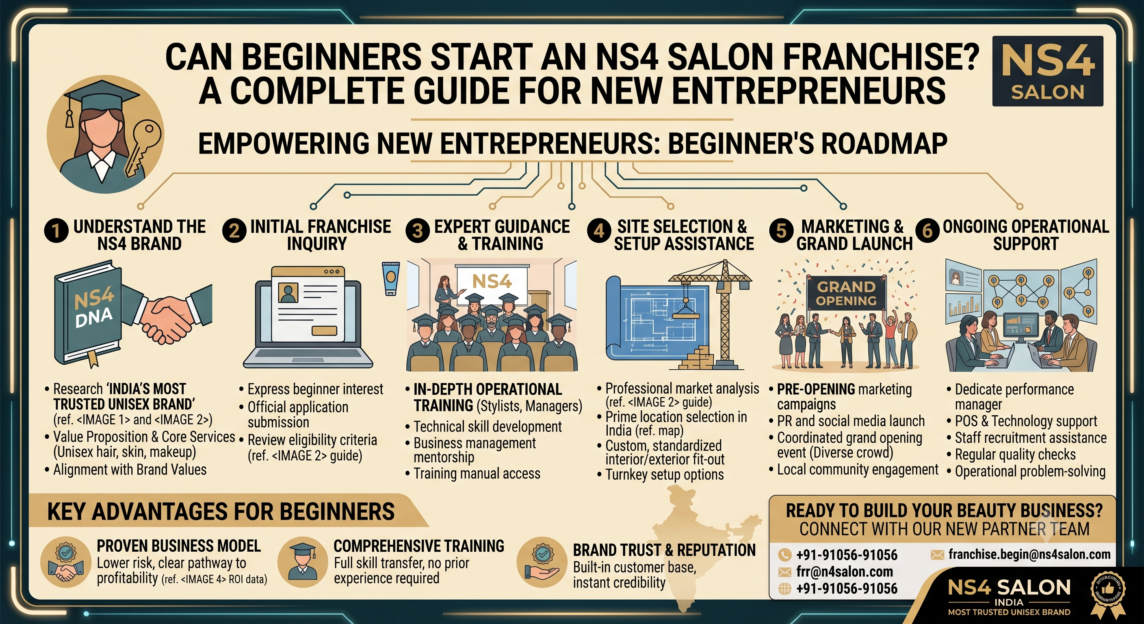

Independent Salon vs NS4 Salon Franchise: Complete Business Comparison

The most useful way to evaluate the Independent Salon vs NS4 Salon Franchise question is to compare the two models across the areas that actually affect business performance.

Investment and Startup Costs

Investment is one of the first things an entrepreneur considers.

With an independent salon, the owner determines the budget from scratch. The total investment may include:

  • Security deposit
  • Monthly rent
  • Interior work
  • Salon chairs
  • Mirrors
  • Wash stations
  • Hair equipment
  • Facial equipment
  • Makeup equipment
  • Nail equipment
  • Reception area
  • Air conditioning
  • Lighting
  • Signage
  • Product inventory
  • Staff salaries
  • Launch marketing
  • Working capital

Because there is no fixed franchise framework, an independent salon can technically be started with different budgets.

However, lower initial investment doesn’t necessarily mean lower total risk.

You may save on franchise fees but spend significantly more time and money developing branding, systems, marketing, training, and customer acquisition.

Franchise Investment

An NS4 franchise also requires investment, including the applicable franchise fee and the cost of establishing and operating the salon.

The benefit is that you’re working within an established business format.

For an entrepreneur, the question shouldn’t simply be:

“Which model is cheaper?”

A better question is:

“Which model gives me the strongest chance of building a sustainable business with my available capital?”

That’s a much smarter way to look at the numbers.


Branding and Customer Trust

Branding is one of the biggest differences between the two models.

With an independent salon, your brand starts at zero.

You need to build:

Name → Awareness → Trust → First Visit → Good Experience → Repeat Visit → Referral

That process can take time.

An established salon franchise starts with a brand identity that customers may already recognize.

However, branding isn’t magic. A franchise doesn’t guarantee customers or profits.

The salon still needs:

  • Excellent customer service
  • Skilled professionals
  • Clean surroundings
  • Consistent results
  • Positive reviews
  • Good local marketing
  • Competitive pricing
  • Customer retention

Think of branding as a head start—not a finish line.


Location and Salon Setup

Location can make or break a salon business.

An independent salon owner can select virtually any location that fits the business strategy.

A franchisee also gets location flexibility, but the location should ideally match the brand’s positioning and target audience.

Important factors include:

  • Visibility
  • Parking
  • Footfall
  • Nearby residential areas
  • Competition
  • Accessibility
  • Commercial activity
  • Rental cost
  • Local customer demographics

A beautiful salon in the wrong location can struggle.

A well-positioned salon with strong service quality can perform much better.

Setup Advantage of a Franchise

One advantage of a franchise model is that entrepreneurs may receive guidance regarding the salon concept and setup.

This can help reduce guesswork.

Instead of spending months deciding every design detail, the owner can work within an established format.


Training and Professional Expertise

Training is another major factor.

In an independent salon, the owner is responsible for deciding how employees are trained.

They may:

  • Hire experienced professionals.
  • Send employees to external academies.
  • Conduct internal training.
  • Learn through industry workshops.
  • Build their own training system.

This can work extremely well for experienced salon professionals.

For a new entrepreneur, however, it may be challenging.

A structured franchise ecosystem can provide access to brand-level training or guidance, depending on the franchise agreement.

For a salon business, training isn’t just about technical skills.

It also includes:

  • Customer consultation
  • Hygiene
  • Service protocols
  • Product knowledge
  • Upselling
  • Customer communication
  • Hair and beauty trends
  • Complaint handling
  • Retail sales

Better-trained teams can create more consistent customer experiences.


Marketing and Lead Generation

Marketing is where many new salon owners underestimate the workload.

Opening the salon is one thing.

Getting people through the door every week is another.

An independent salon typically needs to create its own marketing strategy.

That could include:

  • Instagram
  • Facebook
  • Google Business Profile
  • Local SEO
  • WhatsApp marketing
  • Referral campaigns
  • Influencer collaborations
  • Festive offers
  • Paid advertisements
  • Customer review campaigns
  • Local partnerships

The advantage is complete creative control.

The disadvantage is that everything is your responsibility.

Franchise Marketing

A franchise can provide a more structured marketing direction.

The franchisee may benefit from established brand creatives, promotional concepts, brand guidelines, and marketing support, depending on the agreement.

This can save time and help maintain a consistent brand image.

However, local marketing remains extremely important.

Customers don’t visit a salon because of a national or regional brand alone. They visit because the salon is accessible, trustworthy, affordable, professional, and relevant to their needs.


Services, Products, and Pricing

Independent salon owners have maximum freedom when creating their service menu.

They can introduce services based on local demand.

For example:

  • Haircuts
  • Hair color
  • Global hair color
  • Keratin
  • Nanoplastia
  • Hair Botox
  • Hair spa
  • Facial
  • Cleanup
  • Manicure
  • Pedicure
  • Nail extensions
  • Bridal makeup
  • Party makeup
  • Groom packages

An independent salon can change prices whenever it wants.

A franchise may operate within brand standards and recommended service structures.

This can actually be an advantage.

Standardization helps prevent random pricing and inconsistent customer experiences.

The key is finding the right balance between brand consistency and local market needs.


Daily Operations and Business Support

Running a salon involves much more than serving customers.

Every day, the owner may need to deal with:

  • Staff attendance
  • Payroll
  • Inventory
  • Customer complaints
  • Appointment management
  • Supplier payments
  • Marketing
  • Reviews
  • Sales targets
  • Hygiene
  • Equipment maintenance
  • Staff performance

An independent owner creates these systems independently.

That gives maximum control but also creates maximum responsibility.

A franchise model can provide a framework for several of these activities.

For a first-time entrepreneur, this can be a major advantage.

It’s like having a roadmap instead of trying to draw the map while driving.


Profitability and ROI

Profitability depends on many variables, so no responsible business comparison should promise a fixed return.

Your salon’s performance can depend on:

Revenue − Operating Expenses = Operating Profit

Revenue may come from:

  • Hair services
  • Hair treatments
  • Hair color
  • Skin services
  • Makeup
  • Nail services
  • Bridal packages
  • Product sales
  • Memberships
  • Packages

Expenses may include:

  • Rent
  • Salaries
  • Utilities
  • Product consumption
  • Marketing
  • Maintenance
  • Taxes
  • Software
  • Franchise-related costs
  • Miscellaneous expenses

Independent Salon ROI

An independent salon may have more pricing and cost-control flexibility.

However, the owner also carries the burden of creating demand.

If marketing is weak, customer acquisition can become expensive.

Franchise ROI

A franchise may potentially reduce certain startup uncertainties through brand systems and support.

But franchise costs must be carefully included in the financial model.

Before investing, calculate:

  1. Total startup investment
  2. Monthly fixed expenses
  3. Estimated monthly customers
  4. Average customer bill
  5. Gross margin
  6. Monthly revenue
  7. Marketing expenditure
  8. Break-even point
  9. Working-capital requirement
  10. Expected payback period

Don’t make the decision based only on the franchise fee.

Look at the entire business economics.


Risks and Challenges

Both models have risks.

Independent Salon Risks

Common challenges include:

  • Slow brand recognition
  • High competition
  • Difficulty hiring skilled staff
  • Marketing challenges
  • Unpredictable customer acquisition
  • Poor initial cash flow
  • Lack of business systems
  • Pricing mistakes

Franchise Risks

Franchise businesses can have different challenges:

  • Franchise fees
  • Brand compliance requirements
  • Limited flexibility in certain areas
  • Ongoing commercial obligations
  • Dependence on brand reputation
  • Restrictions defined by the franchise agreement

That’s why you should read the franchise agreement carefully before signing.

Ask about:

  • Franchise duration
  • Renewal terms
  • Fees
  • Territory
  • Marketing obligations
  • Training
  • Support
  • Exit conditions
  • Branding requirements
  • Procurement rules
  • Performance expectations

Never invest purely because a business model sounds attractive.


Who Should Choose an Independent Salon?

An independent salon may be better suited to you if:

  • You already have salon experience.
  • You have a loyal customer base.
  • You understand local competition.
  • You are comfortable building a brand.
  • You enjoy marketing.
  • You want maximum freedom.
  • You have strong business management skills.
  • You have a unique salon concept.

For example, an experienced makeup artist with a strong Instagram following and a loyal client base may not need the support of an established franchise brand.

They already possess something extremely valuable: personal brand equity.


Who Should Choose an NS4 Salon Franchise?

An NS4 franchise can be particularly attractive to entrepreneurs who want a structured entry into the salon industry.

It may suit someone who:

  • Wants to enter the salon business.
  • Prefers an established brand.
  • Doesn’t want to build a brand from zero.
  • Wants professional business guidance.
  • Values structured operations.
  • Wants access to established salon concepts.
  • Plans to build a scalable business.
  • Wants to combine ownership with brand support.

It’s also worth considering for investors who are interested in building a salon business but aren’t necessarily professional hairstylists or makeup artists themselves.

In such cases, having systems and professional guidance can be especially valuable.


Independent Salon vs NS4 Salon Franchise: Quick Decision Table

Business Factor Independent Salon NS4 Salon Franchise
Freedom ⭐⭐⭐⭐⭐ ⭐⭐⭐⭐
Brand support ⭐⭐ ⭐⭐⭐⭐⭐
Setup guidance ⭐⭐ ⭐⭐⭐⭐⭐
Marketing framework ⭐⭐ ⭐⭐⭐⭐
Brand recognition Must be developed Established brand
Operational flexibility ⭐⭐⭐⭐⭐ ⭐⭐⭐⭐
Training support Self-arranged Structured support may be available
Entrepreneurial control Very high High
Beginner-friendly Moderate Potentially higher
Scalability Owner-built Franchise model
Business systems Self-created Established framework

How to Choose the Right Model

If you’re still unsure, use this five-question test.

Question 1: Do I have salon experience?

If yes, an independent salon may be easier for you to manage.

If no, a structured franchise model may deserve stronger consideration.

Question 2: Can I build a brand from scratch?

If you enjoy branding, social media, marketing, and networking, independence may suit you.

If you’d rather start with an established brand identity, consider a franchise.

Question 3: How much freedom do I need?

If you want to change everything whenever you like, independent ownership wins.

If you’re comfortable following established standards, a franchise may work better.

Question 4: What’s my long-term goal?

If you want one highly customized salon, independence can be attractive.

If you want to build multiple locations using a repeatable model, franchising may provide a more structured path.

Question 5: Am I buying a job or building a business?

This is perhaps the most important question.

A salon should ideally be built as a business system—not simply as a place where the owner personally performs services every day.

If you want a scalable business, think about systems, staff, customer retention, marketing, and repeatable operations from day one.


7 Powerful Reasons an NS4 Franchise Can Be the Smarter Choice

For the right entrepreneur, an NS4 Salon Franchise can offer several practical advantages.

1. Established Brand Identity

You don’t have to invent a brand from zero.

2. Structured Business Model

A franchise provides a framework instead of leaving every decision to the entrepreneur.

3. Professional Guidance

Guidance can be valuable when entering an industry for the first time.

4. Marketing Advantage

An established brand can make marketing more systematic.

5. Customer Confidence

A recognizable salon identity may help reduce the initial trust barrier.

6. Scalable Opportunity

A standardized model can make expansion easier to plan.

7. Reduced Guesswork

You still have to work hard—but you don’t necessarily have to figure everything out alone.


Frequently Asked Questions

1. Is an independent salon better than an NS4 Salon Franchise?

It depends on your experience, budget, business goals, and preference for control. An independent salon provides maximum freedom, while an NS4 franchise can provide an established brand framework and structured support.

2. How much does an NS4 Salon Franchise cost?

NS4 has offered different franchise formats with franchise fees varying by model. Commonly referenced fees are approximately ₹3 lakh + applicable GST for a Studio format, ₹5 lakh + applicable GST for a Premium format, and ₹7 lakh + applicable GST for a Luxury format. Total project investment is higher because it can include interiors, equipment, rent, staffing, inventory, marketing, and working capital. Always confirm current pricing directly with NS4.

3. Can I open a salon without a franchise?

Yes. You can start an independent salon by creating your own brand and handling the setup, staffing, marketing, operations, and customer acquisition yourself.

4. Is a salon franchise profitable?

A salon franchise can be profitable, but profitability isn’t guaranteed. It depends on location, investment, pricing, customer volume, staff productivity, operating expenses, marketing, and management.

5. Is an NS4 franchise suitable for first-time entrepreneurs?

It can be suitable for entrepreneurs who prefer a structured business model and professional guidance. However, franchisees still need strong management, financial planning, customer service, and local marketing skills.

6. Which requires more marketing: an independent salon or franchise?

Both require marketing. An independent salon must build its brand from scratch, while a franchise may benefit from established branding and marketing systems. Local marketing remains essential for both.

7. Can I customize services in a franchise salon?

Customization depends on the franchise agreement and brand standards. Before signing, ask NS4 about permitted services, pricing flexibility, promotions, products, and local marketing.

8. What is the biggest advantage of an independent salon?

The biggest advantage is control. You can make decisions about branding, pricing, services, suppliers, interiors, promotions, and operations without franchise restrictions.

9. What is the biggest advantage of an NS4 franchise?

The biggest advantage can be the combination of entrepreneurship with an established salon brand and structured business framework.

10. How should I calculate my salon ROI?

Start with your total investment and monthly operating expenses. Estimate realistic customer volume and average bill value, calculate expected revenue, and then determine your operating profit and estimated payback period. Use conservative assumptions rather than relying on optimistic projections.


Final Verdict: Independent Salon or NS4 Salon Franchise?

The Independent Salon vs NS4 Salon Franchise debate doesn’t have one universal winner.

If you’re an experienced salon professional with a loyal customer base, strong marketing knowledge, and a unique vision, an independent salon can give you unmatched freedom.

But if you’re an entrepreneur looking for an established salon brand, structured systems, professional guidance, and a potentially more organized route into the beauty industry, an NS4 Salon Franchise may be the more attractive option.

The smartest decision is to look beyond the initial franchise fee or salon setup cost.

Consider the complete picture:

Investment + Brand + Training + Marketing + Operations + Customer Acquisition + Profitability + Scalability

That’s where the real business decision lies.

Before committing your capital, prepare a detailed business plan, study the local market, compare competitors, calculate your break-even point, and discuss the latest franchise terms directly with NS4.

In short, an independent salon gives you the freedom to build everything your way, while an NS4 Salon Franchise gives you the opportunity to build a salon business within an established framework.

For entrepreneurs who want to reduce the guesswork and focus on building a professional, scalable salon business, the franchise route can be a powerful option worth exploring.

0 0 Continue Reading →

How to Open a Successful Unisex Salon with an NS4 Salon Franchise

Why Start a Unisex Salon Business in 2026?

The beauty and wellness industry has changed significantly over the last few years. Salon services are no longer viewed as an occasional luxury. Haircuts, hair colour, skincare, grooming, bridal makeup, nail services, and professional hair treatments have become part of many customers’ regular lifestyles.

That’s why opening a unisex salon can be an attractive business opportunity for entrepreneurs who want to enter the beauty and personal-care sector.

A unisex salon serves both male and female customers under one roof. This creates the opportunity to generate revenue from multiple customer segments rather than depending on one category alone.

However, there’s a catch: opening a salon isn’t simply about renting a shop, purchasing chairs, hiring stylists, and putting up a signboard. Successful salon businesses require strong branding, trained professionals, consistent service quality, marketing, customer retention, and disciplined financial management.

This is where a franchise model can make the journey easier.

With an NS4 Salon Franchise, entrepreneurs can enter the salon industry using an established brand and a structured business approach instead of developing everything from scratch. NS4 states that the brand was established in 2008 and has expanded its salon network across multiple cities. Its franchise website currently highlights 40+ salons across 9+ cities and a strong repeat-customer base.

Growing Demand for Professional Grooming

Today’s customers are increasingly interested in professional services rather than basic grooming at home.

Popular services include:

  • Haircuts and styling
  • Hair colouring
  • Global hair colour
  • Keratin treatments
  • Nanoplastia
  • Hair Botox
  • Hair spa
  • Facial treatments
  • Hydra facial
  • Bridal makeup
  • Party makeup
  • Manicure and pedicure
  • Nail extensions
  • Men’s grooming
  • Pre-bridal services

This wide service mix allows a salon to create multiple revenue streams.

For example, a customer may visit for a haircut and later purchase a hair spa, colour service, skincare treatment, or membership package. When the service experience is excellent, that customer can become a repeat client.

Why Tier-2 and Tier-3 Cities Offer Opportunity

You don’t necessarily need a metro-city location to build a successful salon.

Growing cities and emerging markets are seeing increasing demand for branded beauty and grooming services. Customers in these markets often want professional services, modern interiors, trained staff, quality products, and transparent pricing.

This creates an opportunity for organized brands to expand beyond major metropolitan areas.

NS4’s published salon network includes locations across cities such as Aligarh, Hathras, Muzaffarnagar, Gorakhpur, Meerut, Mathura, Kasganj and Agra, demonstrating its focus on North Indian markets.

Benefits of a Franchise Business Model

Starting independently gives you complete control, but it also means you’re responsible for developing:

  • Brand identity
  • Salon design
  • Service protocols
  • Staff training
  • Marketing strategy
  • Customer acquisition
  • Pricing systems
  • Operational procedures
  • Supplier relationships

A franchise can reduce some of this initial burden by providing an established framework.

In simple terms, you’re not starting completely from zero.


Why Choose an NS4 Salon Franchise?

Choosing the right franchise partner is one of the most important decisions you’ll make before opening your salon.

A strong franchise should provide more than a logo and a brand name. Ideally, it should offer a complete ecosystem covering setup, training, marketing, operations, and ongoing guidance.

NS4’s franchise information describes support around business setup, interior planning, staff training, branding, marketing assistance, and operational guidance.

Established Brand and Business System

Building a new salon brand can take years.

Customers need to discover your business, try your services, trust your staff, and eventually become repeat customers.

With a recognized franchise brand, you can start with an existing identity and business framework.

NS4 states that it has been operating since 2008 and has developed an online and offline salon ecosystem.

That’s particularly useful for first-time entrepreneurs who may understand business but don’t have years of salon-industry experience.

Professional Training and Operational Support

Salon success depends heavily on people.

A beautiful interior won’t save a salon if the service quality is inconsistent.

Stylists, beauticians, makeup artists, reception staff, and managers all need to understand:

  • Technical procedures
  • Customer consultation
  • Product usage
  • Hygiene standards
  • Upselling
  • Customer communication
  • Service protocols
  • Complaint handling

Training and operational guidance can therefore be valuable parts of a franchise partnership.

Multiple Salon Services

A modern unisex salon should ideally offer services across several categories.

Category Example Services
Hair Haircut, styling, spa, colour
Hair Treatments Keratin, Nanoplastia, Botox, smoothening
Skin Facial, cleanup, D-Tan
Makeup Bridal, party, HD makeup
Nails Manicure, pedicure, nail extensions
Grooming Men’s grooming, waxing, styling
Packages Bridal, pre-bridal, membership packages

This diversified model can help increase average customer spending and encourage repeat visits.


Choose the Right NS4 Franchise Model

One of the biggest advantages of a structured franchise system is having different formats for different investment capacities.

NS4’s published franchise information includes Studio, Premium, and larger salon formats. The exact investment should always be confirmed with the franchise team because location, interiors, equipment, taxes, and other requirements can affect the final budget.

Studio Model

The Studio format is designed for entrepreneurs who want to start with a relatively compact salon.

According to NS4’s published information:

  • Area: approximately 600–800 sq. ft.
  • Franchise fee: ₹3 lakh + GST
  • Indicative overall investment: approximately ₹20–25 lakh

This model may work well in smaller markets or locations where a compact salon can achieve good customer traffic.

Premium Model

The Premium model provides more space and allows a broader service experience.

Published information indicates:

  • Area: approximately 1,000–1,500 sq. ft.
  • Franchise fee: ₹5 lakh + GST
  • Indicative investment: approximately ₹25–35 lakh

This format may be suitable for entrepreneurs targeting established residential or commercial areas.

Luxury Model

A larger luxury salon can offer more extensive services, a premium customer experience, and greater capacity.

A larger-format salon may require approximately 2,000–3,000 sq. ft., depending on the final plan and location.

This format can be suitable for high-footfall commercial areas where premium services and larger customer capacity justify the additional investment.

A Simple Comparison

Model Approx. Area Franchise Fee* Indicative Investment*
Studio 600–800 sq. ft. ₹3 Lakh + GST ₹20–25 Lakh
Premium 1,000–1,500 sq. ft. ₹5 Lakh + GST ₹25–35 Lakh
Luxury 2,000–3,000 sq. ft. Discuss with NS4 Higher investment based on setup

*Figures are based on NS4’s published franchise information and should be verified directly before making an investment decision.
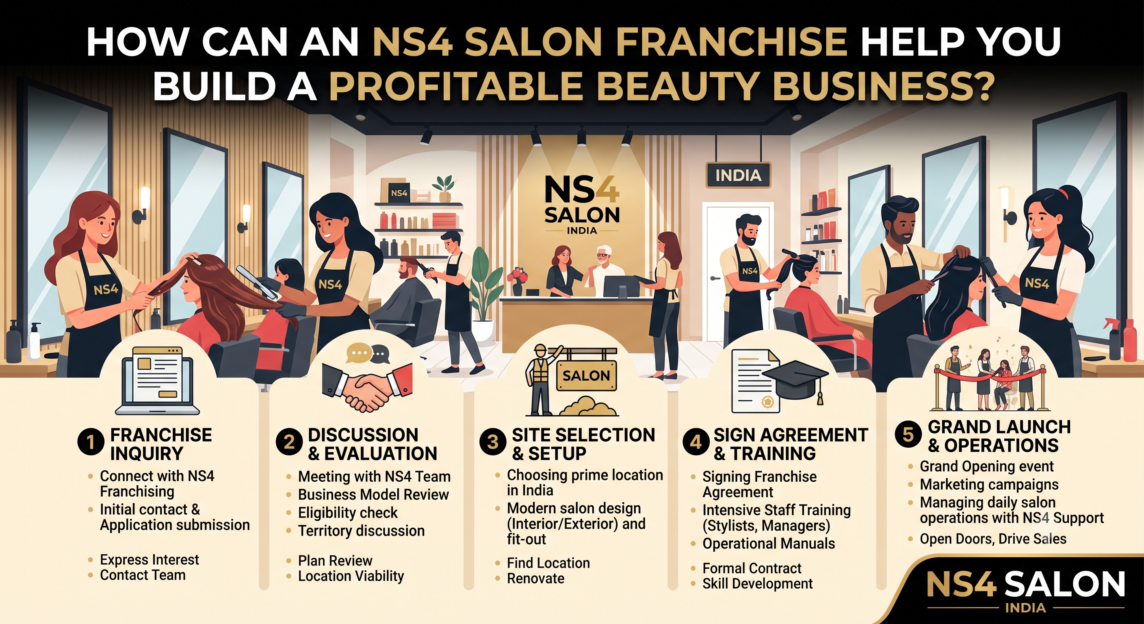

Understand the Investment Before You Start

A common mistake is focusing only on the franchise fee.

That’s just one part of the total business investment.

Before signing an agreement, prepare a complete budget covering:

  1. Franchise fee
  2. GST and applicable taxes
  3. Security deposit
  4. Interior work
  5. Salon furniture
  6. Styling equipment
  7. Electrical and plumbing work
  8. Air conditioning
  9. POS/software systems
  10. Initial product inventory
  11. Staff salaries
  12. Marketing
  13. Rent
  14. Utilities
  15. Working capital
  16. Launch expenses

NS4’s published franchise page also describes a process involving a token amount before site evaluation, agreement terms, and royalty arrangements. Prospective franchisees should review the current commercial terms and agreement carefully with the company before committing funds.

Franchise Fee

The franchise fee gives you access to the franchise relationship and associated brand/business framework. It shouldn’t be confused with the complete cost of opening a salon.

Interior and Equipment Costs

Your interior should reflect the brand positioning.

Important areas include:

  • Reception
  • Hair stations
  • Shampoo area
  • Facial rooms
  • Makeup area
  • Nail station
  • Waiting area
  • Storage
  • Staff area

Good lighting is particularly important because customers notice salon cleanliness and presentation immediately.

Working Capital

Don’t spend your entire budget on interiors.

Keep sufficient working capital for the first several months.

You’ll need cash flow for rent, salaries, electricity, products, advertising, maintenance, and unexpected expenses.

That’s where many new businesses stumble: the salon looks fantastic on opening day, but the owner hasn’t planned enough cash for the months that follow.


Select the Right Salon Location

Location can make or break a salon.

A cheaper shop in a hidden lane isn’t automatically a good deal. Likewise, an expensive location isn’t automatically profitable.

You need the right balance between visibility, accessibility, target customers, competition, rent, and future growth.

Footfall and Visibility

Look for:

  • Main roads
  • Busy commercial areas
  • Residential catchments
  • Shopping areas
  • Markets
  • Near offices
  • Near educational institutions
  • High-visibility corners
  • Easy parking or access

Customers should be able to find the salon without playing detective.

Competition and Target Customers

Competition isn’t necessarily bad.

In fact, several salons operating in the same area can indicate existing demand.

The important question is:

What will make customers choose your salon?

Possible differentiators include:

  • Strong brand identity
  • Better service experience
  • Professional staff
  • Premium ambience
  • Transparent pricing
  • Advanced hair treatments
  • Bridal packages
  • Membership programs
  • Consistent customer service

Commercial Space Requirements

Before finalizing a property, evaluate:

  • Carpet area
  • Frontage
  • Floor location
  • Visibility
  • Parking
  • Water supply
  • Electricity load
  • Washroom facilities
  • Signage permissions
  • Local commercial regulations
  • Rent and deposit

NS4’s franchise process specifically involves location evaluation and approval, so entrepreneurs should coordinate with the franchise team before locking in a property.


Set Up Your Unisex Salon Professionally

Once your location is approved, the next step is turning the space into a professional salon.

Interior Design

Your salon should feel:

  • Clean
  • Modern
  • Comfortable
  • Premium
  • Welcoming
  • Consistent with the brand

Think about the customer journey from the moment they enter.

The reception should immediately communicate professionalism.

The waiting area should be comfortable.

Workstations should provide enough space for stylists to work efficiently.

And, of course, hygiene should never be an afterthought.

Equipment and Product Selection

Equipment should be selected based on service requirements.

Typical equipment includes:

  • Styling chairs
  • Mirrors
  • Hair dryers
  • Hair steamers
  • Shampoo units
  • Facial beds
  • Trolleys
  • Sterilization equipment
  • Manicure and pedicure equipment
  • Makeup stations
  • Storage units

Product quality matters too.

Professional hair and skincare services depend heavily on using suitable products and following correct procedures.

Staff Recruitment

Your employees are the face of your business.

Recruit professionals based on both technical ability and customer attitude.

Look for:

  • Skilled hairstylists
  • Hair colour specialists
  • Beauticians
  • Makeup artists
  • Nail technicians
  • Receptionists
  • Salon managers

Don’t only ask, “Can this person perform the service?”

Also ask:

Can this person make a customer feel comfortable and valued?

That’s the difference between a one-time transaction and a long-term client.


Training and Standard Operating Procedures

Training is one of the most important parts of running a successful unisex salon.

Even experienced professionals need to understand your salon’s specific systems.

Technical Training

Training can cover:

  • Haircutting
  • Hair styling
  • Colour application
  • Hair treatments
  • Skin treatments
  • Makeup
  • Nail services
  • Consultation procedures

Customer Service

Customers remember how you made them feel.

Train your team to:

  • Greet customers warmly
  • Understand requirements
  • Explain services clearly
  • Recommend suitable treatments
  • Avoid aggressive selling
  • Handle complaints professionally
  • Follow up after important services

Hygiene and Safety

Every salon should maintain strict hygiene practices.

This includes:

  • Cleaning tools between clients
  • Sanitizing workstations
  • Proper towel management
  • Clean wash areas
  • Safe product storage
  • Regular equipment maintenance
  • Proper disposal of waste

A customer should never have to wonder whether the salon is clean.


Build a Strong Marketing Strategy

Opening the salon is only the beginning.

Now you need customers.

Your marketing strategy should combine offline and digital channels.

Local SEO and Google Business Profile

For a local salon, Google visibility is incredibly important.

Optimize your Google Business Profile with:

  • Correct business name
  • Accurate address
  • Working phone number
  • Opening hours
  • Services
  • High-quality photographs
  • Regular posts
  • Customer reviews
  • Service descriptions

Use location-focused keywords naturally, such as:

  • Unisex salon near me
  • Best salon in [city]
  • Hair salon in [city]
  • Beauty salon in [city]
  • Bridal makeup in [city]
  • Hair colour in [city]

Don’t stuff keywords everywhere. Keep the information natural and useful.

Social Media Marketing

Instagram and Facebook are powerful channels for salons because beauty is highly visual.

Post:

  • Before-and-after transformations
  • Hair colour results
  • Haircuts
  • Bridal makeup
  • Customer testimonials
  • Salon interiors
  • Offers
  • Reels
  • Team introductions
  • Educational content

A simple formula works well:

Show the result → explain the service → build trust → provide a booking CTA.

Launch Offers and Memberships

A grand-opening offer can help attract your first customers.

For example:

  • Haircut + Hair Spa package
  • Hair colour + Haircut package
  • Facial + Cleanup package
  • Bridal consultation offer
  • First-visit discount
  • Membership package
  • Referral reward

However, don’t build your entire business around discounts.

Your goal is to convert promotional customers into loyal customers who return because of quality.


How to Manage Salon Operations Successfully

Getting customers through the door is one thing.

Keeping them is another.

Customer Retention

Repeat customers are extremely valuable.

Create systems for:

  • Birthday offers
  • Memberships
  • Service reminders
  • Hair colour follow-ups
  • Bridal follow-ups
  • WhatsApp communication
  • Loyalty rewards
  • Referral programs

For example, if someone receives a hair treatment today, your team can record the service and recommend an appropriate future maintenance visit.

Staff Management

Staff turnover can seriously affect salon performance.

Build a positive workplace with:

  • Clear responsibilities
  • Training
  • Incentive structures
  • Performance reviews
  • Career growth
  • Respectful communication
  • Realistic targets

A motivated team is more likely to deliver consistent customer experiences.

Inventory and Financial Control

Track your products carefully.

Monitor:

  • Product usage
  • Purchases
  • Stock levels
  • Wastage
  • Service revenue
  • Retail revenue
  • Staff incentives
  • Rent
  • Utilities
  • Marketing costs

Review your numbers every month.

Revenue alone doesn’t tell you whether your salon is actually healthy.

You need to understand gross margins, operating expenses, cash flow, customer acquisition, average bill value, and repeat-visit rates.


7 Powerful Steps to Build a Successful NS4 Salon Franchise

If you want to simplify the entire process, think of your salon launch as seven major steps:

1. Research Your Market

Understand your city’s customers, competitors, pricing, and demand.

2. Select the Right Franchise Format

Choose Studio, Premium, or a larger format based on your budget and market potential.

3. Finalize the Location

Prioritize visibility, accessibility, customer demographics, and sustainable rent.

4. Complete Salon Setup

Work on interiors, equipment, branding, technology, and inventory.

5. Recruit and Train Your Team

Build a team that combines technical skills with excellent customer service.

6. Launch a Strong Marketing Campaign

Use Google, social media, local promotions, referrals, and partnerships.

7. Focus on Repeat Customers

The real growth begins after opening day. Build relationships, track customer preferences, and encourage repeat visits.


Common Mistakes to Avoid When Opening a Salon

Even with franchise support, business owners need to avoid several common mistakes.

Spending Too Much on Interiors

A beautiful salon is important, but overspending can create cash-flow pressure.

Choosing a Location Based Only on Cheap Rent

Low rent doesn’t help if customers can’t easily find or access you.

Hiring Only on Salary

The cheapest employee isn’t always the best employee.

Ignoring Digital Marketing

Customers increasingly discover salons online.

Offering Too Many Discounts

Discounts can attract customers, but excessive discounting can damage margins and brand perception.

Not Tracking Numbers

If you don’t know your monthly revenue, expenses, average bill value, and repeat-customer rate, you’re essentially driving with your eyes closed.

Ignoring Customer Feedback

Reviews and feedback can reveal problems before they become serious.


Is an NS4 Salon Franchise Right for You?

An NS4 Salon Franchise can be worth considering if you’re looking for a structured way to enter the unisex salon business and prefer working with an established brand rather than building every system independently.

It may be suitable for:

  • First-time entrepreneurs
  • Existing business owners
  • Beauty professionals
  • Investors
  • Women entrepreneurs
  • Working professionals
  • Existing salon owners looking to expand

NS4’s franchise model combines an established salon identity with support around setup, training, marketing, and operations.

However, no franchise can guarantee business success.

Your results will depend on factors such as location, investment discipline, team quality, customer experience, marketing execution, pricing, competition, and management.

Before investing, review the latest franchise agreement, fee structure, royalty terms, expected investment, territory conditions, and operating requirements directly with NS4.

For current franchise details, you can visit the official NS4 Salon Franchise website.


Frequently Asked Questions About NS4 Salon Franchise

1. What is an NS4 Salon Franchise?

An NS4 Salon Franchise allows entrepreneurs to operate a salon under the NS4 brand using its franchise framework, business systems, training, and operational support.

2. How much does an NS4 Salon Franchise cost?

The total investment depends on the salon format, location, size, interiors, equipment, inventory, and working capital. NS4’s published information lists Studio investment at approximately ₹20–25 lakh and Premium investment at approximately ₹25–35 lakh, with franchise fees starting from ₹3 lakh + GST for the Studio format.

3. What is the minimum franchise fee?

According to NS4’s published information, the Studio Model franchise fee is ₹3 lakh + GST, while the Premium Model is listed at ₹5 lakh + GST. Terms can change, so confirm the current structure directly with NS4 before investing.

4. Do I need previous salon experience?

Previous salon experience isn’t necessarily required. NS4 states that franchise partners receive professional training and operational guidance, making the model suitable for entrepreneurs and first-time business owners.

5. What support does NS4 provide?

Published franchise information describes support including business setup, interior planning, staff training, branding, marketing assistance, and operational guidance.

6. What services can I offer in an NS4 unisex salon?

Services can include haircuts, styling, hair colour, Keratin, Nanoplastia, Hair Botox, Hair Spa, facial treatments, bridal makeup, party makeup, nail services, grooming, waxing, manicure, pedicure, and other beauty services.

7. Which location is best for an NS4 Salon Franchise?

The best location depends on local demand, competition, customer demographics, visibility, accessibility, parking, and rent. NS4’s franchise process includes location evaluation, so prospective franchisees should coordinate with the franchise team before finalizing a property.

8. Can I open an NS4 Salon Franchise in a Tier-2 or Tier-3 city?

Yes. NS4 has a presence across several North Indian cities and its published franchise material discusses expansion opportunities in Tier-2 and Tier-3 markets.

9. How can I make my salon profitable?

Focus on location, service quality, trained staff, customer retention, strong local marketing, effective inventory control, suitable pricing, and consistent financial monitoring.

10. How do I apply for an NS4 Salon Franchise?

You can submit a franchise enquiry through the official NS4 franchise website. The published process includes consultation, documentation, location evaluation, agreement, setup, training, and launch.


Conclusion

Opening a successful unisex salon requires much more than an attractive interior and professional equipment. You need a strong brand, trained staff, efficient operations, smart marketing, financial discipline, and—most importantly—a commitment to customer satisfaction.

An NS4 Salon Franchise can provide a structured starting point for entrepreneurs who want to enter the beauty and wellness industry with an established brand and franchise support system.

From selecting the right format and location to training employees and building a strong digital presence, every decision matters.

The smartest approach is to treat your salon not simply as a beauty business, but as a customer-experience business.

Give customers a reason to visit.

Give them a reason to trust you.

And, most importantly, give them a reason to come back.

With the right location, investment plan, team, marketing strategy, and operational discipline, your NS4 unisex salon can become a strong local business and a foundation for long-term growth.

For the latest franchise models, commercial terms, and application process, check the NS4 Salon Franchise website before making any investment decision.
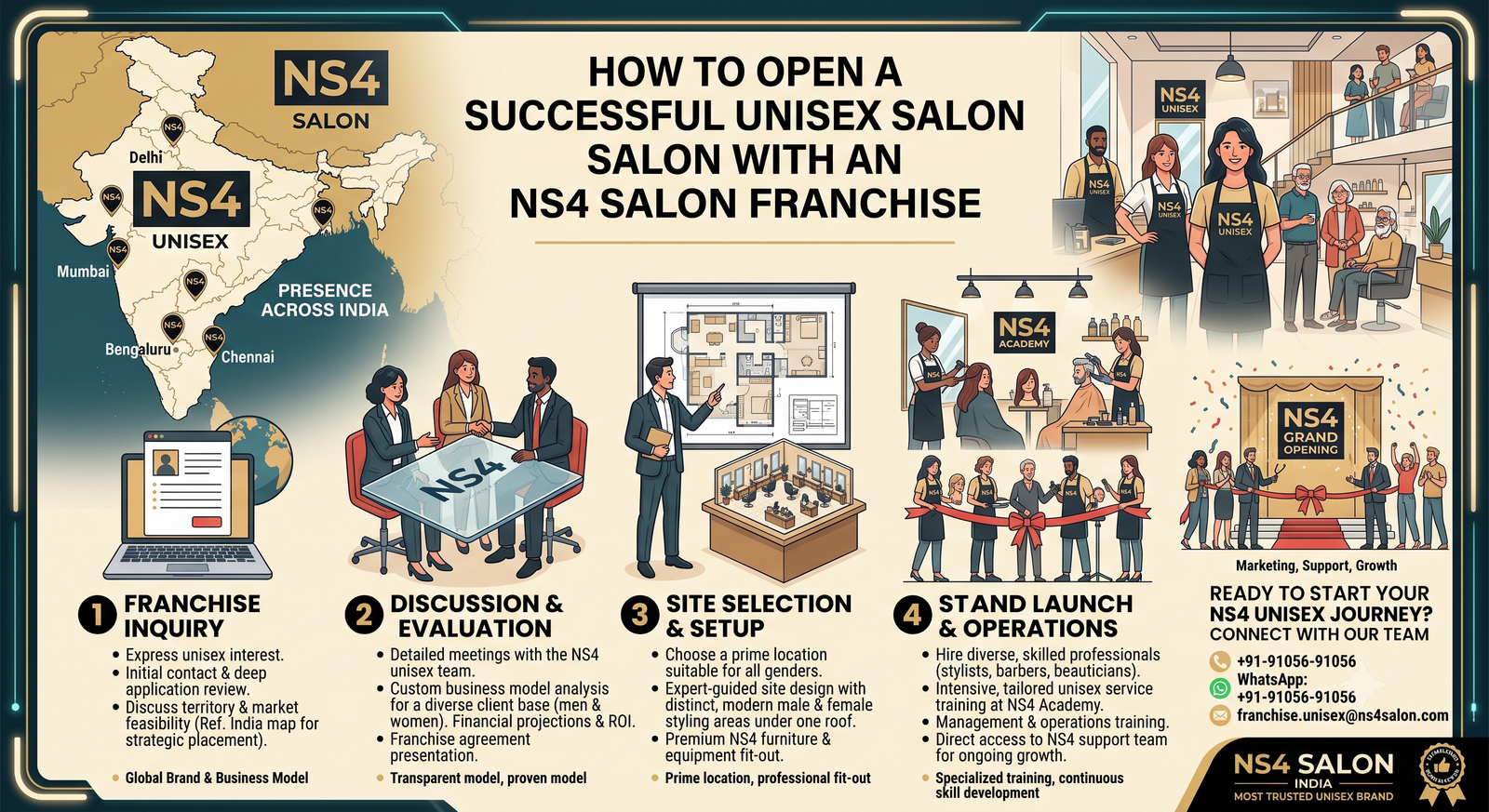
0 0 Continue Reading →